

The Mountain Tactical Institute (MTI), formerly Mountain Athlete, is the training behemoth brainchild of Rob Shaul, a Jackson, WY-based coach who has positioned himself as a training guru to mountain, professional, and tactical athletes. This is a review of MTI’s Backcountry Ski Preseason Training Plan, a 7-week equipment-minimal home training plan to prepare an athlete for an upcoming season of backcountry skiing.
Stats from MTI:
- 7-Week Plan specifically for backcountry and sidecountry skiing
- Trains uphill skinning fitness, downhill skiing strength, stamina, core, and general fitness
- Limited equipment training plan
- Version 4 of the plan, updated April 2019
- $55
“This intense, limited equipment, 7-week, 6 day/week training program is designed to prepare athletes for backcountry and side country skiing. It models the training program we give to our professional mountain guides and recreational backcountry skiers [sic] here in Jackson, WY. This program is designed to be completed the 7 weeks directly before your backcountry ski season begins. Week 7 the plan is an assessment/taper/unload week.
“This training plan has a significant mountain endurance emphasis – uphill movement under load – which reflects the primary fitness demand of backcountry skiing – uphill skinning and/or boot packing.
“You’ll train 6 days/week for 7 weeks – a total of 42x training sessions.”
Why Use a Training Plan
Fourteen months ago, my left foot stopped working and starting dragging on the floor. Within a week of the first pain and numbness that accompanied the floppiness, I was diagnosed with a herniated disc and went under the knife to try to restore function to my leg. After a straightforward surgery, I spent 2 months keeping my back straight as a board and lifting nothing heavier than a gallon of milk.
This was the least inactive period of my entire adult life, even moreso that when my daughter was first born, and in two months I lost quite a lot of fitness and muscle mass. In February, I skied again, but for the remainder of the season I tread carefully, threatened by a risk of reherniation. During the summer, I restored general fitness doing all-purpose gym work and whatever kind of cardio sounded fun. As the weather cooled, I wanted a structured training plan to prepare for ski season so that I could enter a winter of backcountry skiing and ski patrol work in good form.
To understand why you might want a training plan, it’s important to understand that training is different from exercising or just “working out.” Training is focused on targeted outcomes and uses a structured approach to achieve them. Because of this, it’s generally more repetitive, progressive, and less entertaining than random work, varied circuit training, or your local CrossFit gym’s programming. In exchange for some repetitive boredom, you can get measurable, sport-specific results with lower risk of injury. In short, you get better results but might have a bit less fun in the process than doing whatever interests you on a given day. If you want to show up at the start of the ski season with fitness, strength, and durability, you’re more likely to meet those goals with a disciplined training plan than with exercise alone.
I come to this plan having completed others from MTI, Uphill Athlete, Chamonix Mountain Fit/SkiFit, and having been previously coached. Although I have worked a fair bit with MTI and interviewed Rob on my podcast about MTI’s training philosophy, I have no conflicts of interest, and I paid for the plan out of pocket.
Plan Structure
The MTI Plan is a weekly structured approach to training for the demands of backcountry skiing, which we could summarize as aerobic fitness, uphill muscular endurance, downhill eccentric leg strenght, and injury resistance.
From MTI:
Mon: Eccentric Leg Strength (Leg Blasters), Uphill Endurance (Step Ups)
Tue: Leg Lactate Tolerance (Touch/Jump/Touch to Box), Upper Body Strength, Chassis Integrity (functional core)
Wed: Eccentric Leg Strength (Quadzilla), Posterior Chain Strength, Upper Body Strength, Leg Lactate Tolerance (Touch/Jump/Touch)
Thur: Leg Lactate Tolerance (Touch/Jump/Touch to Box), Upper Body Strength, Chassis Integrity (Low Back emphasis)
Fri: Uphill Endurance – Step Ups – up to 1,200x @ 25# backpack
Sat: Aerobic Base Development – Easy Pace Trail Run, 4-10 miles
Key Exercise Complexes
Step Ups – Uphill Endurance
Stepping onto and off of an 18” box or bench while wearing a 25# load on your back. This builds muscular endurance for boot packing.
Touch-Jump-Touch (TJT) Intervals – Leg Lactate Tolerance
Jumping laterally onto and then over to the other side of an 18” bench, touching your inside hand to the ground, and then jumping back across the other way. This builds power through jumping but also aggressively accumulates eccentric (lowering) strength in the legs, mimicking the demands of downhill skiing.
Beginning with the ‘mini’ variation before building to the full: 20 squats, 10 lunges each side, 10 jumping lunges each side, 10 jump squats. This accumulates both concentric and eccentric load in the legs, and in this plan is often followed by a block of step ups once fatigued.
Chassis Integrity
This MTI term encompasses strength through the core, and the plan uses a variety of exercises with a sandbag in addition to pull-ups, and push-up-row combinations to build a more resilient and injury resistant body.
Necessary Equipment
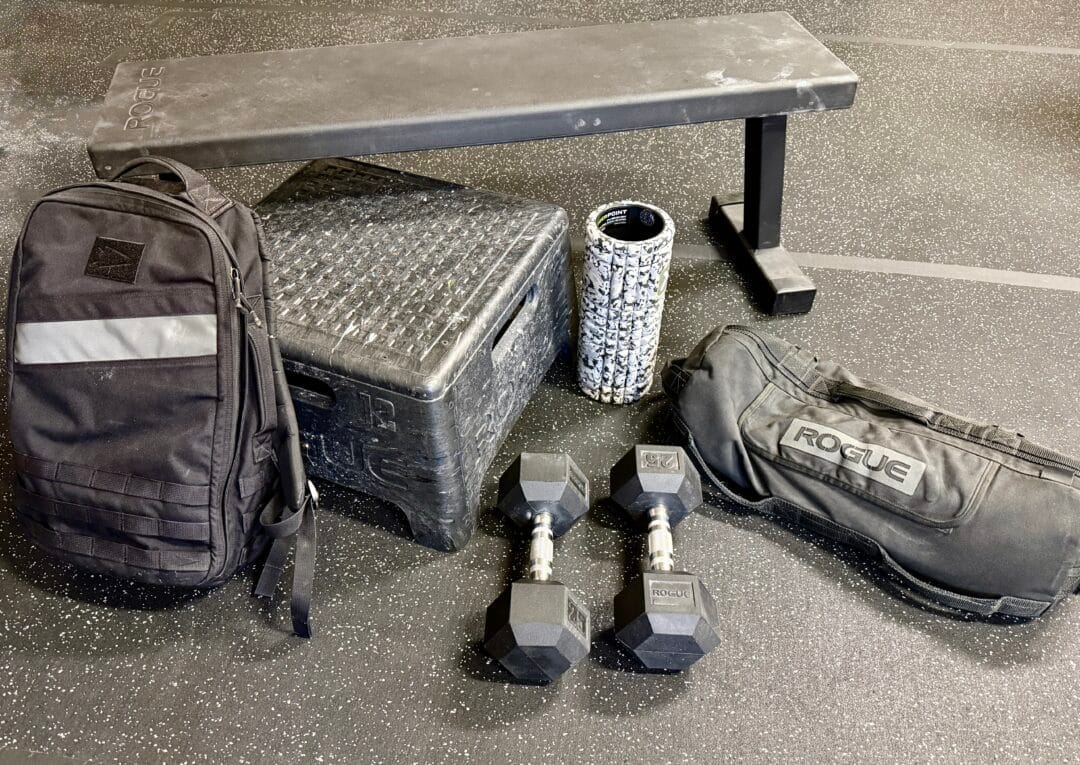
- Pair of dumbbells, 15# (pound) for women, and 25# for men
- Sandbag – 40# for women, 60# for men. I have Rogue’s version, and it has survived two years of abuse to date. MTI also sells its own version for less.
- 25# Backpack – use what you have. I used a GoRuck 20L with 20# plate and a 5# dumbell.
Stopwatch with interval timer and/or wall clock with second hand (Smartphone will work) - Foam Roller
- 16-18″ Box or bench for Step Ups and Touch/Jump/Touch to Box intervals: I used my 18″ bench, which is quite firm. A soft surface may be a trip hazard or may tear. If you don’t have a bench, the Rogue resin boxes are very solid.
My Experience
I jumped into this plan with the idea of completing it as written, using it as my sole preparation for ski season. I started at the end of the second week of October, planning to finish at the start of December. In reality, my work schedule, some travel, and a very good end to the local mountain biking season meant that I completed the work over 10 weeks, finishing at the end of December.
The beginning of the plan was entertaining and novel, learning the exercises and the rotation. I entered the plan with a good aerobic base, but I quickly found my leg muscles devastated by the first few workouts. The TJT intervals, in particular, put me deep into a DOMs hole at the end of the first week, but in the second I found myself adapting quickly.
The plan ultimately feels like cycling through days that involve 1) a large block of step ups, building from 600 at the start of the plan to 1200 by the end; 2) TJT intervals, defined by an initial test and then completed in an EMOM format. These were followed by a variety of chassis integrity and strength exercises; 3) Leg blaster sets followed by a smaller block of step ups; 4) One day a week of trail running. For me, the TJT days were the hardest, probably because volume is based on a personal test. The first time that you complete this exercise you do a 2 min max rep test, and then move to completing sets of 25% max +1-2 reps on subsequent days, so no matter how fit you might be, you’re getting served a good helping of reps. The leg blaster days were comparatively easier, possibly because they use a set volume for everyone. The step ups are monotonous, but are also a good excuse to catch up on your favorite TV show or podcast.
The most notable feeling while completing the training plan was the sense of progress. The plan build load progressively across the 7 weeks, and I found myself able to complete all of the exercises with a feeling of similar difficulty, despite the increasing load. It was not a small change:
TJT intervals: initial 2 min max: 43 -> 56, 20x EMOM 11 reps -> 16
Step ups w/25#: 600x -> 1200x in a single block.
Leg blasters: Initial load 100 squats, 50 lunges, 50 jump lunges, 50 jump squats followed by 300x step ups. Final load 140 squats, 70 lunges, 70 jump lunges, 70 jump squats, followed by 700x step ups.
Coming off a year of recuperating from injury and surgery, I was wary of the possibility of injury or excessive load, but aside from some mild ankle tendonitis during the first week as I became accustomed to the TJT lateral jumping, I had no issues with injury during this plan.
By the 6th week, I bragged to my wife that I’d never been fitter at jumping over a weight bench. This joke belied my real concern: would this work translate to improved ski performance and season readiness.
Ski Results
Downhill
Our season, like many this year, was a slow starter. When I was finally able to get on alpine skis at the resort, conditions were heavy, sloppy, thin, and bumpy. This was a great lab to test the eccentric leg strength build in the plan, and I was impressed with how I felt. The first few days of alpine skiing for me usually involve stopping occasionally to let off a deep burn in the legs, but that was absent. I felt strong, though not mid-season strong. In comparison to an unstructured approach to prior seasons, I felt more fit for aggressive skiing.
Uphill
On the skin track, I felt less benefit. Moving quickly uphill on skis largely depends on aerobic fitness and neuromuscular control to sustain a higher stride rate. Given that efficient skin tracks aren’t steep, and I don’t carry heavy loads, pure strength and muscular endurance don’t contribute significantly to my skinning fitness. There’s an idea that perhaps your muscles can be more efficient if a given contraction is a small percentage of the total muscle strength, so stronger legs would mean that a given step is more efficient, but in reality, I don’t think there’s a good substitute for aerobic time. The plan, which uses only 1 day per week for dedicated aerobic work, relies also on each hour of interval and strength training contributing to aerobic fitness, but even if I sustain a heart rate of 125-130 on average for each workout, the half that is spent doing strength or chassis integrity work is so poorly specific to skin track movement that I don’t think it translates well. I felt that I lost aerobic fitness during this plan, despite adding extra days of mountain biking and trail running that weren’t programmed.
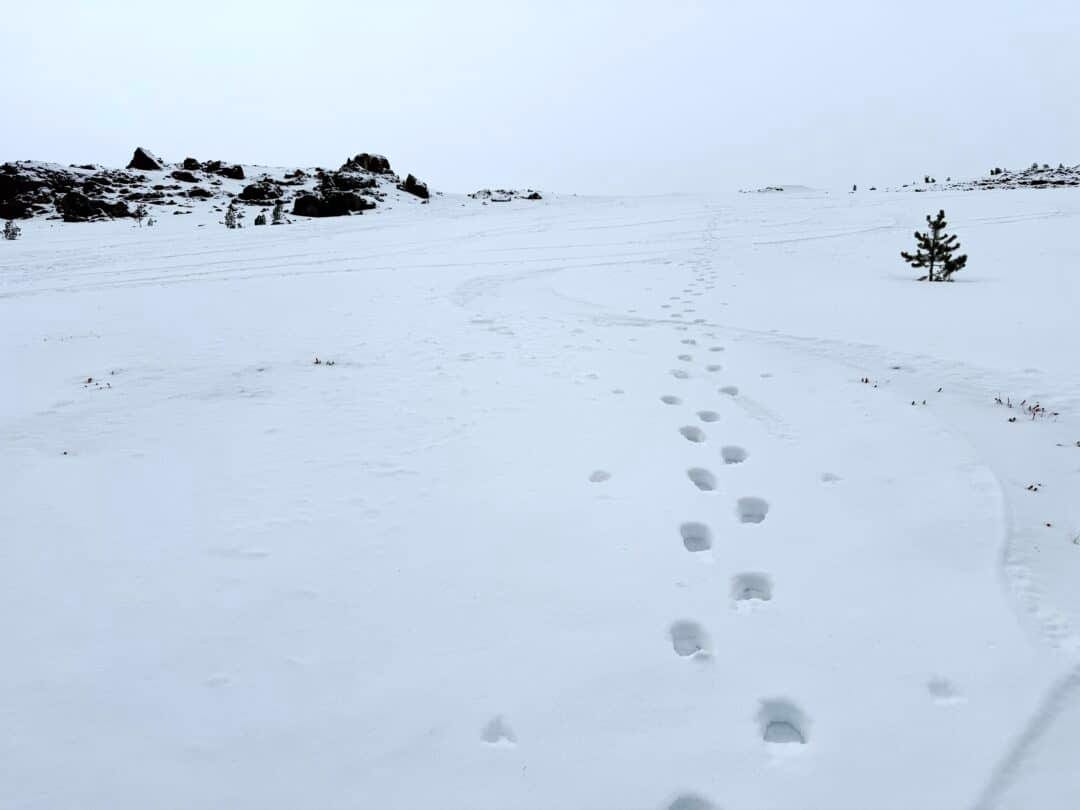
When it comes to bootpacking, however, I felt like a monster. Our early season left little to be skied but an isolated north facing bowl, and both power-hiking up the 3” of snow on the opposite face to access the bowl as well as booting back out of the bowl repeatedly, I felt like the god of quad. This emphasis on bootpacking fitness over skin track fitness could favor those who tend towards booting. I’m looking at you Tetons, and you, Wasatch couloir junkies.
Bottom Line
Overall, I give this plan a B+, which is more than enough for most people.
This is an affordable, equipment minimal training plan that is without a doubt a better preparation for the ski season than unstructured fun and “working out”. For any skier who hasn’t completed structured preseason training before, it will deliver significant results. While it promises a 7-week timeframe, anyone with some competing obligations or desiring a bit of flexibility will want to plan for around 10 weeks to complete the plan. The progression that you see in the plan and in yourself is satisfying, and I found the roughly 1-hour workouts enjoyable.
For pure performance on the skin track, I think that the plan is aerobically lacking for anyone entering the fall with strong aerobic fitness. If I repeat the plan, I’ll be adding 3-5 mile trail runs following the days of step ups or after the leg blasters. As a comparison, when I was coached by Uphill Athlete going into the 2019-20 skimo season (which didn’t come to fruition for black swan reasons), I spent 5-6 days a week doing trail running workouts, with 1-2 days a week spent on core, stabilizers, and leg strength. I was very strong on the skin track at the beginning of that season in a way that I am not this year.
Overall, the training philosophy of MTI is sound, and the limitations of this plan are largely the limitation of using a gym rather than a mountain. My experience with MTI’s other base mountain fitness plans has been excellent, and the pricing is hard to beat. This is accompanied by an app that provides the workouts, tracks the results, and generally makes your training straightforward. If you want to add some structure to your preseason preparation (or midseason maintenance), MTI is worth a strong look.

Leave a Reply
You must be logged in to post a comment.