
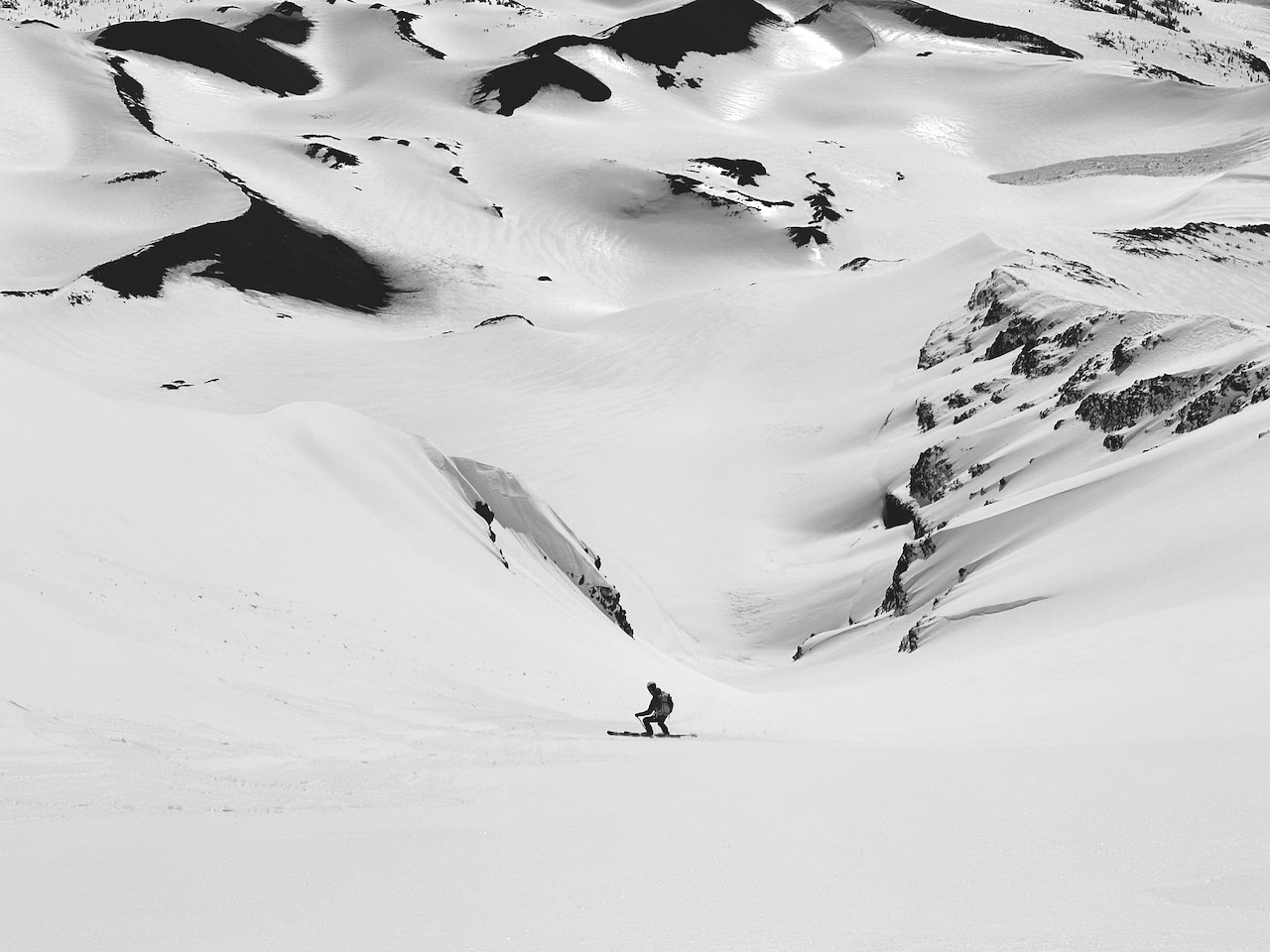
Most often, as we move clocks forward in the spring for daylight saving time and enjoy more afternoon daylight, it takes time for the seasons to catch up. It can feel downright wintery in many locales well into late April. Not so much this season when clocks clicked forward and we timewarped into deep spring. Even more so this week, spring has sprung in earnest with reports of epic avalanches of the loose west variety.
On a less be-on-your-toes note, some corn-starved tourers are satiating their appetites by timing their corn harvest properly during what is officially still winter (at the time of this writing). Here is another piece in our series documenting mindset shifts, where we shift into spring.
***
The High Route: So here we are, I’m at something like 7,500′, after high noon, and it’s nearly 58 degrees. It’s hot. Which makes me think I’m behind the curve when it comes to thinking about corn snow. What are the first steps you want readers thinking about as we abruptly shift seasons?
Billy Haas: The first shift is how one analyzes conditions. We are transitioning from a dry snow pack to a spring snow pack, and eventually, a summer snow pack. When looking at a Winter snowpack we have a certain set of avalanche patterns that are most common, this is similar to a Spring, or what we refer to as a transitional snowpack, and then into a summer snow pack. Almost every region will go through snowpack evolution in some way or another.
We do the most corn skiing in the transition phase—the spring snow pack phase—because that’s when we generally have the cleanest/smoothest snow and we have overnight freezes, two factors contributing to good corn snow.
During this transitional period, we analyze the day looking at data slightly differently when trying to find corn snow. It is a different strategy because it’s more heavily based on overnight freezes, timing of thaws, and working aspects throughout the day, rather than it is about avoiding certain avalanche problems and slopes. We generally make a different set of observations, and weigh certain data more than we usually would during the mid winter. In spring, I’m looking more at temperature trends, solar input or cloud cover, and the wind’s cooling effect on the snow, all things that affect the freezing or thawing of the snow.
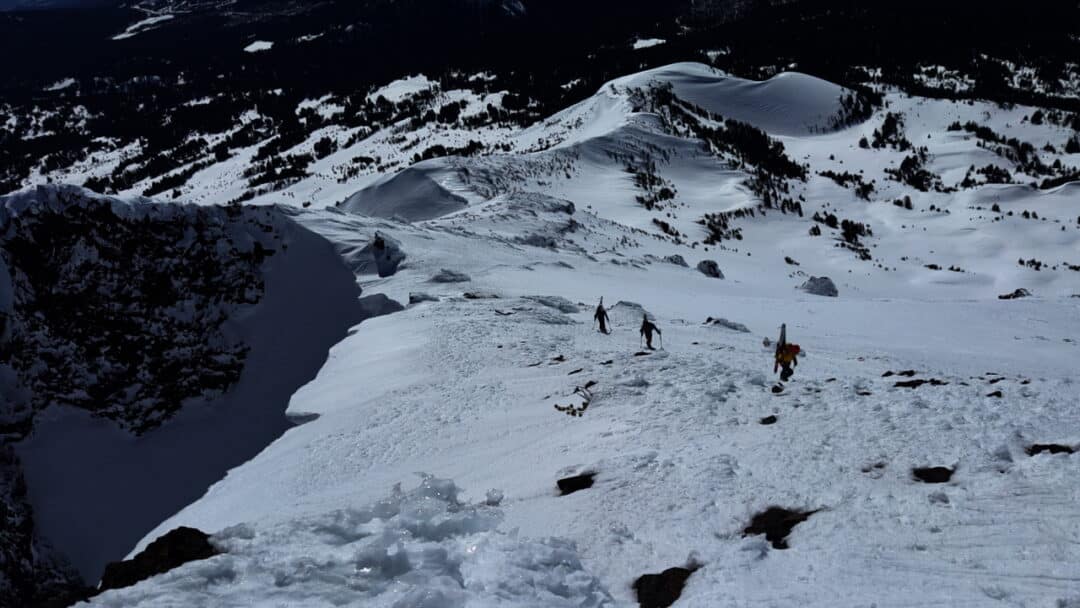
THR: What do the practical aspects of that planning look like?
Haas: The night before, the biggest thing I want to see in a forecast, and when I wake up in the morning, is what happened with the skies overnight, and how did that affect the freezing.
This is because the biggest player in effecting a good refreeze is not just looking at the ambient air temperature, which you should do, but if you just look at the air temperature alone, you may not understand what’s actually happening on the snow surface. What you want to look for, ideally, are clear skies. Clear skies overnight usually indicate at least a good enough freeze for a corn window the next day.
So I am looking at a site offering telemetry data that can provide some insight into cloud cover. Even with a little bit of cloud, just a bit of high cloud, can prevent proper freezing at the snow surface. I want to see clear skies. And even if we only get a few hours of cloud and clear skies, maybe it’s only from 4am to 7am in the morning, that might be enough.
You can glean some info from satellite images, but honestly, the way I look at it most often in my local area is via webcams. You can look at most ski-resort webcams and get an idea of what happened, or local area webcams overlooking the mountains, and you can get an idea of whether it was clear overnight or not. For example, the local Alta cam is hi-def enough to see the night sky. Lastly on this point, although I know I could pass on stating this, if you’re on a trip without service, you can just look outside.
The problem with looking at temperature readings alone is that most often those air temperature readings are taken a meter and a half or greater above the snow surface. So because of that, you’re not actually seeing how cold the snow got. You only learn how cold the air temperature above the snow was a meter and a half or two meters, three meters off the snow surface.
For example, if it’s 35 degrees Fahrenheit 1.5 meters above the snow surface, you could be down on the snow, and it could be 28, that’s not that uncommon.
And if you want to get nuanced looking at weather data, there are plenty of weather stations out there, particularly ski resort weather stations or highway department weather stations that provide a temperature reading at the snow surface. A snow surface temp gives you the most accurate idea of whether or not you saw a refreeze that night, and how substantial that freeze may have been.
THR: What else are you looking at? I know wind can adversely impact the corn cycle.
Haas: On some days, winds are either going to stymie you or help you. I feel like one of the trickiest things to predict when you’re hunting for good spring skiing and corn snow are the winds, and how they are affecting the snow surface.
The other day, for example, I was trying to see how winds were affecting the slope. At first I thought I should take one more lap on a corned-up slope, while I waited for a slightly different aspect to soften. I was standing on the ridge and I actually went onto the face, the one I was looking to ski, and I actually dropped down to the level of the snow, laid down on the snow and felt the wind on my face to see how much the wind was actually hitting the snow. There wasn’t that much. Sure enough, instead of doing a full deep lap way down into this valley, I took a shorter lap, and was happy I did as I found great softened snow when I returned. Had there been more wind on the snow surface, I could have had more time.
THR: How do you time things so you aren’t waiting around for the snow to soften?
Haas: The most basic is looking at the patterns. If you skied a slope one day and it went off at 10am on a southeast slope, you can expect similar conditions, similar timing, when the conditions are similar. Of course, as the season progresses, the sun arcs higher in the sky, and can be more intense, so take that into consideration. But basically, similar to how we look at pattern recognition and other facets of avalanche forecasting and condition forecasting, we must pay attention to that timing, and when each respective aspect goes off. Again, once you have that timing down, you can adjust accordingly. If it looks a little more windy today, but the temps stay the same, maybe you should delay a bit. Or, for example, if it were windy a bit yesterday, and you noted the time it softened, maybe the next day when the winds are less, all other things being equal, the softening may occur a little earlier.
Sometimes 30 minutes or 40 minutes can be the difference between perfect corn and substandard corn. Or, as Adam Fabrikant and I like to say, corn off the cob.
THR: Yeah, it’s never as good off the cob. So I get that.
Haas: We have a whole lexicon for corn: there’s cream corn, there’s corn off the cob, there’s al dente corn, pseudo corn, I could go on.
THR: Ok, for the newcomers to spring touring, let’s examine slope aspect.
Haas: At least here in the Wasatch, we’re generally not skiing too much corn, or anything for that matter, on north-facing slopes. As with most zones, we focus on slopes facing east through west. Here, the north slopes, since we don’t get the hard freeze thaws, those aspects are usually either breakable or it’s just mushy powder.
So on any digital mapping platform, I begin looking at the slope aspect overlay. That layer helps me get a general idea of when certain runs will go off.
Again, this isn’t complicated, but east-facing slopes will go first, and then we’ll work around the day finding good snow, and end on west-facing terrain.
What I love for corn cycles is that if I want to get multiple laps in, it is reasonable to make a plan to tour on east, maybe southeast, facing slopes, and finish my day on west aspects. Again, the slope aspect overlay is a great tool, anytime of year, to help you begin to determine when a specific slope may soften.
Getting more granular, I will use the sun exposure overlay on CalTopo. This allows me to get a better sense of the timing. Certainly, as explained above, you’ve got to factor in other variables, but understanding when a slope comes into the sun is a huge benefit to nail down the timing.
So using the slope aspect and sun exposure overlays in tandem is quite helpful.
Out in the field, when I might be eyeing a slope for the first time, or it is just after a wind event, I don’t want to see a slope that has a ton of dirt in the snow. Dirt, or detritus changes the snow’s albedo properties—albedo is a measurement of how much sunlight a surface, like snow, reflects. Dirty snow has a lower albedo, meaning it absorbs more radiation. That dirty snow shortens your corn windows—dirty snow will soften faster, but will become too mushy, less ideal, in a shorter period, too. In other words, if you’re going to ski it, you have got to get on it earlier and it won’t last as long.
Dirty snow will also create differential heating patterns on a micro scale within the snow. That’s what helps create sun cups, which eventually turn smooth skiing into bumpy skiing. Long story short there, cleaner snow generally equals better corn skiing with smoother snow and longer corn windows.
Again, it is about monitoring things, and being attuned to what variables are in play, and building a base of knowledge in your zone on how that all affects the timing for good snow. Some places tend to retain clean snow. In those locales, you might not need to leave in the dark to find good skiing on an East aspect.
THR: What about the idea of a run’s length? Here in the PNW, we might ski a 4,000-foot volcano panel in spring, and the different elevation bands soften at different times.
Haas: Sure, you could have a few thousand foot run, that’s one of the beauties of Spring skiing is the potential for being in bigger terrain. The top may still be firm, and this is where a lot of people get screwed up. They get to the top of the run, they touch it, and they’re like, “It’s still firm. Let’s wait.” But maybe just 300 feet lower, it’s perfect.
On those longer runs you want to remember that what’s often desirable is the best possible corn for the most turns, so a few scratchy turns off the top could turn into thousands of feet of perfection, but had you waited for the tippy top to soften you would have been late for the majority. That said, on a more serious line, it might be a good idea to let the upper portion soften adequately, and sacrifice the bottom portion to be a little overripe. It’s just something to think about, and which portion of a run you’d want to best corn skiing.
I ski a lot of corn runs where maybe for the first few hundred feet off the top, it’s firm, because there’s a little breeze on top, keeping the ridge line cool. So maybe, initially, it’s a little scratchy. But because I’ve done my homework, I know that down a little lower, it’s ripening and it’s firing corn.
THR: Ok, let’s talk about best practices when it comes to corn skiing.
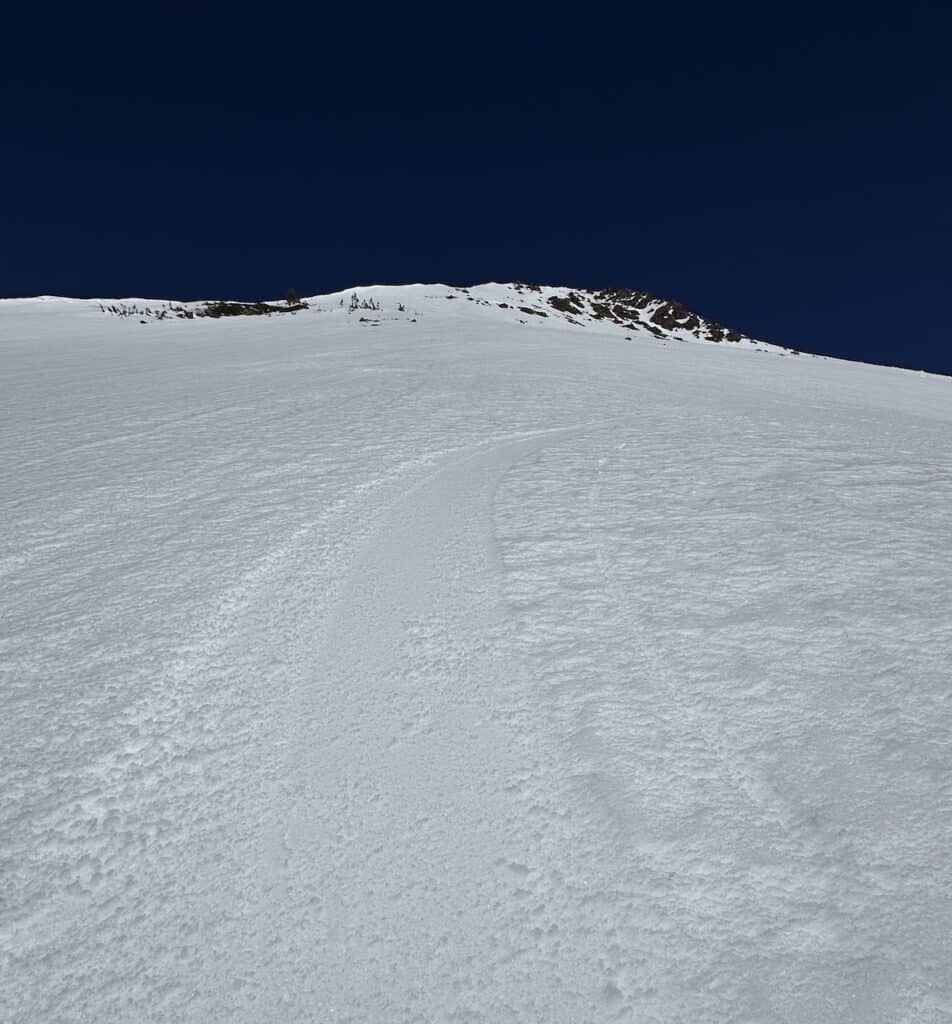
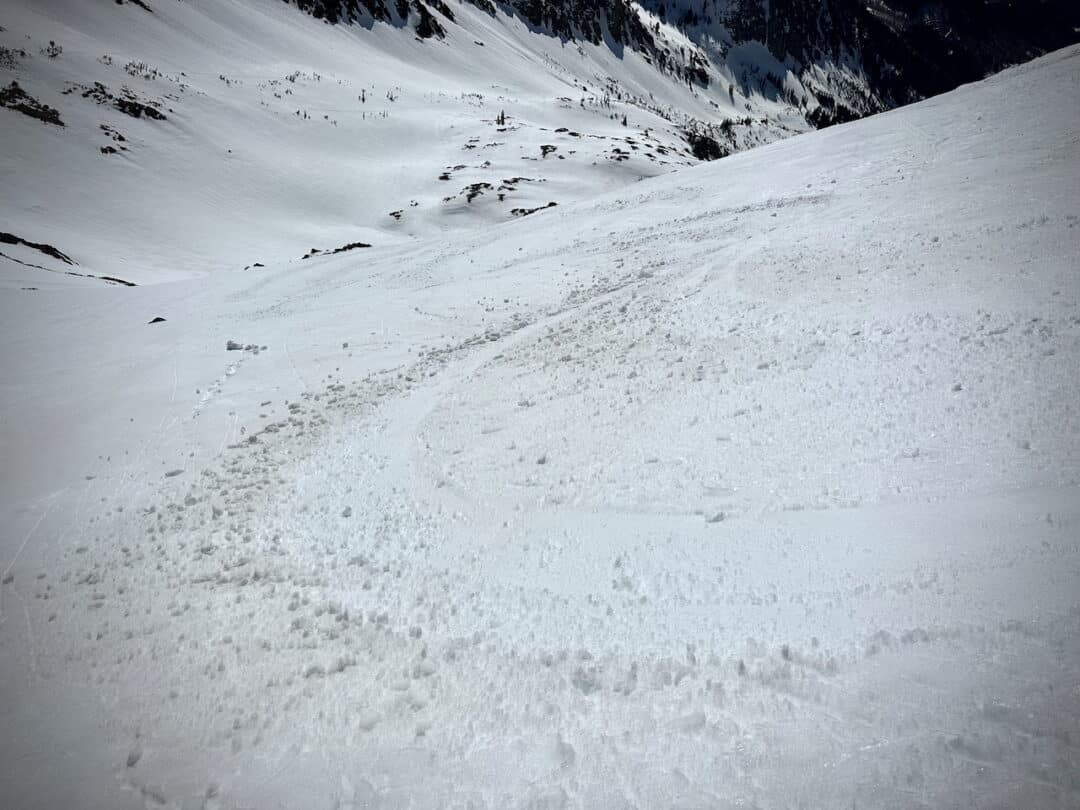
Haas: I think good corn skiing means we should be striving to time corn as best we can. To me timing good corn skiing means not leaving big gouge marks in the snow. This is an opinion, but I don’t think I’m alone in this. What I mean about a gouge, is leaving deep tracks while skiing after the snow surface has warmed up considerably. Ideally, in good corn skiing, there’s a discernible track, you can see the turn, but it is not too deep. Good, perfect corn is when you can see the etching of a turn. No more than 3-5 cm of penetration into the snow. The snow should feel fast and smooth, have good edge grip for a carved turn, but also be soft enough for playful edge release and a skidded turn if desired.
Basically, with that light penetration, after a day of melt freeze, you can’t even tell your track was there. That, to me, is perfectly timed corn. I’m not saying that if you’re late, you can’t ski/ride a run. But it’s just a reminder of how we may impact a slope that otherwise could be great corn snow the following day or two. In the springtime smooth surfaces are king, and with good timing during a corn cycle, a good run has the potential to be a gift that keeps on giving. If we gouge it all up, it ruins a run that could have continued to ski well for days.
Perhaps I am preaching a bit about this, I do take my corn skiing seriously, but I think it’s important people realize that corn skiing/riding should leave light imprints on the snow surface. If we are leaving deep gouge marks in the snow, we need to admit that we were late with our timing.
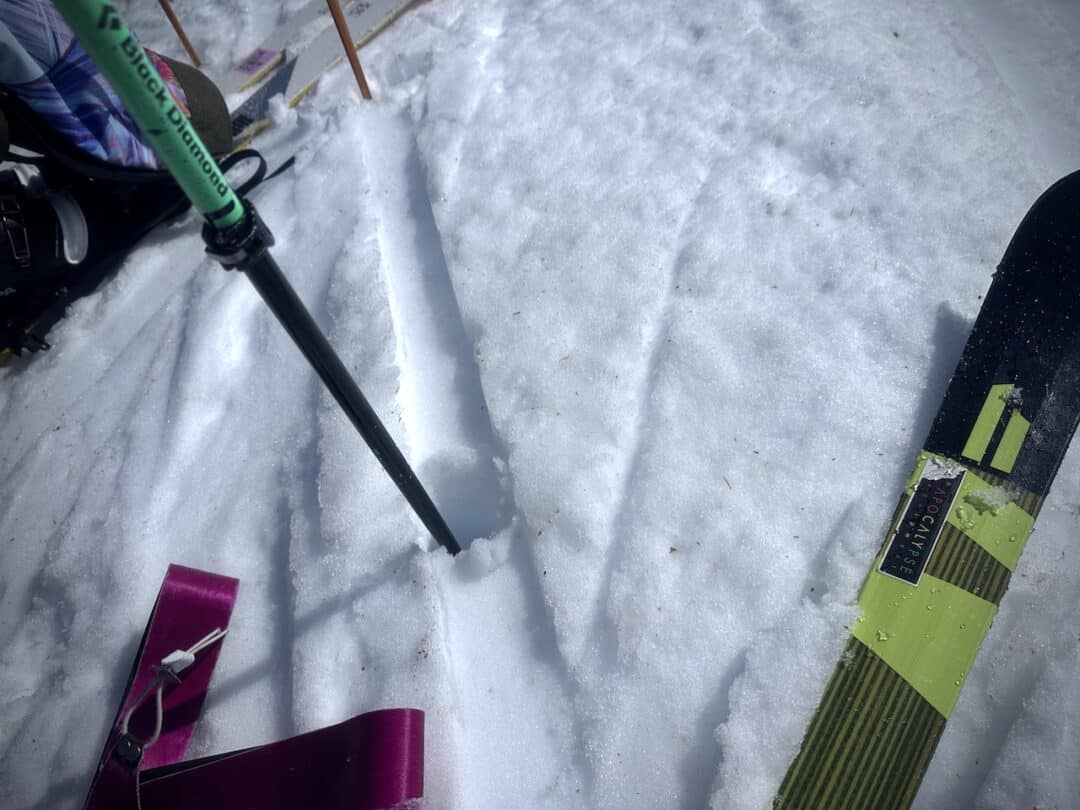
It is easy to determine with a pole—you can punch your pole in with a powder basket, and if you can get that powder basket down maybe, 3-5 cm, you’re within the best corn window. But if you can go deeper than a few inches you are likely a bit late. The depth at which you can penetrate your pole basket is roughly what you’ll penetrate while skiing. This is a bit informal I know, but perhaps it gives a bit of a reference.
Leave a Reply
You must be logged in to post a comment.