

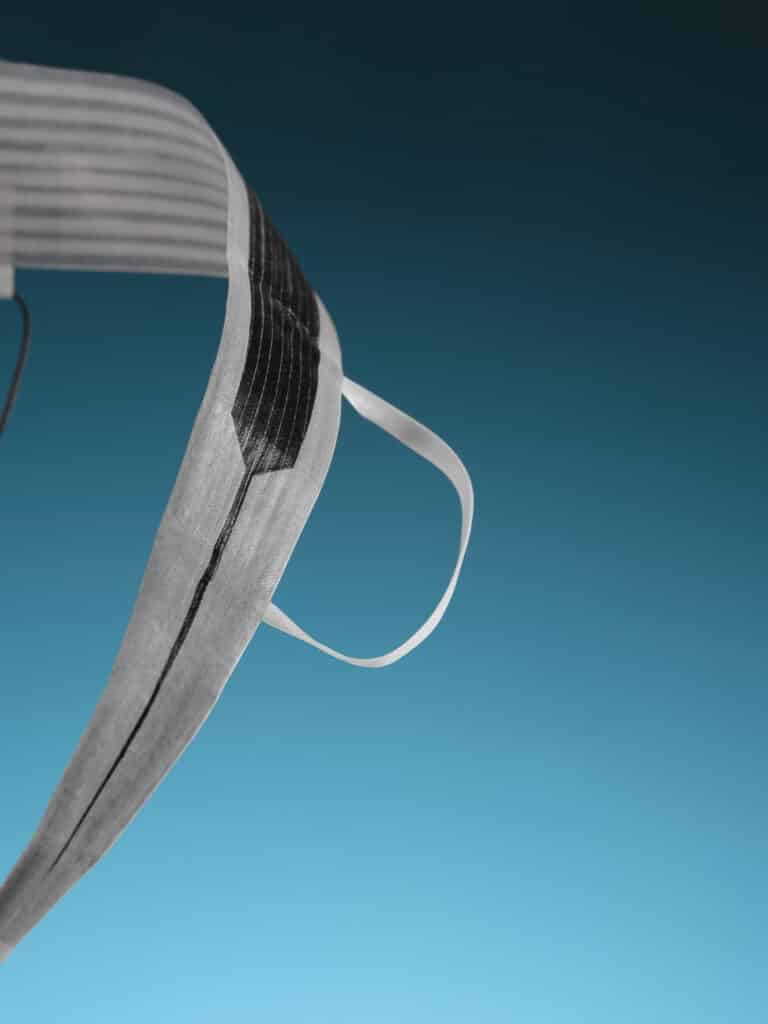
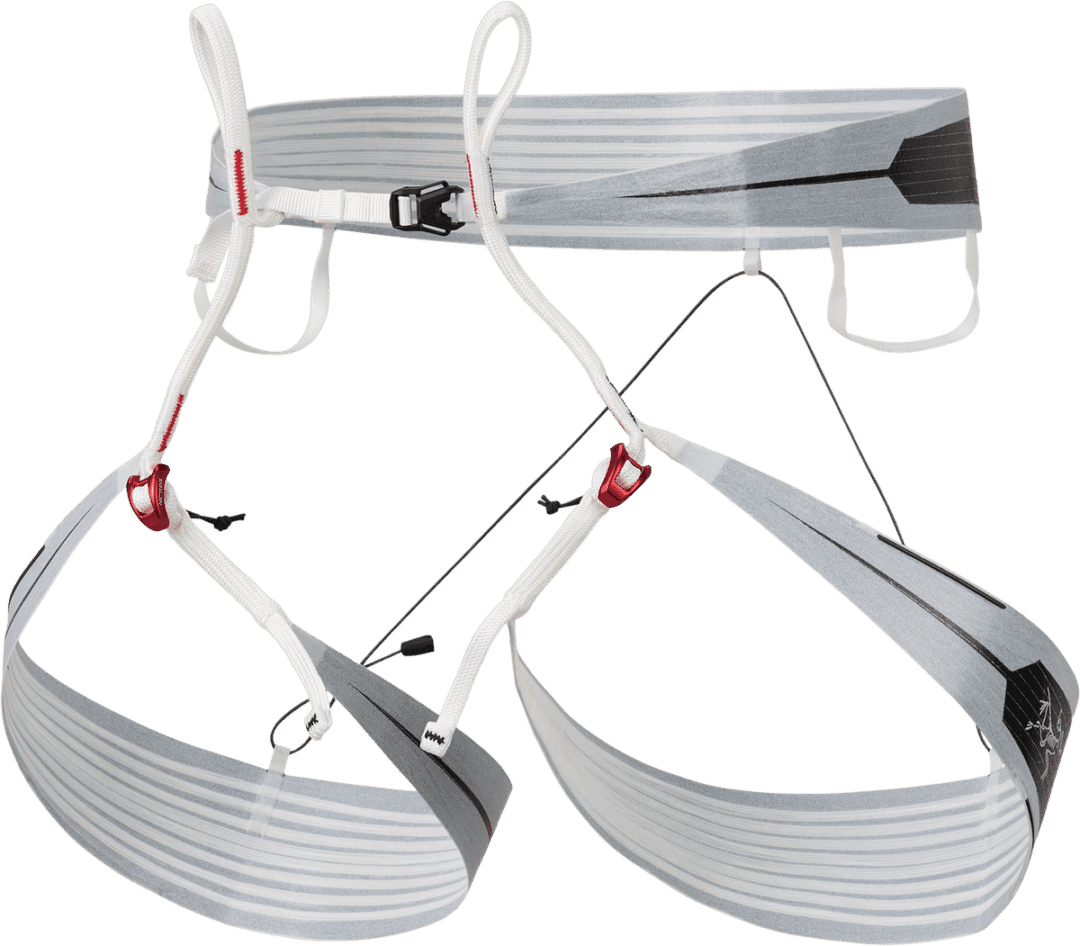
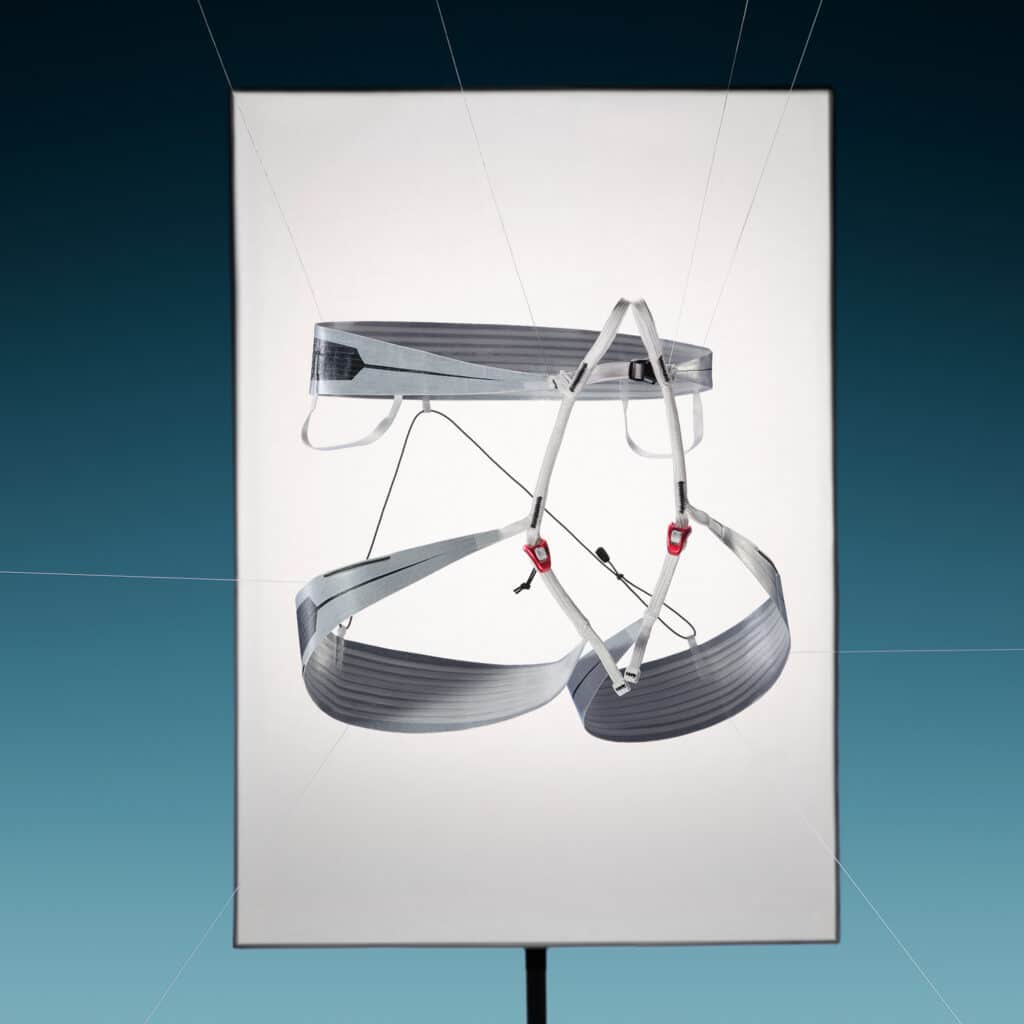
Over the decades, Vancouver-based Arc’teryx has been known for design innovation. Form, function, and style were often fused into remarkable pieces of gear. While this is a first look, the brand’s new Alpha SL Harness—their first ultralightweight ski harness—nails the form and style. We’ll be here over the next few months to comment on the function.
There are several notable innovations at play. Some are unique to the harness, some borrow from the sailing/arborism realms and incorporated into the harnesses’ design. Most notable, this is a near-seamless design. Arc’teryx accomplishes this by using Aluula composites and braid/rope splicing techniques. (Below we have an interview with JJ Mah, Design Director, Advanced Concepts at Arc’teryx, where we discuss the new materials, their benefits, and the manufacturing process.) The only stitching on the harness is in the form of 4 bartacks, which hold splices in place around the leg loop/tie in points.
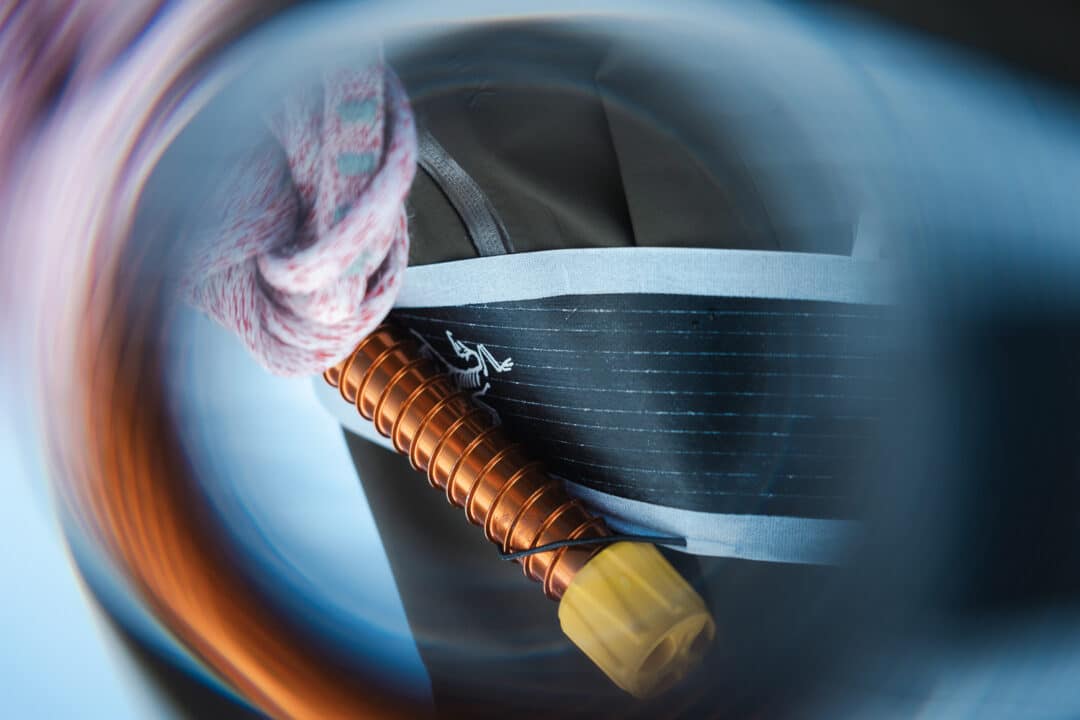
Splicing like this from a large brand making consumer products is rare; JJ confirmed that all the splicing is done by hand here. There isn’t a machine for these operations. Somewhat similarly, JJ described the bonding process for the leg loops and waist belt as analogous to a carbon fiber layup. Components are laid into a mold in a specific order and orientation, then closed into the mold and cured (in this case, likely heated) to bond the various layers of PE fabrics and yarns.
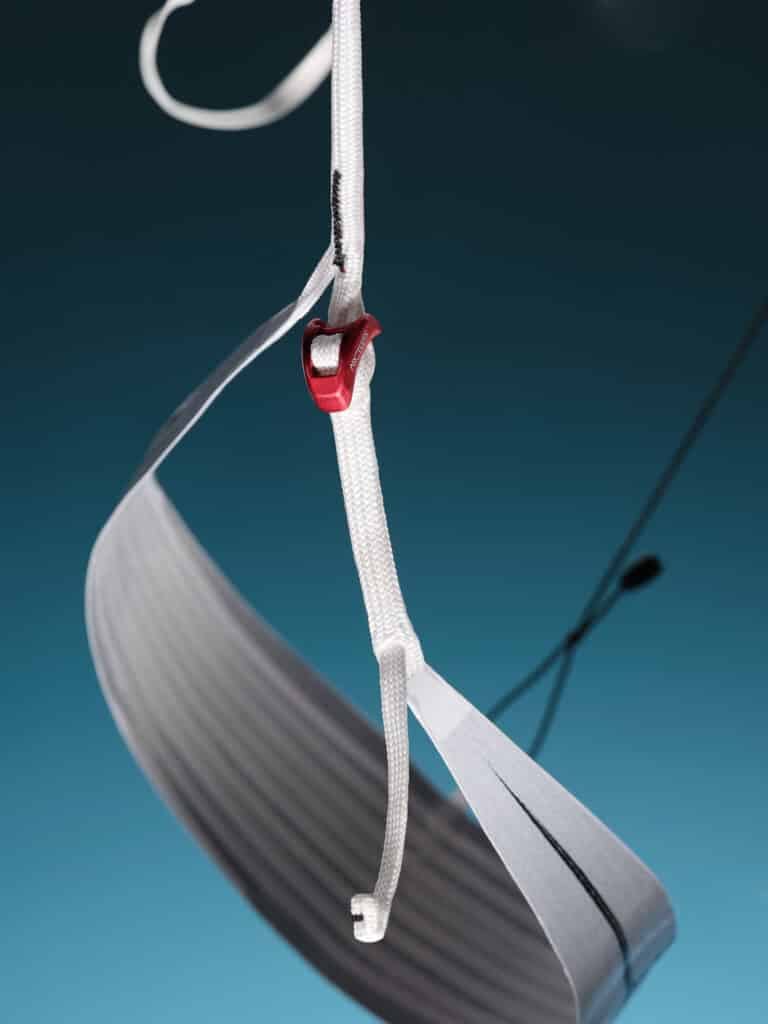
And notably, the leg loops secure/adjust by using the “mechanical properties of the braid to cinch on itself, providing secure, glove-friendly adjustability while maintaining a streamlined profile.” This concept will be familiar to folks who have seen/used a whoopie sling for hammocks or other adjustable load carriage.
For some time now, Arc’teryx has used what they call ‘Warp strength’ in their harnesses. Essentially, webbing has a weft (yarns across the length) and warp (yarns along the length). Warp strength refers to the process of removing the non-load bearing weft yarns, so the webbing effectively forms a series of lengthwise yarns, only connected where the weft ‘restarts’ in the ends of the webbing. This allows them to spread and laminate the warp yarns into the waist band or leg loops to very effectively distribute the load over a wide area.
While a normal climbing harness uses a flat, woven webbing, the Alpha SL uses braided cord, similar in essence to something like amsteel. Crucially, in a braided cord, each yarn is load bearing, there are no non-load bearing weft yarns. To accomplish a similar concept to warp strength, but utilizing these UHMWPE braided cords, Arc’teryx is custom weaving each component to length, so a piece of cord will have sufficient woven tails to create the splices/loops necessary for tie in points, leg loop risers, etc, then have a middle section of loose yarns that are spread and laminated into the Aluula frame of the waist/leg loops. That’s a process that’ll be hard to replicate at home.
What to Eye in the Alpha SL First Look?
- Gram counters rejoice: a size 4 unit weighs a confirmed 77g. I’ve experimented with a mix of harnesses over the years, but I still use a 1st-gen Petzl Fly for glacier travel/etc., (foam removed, but I wish I had not done that) that weighs ~100g in a medium. Tack on 20-30g for the foam.
- Similar to the Lithos SL harness, the Alpha SL uses a bicycle inspired numerical sizing system, with sizes 1-5 available. Unlike the Lithos, the Alpha SL has adjustable leg loops, so there is no A/B leg loop sizing.
- The Alpha SL’s flat-fabric sections (waist belt and leg loops) are pliable, yet feel semi-rigid. It is much more rigid than other ultralight ski harnesses. This is a result of fabric/material choice and the bonding possess, which uses heat, not glue, to fuse the different Aluula composites together. (As noted in the discussion below, Aluula composites use proprietary UHMP weaves.) Despite the hand feel, the harness folds into a tidy package (it comes with a stuff sack) to stash in your pack.
- UHMWPE braids and refined toggles connect the leg loops to the waist section/hardpoints. Leg loops adjust via a whoopie sling style splice bury, with a stated range of up to 3”.
- The gear loops are a semi rigid, multi layer Aluula Durlyte. They are far more functional than most ski-harness gear loops thanks to their rigidity. One could comfortably carry a glacier kit or light rack.
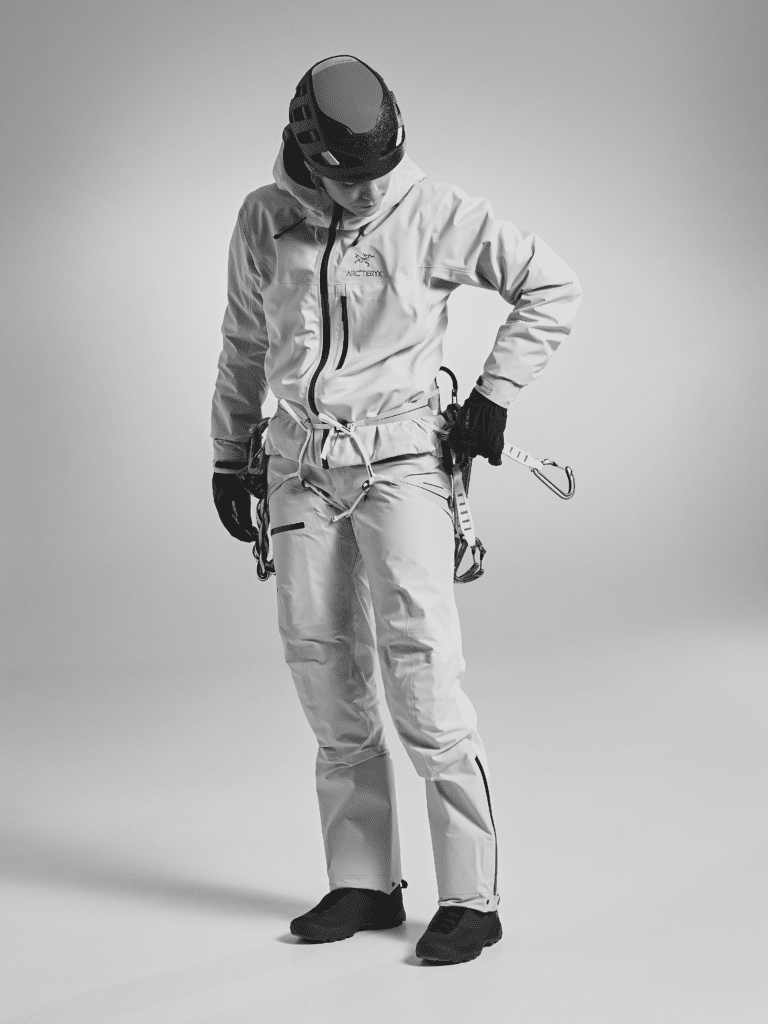
- The Alpha SL can be easily put on and taken off with boots on the ground, meaning the leg loops easily open up and secure without having to remove boots/crampons.
Alpha SL Specs:
Fabric/materials: Aluula Durlyte, Aluula Aeris X, 6mm hollow braid UHMWPE, ~1.5mm UHMWPE Shock cord
Weight: Confirmed Size 3 77g
Price: $180.00
***
An interview with JJ Mah, Design Director, Advanced Concepts at Arc’teryx
This interview has been lightly edited for clarity
JJ: I can start with where or why we even jumped into this world. Ultralight harnesses are not a new thing; they’ve been around for a long time. Arc’teryx has been making harnesses since ’89. We were actually founded on making climbing harnesses, but in the space of ski harnesses, glacier travel, and sort of emergency harnesses, there was never really anything that was all that appealing to us. It felt like they were all built in a very similar way. They all had very similar pain points.
Typically, these harnesses are edge-bound. Edge-bound construction takes webbing and sews it over a piece of mesh. While it’s a very lightweight and easy way to create a structural harness, under load, they just completely collapse.
And so, talking to our athletes, we were looking to do something better that we wanted to use ourselves—making something that we actually want to use and something that was actually better. It wasn’t until we got our hands on new materials like Aluula and started working on new construction and manufacturing techniques that we created a new platform. Something that was ultra lightweight yet didn’t totally compromise all the functional components that you need in a harness, especially when it comes down to comfort, your loops and your buckles, and the adjustment mechanism.
Something that’s been brewing for quite some time now. Probably as long as I’ve been at Arc’teryx—for the past 10 years, it’s been kind of this thing that’s been batted around for a long time, but no one’s really felt we had something on our hands until maybe the past four years.
Gavin Hess: What Aluula fabrics are you using? The harness materials feel different than the Alpha SL pack. Or at least different than the other Aluula products or fabrics that I’ve seen or felt.
JJ: There are a few Aluula materials used in this harness, and they’re actually materials that we developed with Aluula in the early days of R&D. In the harness, we’re using what Aluula calls Duralite. So it’s this white material that spans the back and the front. We are also using Aris X.
The easiest way to describe how we’re using them, and the technology we’re calling “WARP Strength Fusion Technology,” is closer to how a carbon fiber product is made. The cool thing about this product is that there’s actually no sewing involved, except for the bar tacks.
JJ: If you think about carbon fiber and how it’s constructed, it’s essentially like you’re taking structural yarns and laying them down to create structural integrity, and then fusing it all together using a resin or a glue. But in the case of warm strength fusion technology and using Aluula materials, we’re fusing the whole package into one material without glue. It’s a mono-polymer, so all polyethylene-based materials fuse into one material. That provides a really thin yet stiff, supportive chassis. So when you hang in it, you’re getting load distribution top to bottom. These yarns help spread the load when you hang in the harness, and the Aluula fabrics—the Duralite and the Aris X—provide abrasion resistance and stiffness across the top and bottom of the package. That helps describe the “WARP Strength Fusion Technology.”
Jason: Do you have anything to add about the construction methods?
JJ: So the “WARP Strength Fusion Technology,” as mentioned, is our solution for creating a very lightweight, minimal structural chassis that doesn’t suck to hang in. We’ve achieved that by using braids instead of webbing. The braids come from sailing and are an age-old technique in sailing and arborism.
With webbing, the warp and weft yarn create the structure. Yet the weft yarns don’t hold any of the load; it’s all the warp yarn.
With “WARP Strength Fusion Technology,” we discovered you can manipulate that webbing and pull the weft out, fan it, and then bond it or sew it into place. That works well in most cases, like a climbing harness. But with this harness, we were counting grams. We had to go lighter, so we used a braid for the separating leg loops.
All the yarns in a braid are load-bearing. So we could take it down to a six-millimeter braid in a full UHMP construction—ultra-high molecular weight polyethylene; Dyneema is a brand name for UHMP. And then we’re connecting these three separate braids.
There’s one in the Swami and two in the leg loops. We splice them all together at the rise; that’s what we call the connection points between the Swami and leg loops, and they all feed into themselves.
Again, using splicing techniques from sailing, [the fibers] all get fed into themselves to create these really minimal, supple eyes. Typically, when you join webbing together, it becomes really stiff. But these are really minimal and supple, so they move with you while you’re walking, and then there are just two bar tacks that lock everything into place.
That’s the way the structural platform is built, and then there’s a bunch of other little features that utilize the properties of the braid.
On the Alpha SL Leg Loops
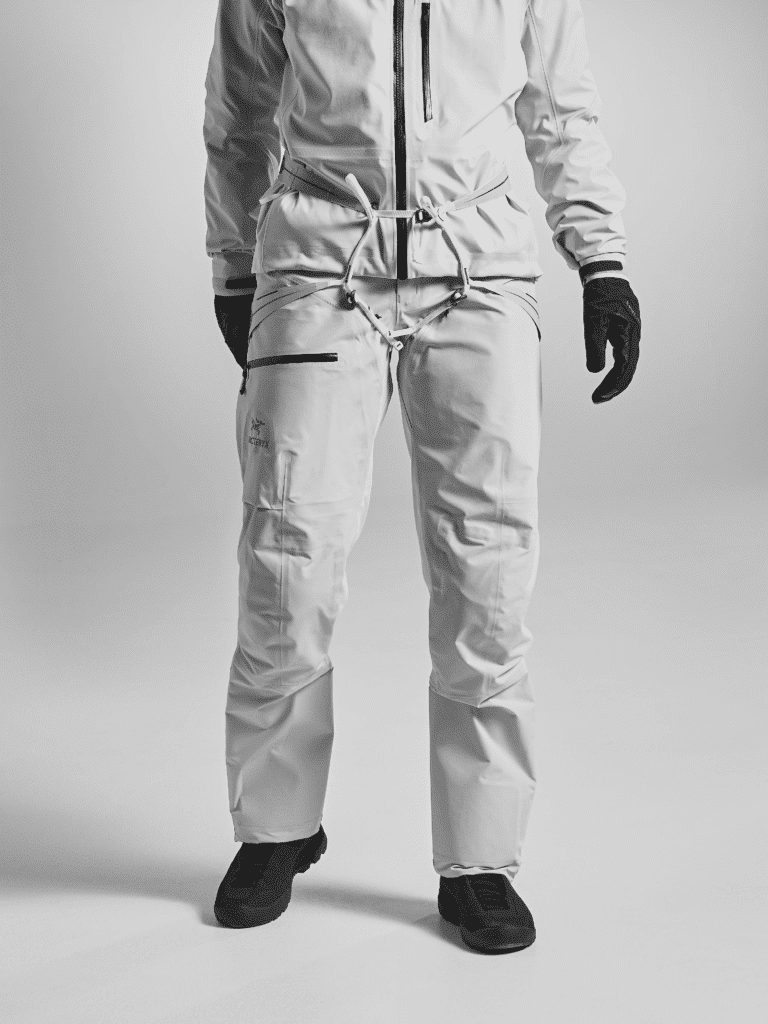
JJ: With a typical diaper-style harness [for ski mountaineering], you can fully open it up and put it on with your feet on the ground while wearing crampons, skis, and whatnot. Usually, these harnesses have a fixed leg-loop circumference with some adjustability.
Using the braid, we’ve developed a process we call a braid lock, where it’s spliced into itself; again, this is a sailing technique. So underneath, you can pull it, which gives you a bit of adjustment. But under load, the braid constricts on itself so that it won’t release
The black toggle helps unlock the braid when you pull it. That gives you about three inches of adjustment. If you’re using this typically for a multi-season kind of harness when you’re scrambling in spring and summer or in winter with extra layering, you get a little bit more adjustment to get it over whatever layering system you’re using.
On the Alpha SL Buckle
JJ: A lot of the harnesses out there use a toggle-style buckle. We’ve developed a new style—it doesn’t have a name, but we were kind of colloquially calling it the arrowhead. It’s tapered, and it has these feet on the bottom, so you can pop into the receiving eye, which is a splice loop, and then the feet seat down, self-securing, providing a really secure connection point.
Jason: The weave portion—I don’t know if you use that term, but the vertical part that is essentially from the sailing industry—is that all one piece of fabric that rolls into the waistband?
JJ: It’s woven differently, or it’s stitched on, and so it’s three separate pieces of engineered braid, and that’s something that we developed a new manufacturing process to be able to produce that. So to go from a braid, splaying it out, and then back to a braid, that actually has to happen on a machine. So once we take those three units of braid, unbraid, braid, then we lay it down, like in a carbon fiber style process, into this Aluula package, fuse it all, and give you this one material that is really thin and supportive.
Gavin: So this is manufactured to come as a pre-sized manufactured braid to open up to braid piece to length.
JJ: Yeah, we have to manufacture those per length, per size, and then they get manually integrated into that package.
Gavin: Are they all hand spliced?
JJ: It’s a pretty crazy manufacturing feat. A lot of very detailed handcraft goes into this, and it was probably the bulk of the challenge because we developed the harness in-house, which is the Arc’teryx process. We knew we could design and build one, but then we had to develop the manufacturing processes and tooling, take it to a factory, and teach them how to make this harness in a repeatable way. And we spent at least two years just on that alone. It was a pretty big crux on that point. But yeah, it’s a pretty cool product that looks machine-made, but there’s a lot of handicraft in there.
General Properties of the Alpha SL Harness
Gavin: Yeah, does it essentially piece together once it’s all laid out? It just goes into a heated press or something.
JJ: Yep, there are all sorts of lamination involved throughout the process. I’ll talk through the rest of the components that are also laminated. Features like gear loops, for example, on a skiing harness are typically just a piece of cord that catches and kind of snags on a hook and nose beaner. The gear loops on the Alpha SL are actually bonded Aluula fabric. We developed a process to basically origami-fold it, bond it into a material that’s almost as rigid as what you would see on a sport climbing harness—like pretty much plastic—but with a bit more shape. It’s bonded into the harness without sewing, so it’s really lightweight and strong. You don’t have the pressure points of your bar tacks digging into your sides, but it has a bit more body.
Gavin: It’s really impressive how hard it is to find any seams, both in the waist belt and, like, the edges of the gear loops and stuff.
JJ: So if you’re talking about racking equipment, then, yeah, ice screws carry down on the leg loop. Have you had a chance to use those yet, Gavin?
Gavin: Yeah, I did.
JJ: I know, typically that’s either just a piece of cord or elastic. We wanted it to be able to disappear when you’re not using it and not snag on anything. So these are actually bonded UHMP. We developed this UHMP shock cord and bonded it in place, but it tucks out of the way, so it barely stands off the package when you’re not using it. When you do need them, pop that out, poke your screw through, and it’s actually important to poke that through both slots because it keeps it nice and horizontal and out of the way. But then it holds your screw for walking, and that’s on both sides, left and right.
Jason: I’m curious—what is the feedback process when working with athletes on something like this? This is a safety product that also has comfort as part of its design, and, of course, minimal weight.
JJ: It’s always two parts for any of our products. There’s qualitative field testing, balanced with quantitative or lab testing, which is especially critical for PPE products like harnesses.
For this product, we started by looking at what’s happening in the world of fast and light alpinism. Those blurring the lines of climbing and skiing, climbing and running, and then looking at what Sam’s doing, for example, and how he’s using his harness, as well as people like Eric Carter who are going on technical runs with a helmet and a harness on. There’s definitely this bigger demand for what equipment is expected to do. So this was definitely a pretty big piece of using this product and getting the feedback loop because we’d never made ski harnesses before, or in this ultralight space. We really wanted to make sure the problems we thought we were solving aligned with the problems athletes were actually experiencing.
It was around 600 to 700 hours of field testing, really putting it through the wringer.
Jason: My basic understanding of harnesses is like, “Oh, I’m ordering a Petzl harness, and it’s a medium or something like that. You’ve shifted your sizing a bit; can you explain it to us?
JJ: We’ve shifted to a numbering system, which was actually inspired by the bike industry. That means moving away from gendered sizing. Because harnesses fit in such an intimate way, and people have all sorts of proportions between waist and hip circumference and rise, we moved to a numbering system. One through six is the Lithos range: a three is probably the closest to a women’s large, men’s medium. But in the Alpha SL, we are doing one through five without AB leg loops because the leg loops are adjustable—they’ll actually span an A and B range. So yeah, lots of adjustability, but we’re moving to a bit more of a universal fit system.
Gavin: That Lithos sizing system is awesome. I feel like it’s the best-fitting harness I’ve ever had. With the Alpha SL, I have a size three, and it’s certainly on the snug side on the waist. My Lithos is a four A, and that fits me perfectly. The three, and particularly with winter layers on, is a bit snug in the Alpha SL. I’m at the end of the sizing range in the 3.
JJ: The swamis are going to be consistent between the Lithos sizing, so you’d probably be a size four in the Alpha SL, and then yeah, you have that ability to adjust the leg loops.
Jason: And maybe this is all proprietary, but how do you see fabrics like this and production methods like this being folded into what you are producing? Maybe across the board.
JJ: I’m excited. I’m excited as a user, and as a designer, because it opens up a lot of new opportunities to build ultra-lightweight products that don’t compromise functionality, durability, or sustainability. These materials and this harness-it’s cool that it’s entirely mono-polymer, except for the metal buckles and the plastic side release. So the recycling infrastructure isn’t there yet, but in the future, when we can recycle it, this thing’s ready to go. You have to clip off the plastic buckle and the metal buckles. I think the future is looking pretty bright for ultra-lightweight gear in the Alpine space. Yeah, just excited.
It’s been a slow process of chipping away, evolving old ideas, and tweaking new ones. That’s the beauty of product design: it’s not always about one shiny idea; it’s the sum of its parts.
Gavin: Are there going to be further iterations on this, like braid technology and the Aluula harnesses into more functional climbing-style harnesses, rather than just a ski harness?
JJ: Potentially, yeah. It definitely opens up lots of opportunities.
Leave a Reply
You must be logged in to post a comment.