
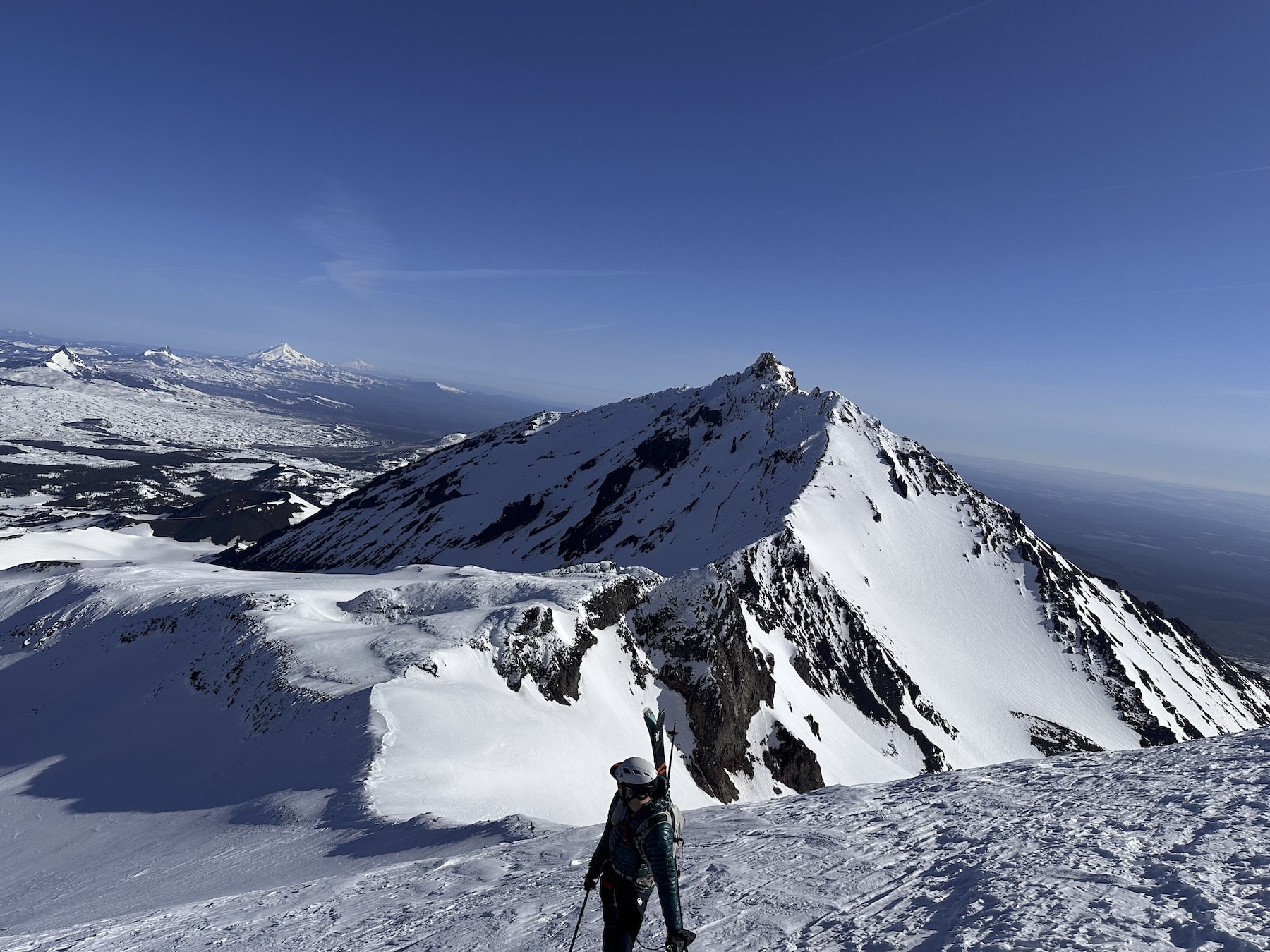
A maybe not-so-strange thing became more apparent around a decade ago. While it wasn’t so uncommon to see snowmobile tracks (snowmobile/snowmachine tomato/tomatoe) in designated wilderness around Bend, Oregon, it wasn’t exactly uncommon, either. All things considered, Bend has an ample amount of designated wilderness, roughly 20 miles west of downtown. The Three Sisters Wilderness is our go-to destination for winter recreation, whether sliding on skis or a splitboard. Depending on where you access the wilderness area, which isn’t exactly massive, you can count on a semi-flat/rolling approach on skins or foot. If you have access to a snowmobile, approaches are a bit easier. Those rolling six miles to the wilderness boundary at Broken Top are reduced to 20 minutes with a machine (30-40 if, like me, you are a weenie with a throttle). Of course, with the combustion-engine assist, you miss out on some fine old-growth quietude.
At the wilderness boundary, ski/ride tourists park their steeds and go about the human-powered portion of their day. Around mid-to-late day, they return and zoom back to the trailhead and load up. The Three Sisters Wilderness houses four sizable volcanoes (Broken Top, South Sister, Middle Sister, and the North Sister). Considering the vastness of the Rockies, the Sierra, or the North Cascades, as I’ve noted before, this is a tidy place. But like other places, we have different user groups advocating for access.
Perhaps what’s happening locally is also common in other regions: Snowmobile tracks, way back, way beyond the wilderness boundary, are now common. The highpoint marks aren’t just some folks having a good time and getting carried away on boundary-adjacent slopes. Last season, I saw sled tracks up the South Face of Broken Top—what looked to be a 2500-foot joyride all the way from the drainage’s base to near the rimy crest, miles beyond the wilderness boundary. Big and bold, and I’m sure loads of fun. But not exactly in the spirit of designated wilderness or compromise. Compromise, to me, is the key here. I’m a strong advocate for public lands. And I land on honoring the intent (and legal foundation) of non-motorized wilderness. However, our seemingly disparate user groups —sledders and ski/ride tourers—have made compromises all over the U.S. These compromises may result in one side of a cirque being motorized while the other remains non-motorized. Of course, this is outside designated wilderness where, again, no motors are allowed. But it shows good faith
Let’s not leave the elephant in the room unattended—these are, at best, unsettled times. Some like it that way. Others are spiraling. I can say this much: On the whole, the folks I have met who are sledding and enjoying public lands are a lot like the folks I see touring. Some have a great disposition, while others posture and vibe. (Small data point here. The posturing and vibing crews on both sides of the aisle often wear the same style of shades. Brashness begets brashness. There’s some common ground out there.)
We were afforded some fine January storms last season. On one occasion, my pal Barry and I dawn-patrolled to Broken Top, hit the wilderness boundary, and watched the alpenglow. Broken Top, as the name suggests, blasted its top off an epoch ago. Now, a stately half-crater with a nifty bowl draws human-powered recreationalists in. It also seemed to have drawn a sledder in, too. Near first light, we caught a glimpse of a sled, maybe 1.5 miles distant, parked, as if a parking attendant had positioned the machine for the ultimate VIP valet parking setup. A ski tourist could ascend to Broken Top’s rim, eye the view, and wiggle toward the awaiting sled, turn the key, fire the spark plugs, and presto, zip home that much faster.
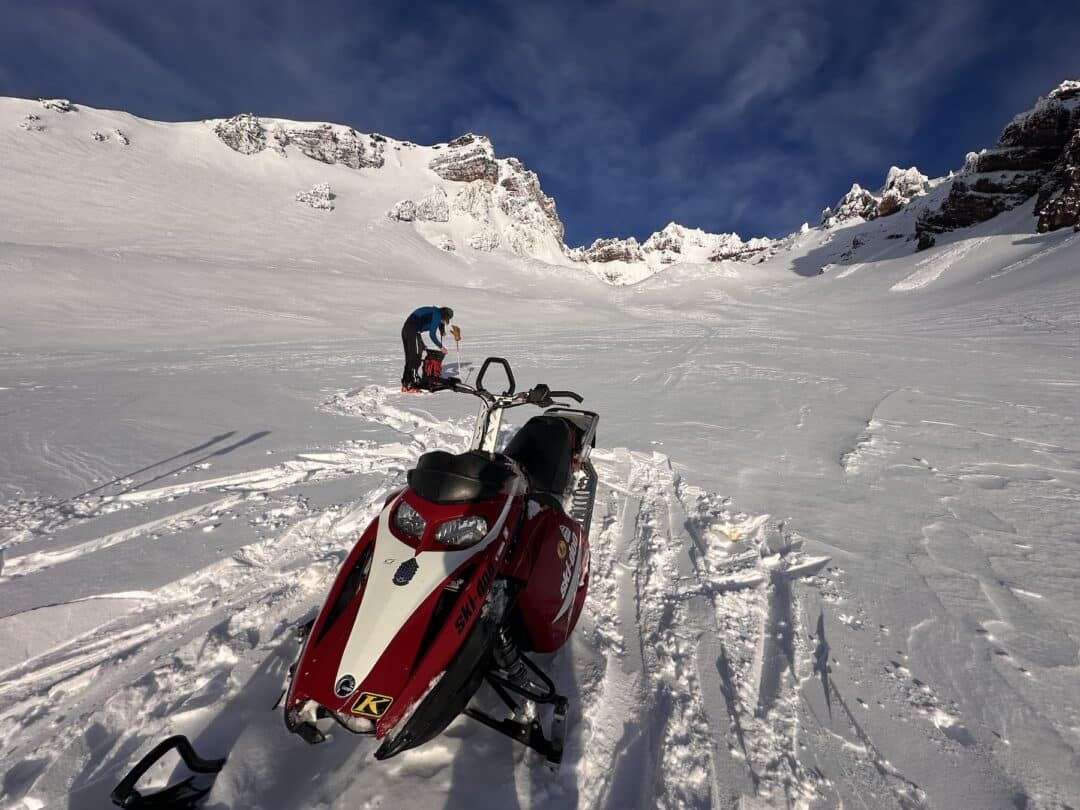
But the point here is that someone felt it all OK to bump into a no-go zone for motors, get gnarly as if documenting some Monster-Energy-fueled spasm, seize their engine, and leave the heap of early-2000 Ski-Doo for the next fools to wander in there. Who just so happened to be Barry and me.
A week later, on a return trip to Broken Top, I was high on its east ridge. The broken-down sled was still there. About the time when I clicked into my skis—click!—another sledder zipped in, lassoed a tow rope to the dead machine, and towed it out toward Mt. Bachelor. Problem solved. But not really.
This summer, the outdoor recreation community rallied. They were among a massive chorus of voices calling for a change to proposed legislation that, in short, would have put some of our public lands up for auction and further reduced protections. That was a good thing. Still, there’s an even more positive local upshot to all this. My conversations about change, protections, and access are often with people who I suspect do not share common values. I am/was wrong. I’ve had excellent conversations in the backcountry with sledders. We may disagree on some points, but that’s part of the human experience.
I suppose the way to move forward is to discuss this with those who may disagree. We can also coalesce as a group to use our collective voices—moving the needle in a desired direction. This may have different looks for different folks. Find what works for you. There are good organizations out there.
One organization doing solid work is the Outdoor Alliance. The Outdoor Alliance aligns with several groups you may be familiar with, including the American Alpine Club, the Winter Wildlands Alliance, and the Access Fund.
Clearly, this list is not exhaustive, and, as some might read it, aligns with one subset of a political/social mindset. If you feel that we have missed something, we are open to other opinions and encourage you to comment or share a link to a resource/group that you believe is doing the good and hard work of ensuring backcountry skiing/riding maintains a strong voice.
What is clear is that public lands remain a contested topic. The latest rallying cry, and resulting scramble for public comment, involves the 2001 Roadless Rules. Let’s go to the USDA’s Forest Service for a roadless rule definition. (See below for an excellent interactive map from the Outdoor Alliance.)
“The 2001 Roadless Rule established prohibitions on road construction, road reconstruction, and timber harvesting in nearly 60 million acres inventoried roadless areas, with limited exceptions. Today, the 2001 Roadless Rule applies to nearly 45 million acres of National Forest System lands, including in Alaska.”
(This roadless rule does not apply to certain lands in Idaho and Colorado, where state-adopted roadless rules “supersede” the 2002 legislation.)
In an August 27th press release the USDA outlines the argument for rescinding the Roadless Rule. In short, U.S. Secretary of Agriculture Brooke L. Rollins claims, “This administration is dedicated to removing burdensome, outdated, one-size-fits-all regulations that not only put people and livelihoods at risk but also stifle economic growth in rural America. It is vital that we properly manage our federal lands to create healthy, resilient, and productive forests for generations to come. We look forward to hearing directly from the people and communities we serve as we work together to implement productive and commonsense policy for forest land management.”
One item to highlight here is economic growth in rural America. At this point, although the cultural values of the outdoor recreation community don’t always land softly in rural zones (think the “treehugger” moniker), undoubtedly the dollars spent in rural areas, as part of the outdoor economy, have a real and lasting impact.
Damn, that’s a lot of words to get here. But you have until September 19th to make a public comment on the Roadless Rule.
I would impress this upon my own child, who has made skiing and climbing and guiding on public lands part of who he is: Try to be a part of a solution. And as part of that solution, try to understand those who have different opinions. Go have a conversation. Odds are, if you are bumping into one another at a sno-park, one revving an engine, the other slapping on skins, you probably have something in common.
Leave a Reply
You must be logged in to post a comment.