
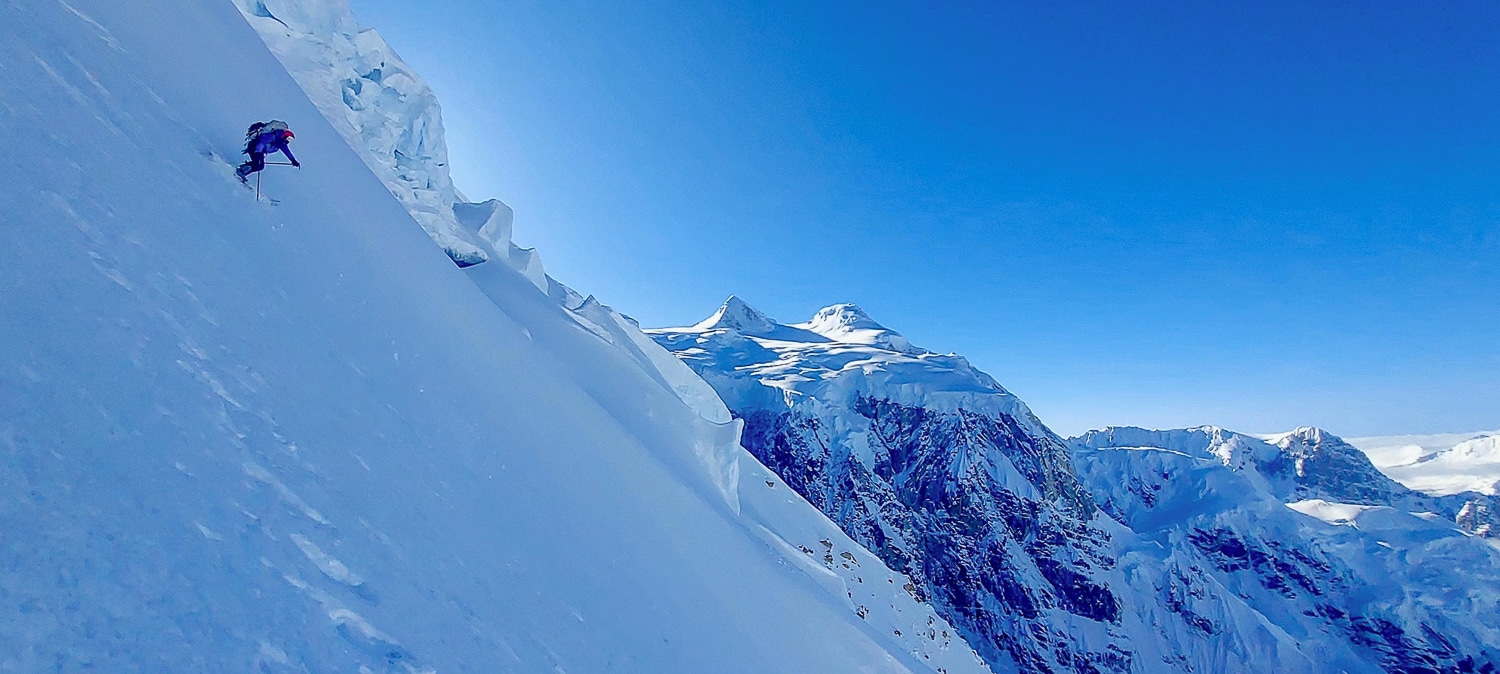
I’ve heard the “Must be present to win” idea from a handful of big mountain skiers I look up to. Not big mountain like fast, but big mountain like big mountains. If you don’t step up to the plate, you can’t swing at the ball.
Last fall, at a slideshow, Adam Fabrikant described the snow surface he found in the Karakorum to be generally “big mountain variable.” In my mind, kind of the best you can hope for at 8,000 m. I think I was right on the hoping for part. His definitely not professional video did not make the snow look charming. Adam’s wheezing and muttering were strange, too. Otherworldly. Not quite as weird as the snow, though. Every problem under the sun and a few under the wind. And he was psyched about the terrain and the snow. Best it gets there.
My limited experience in the big mountains has yielded much the same. We’ve found horrible breakable crust, refrozen wet slide bed surface, and brand-new wind slabs in one day in Alaska. The bed surface stuff was cool. It kind of looked like a water park for weasels, all swoopy. But the skiing was bad, so bad, at least by my taste. But I managed. I was present and I won, whatever that means in the context of a pointless, selfish pursuit. I got on the plane home, too. Double win.
I work part-time at a ski school in the winter, when I’m not touring. I love it. It’s super fun to get better at skiing, and now I mostly get paid to look good skiing bumps and new snow with people I like. And they always ask me to go first. Amazing.
Some of the patrollers, particularly the older ones, call the ski schoolers poodles because we don’t like to get our feet wet, and I think that’s often accurate. We turn our noses up at particular snow and terrain because it’s not in enough, not soft enough, not quiet enough, whatever. And sure, if your job is to put people in the best snow on the hill every day, you get used to eating escargot and skipping the line.
But this good-snow-only attitude will not get you to Gasherbrum I with Adam. It might not even get you to the proud lines in your neighborhood. You might have to get your feet wet. And for my first few years trying to ski terrain as opposed to conditions, my poodle-ness stymied me.
When I first heard this “must be present to win” advice years ago, implementation puzzled me. No one calls themselves ‘risky,’ but I like to think of myself as a cautious avalanche decision-maker with no interest in changing that perspective. I wasn’t really avalanche savvy enough to push the stability envelope without relying on blind luck. I was barely savvy enough to know when I was pushing my luck, so I didn’t. Stable days only then. But on a fair number of those days, the surface may not be ski-movie stuff.
People seem to lose interest in touring during a drought. A week of low danger forecasts scares people off. Funny that the people most often to be, shall we say, somewhat judgmental of my desire to ski bigger terrain, only go touring when there’s widespread instability in the forecast. But that’s exactly when you can be present to win. You don’t have to be stability-daring to ski big stuff or get lots of practice skiing big stuff. I’ve decided for myself that any day it’s not dangerous to ski my terrain of choice is a good day for it.
If you want to ski your own Gasherbrum, you’re going to need to ski some crap and like it. One how and three whys for your consideration.
1) Expectation management is easier than finding better snow
If the skiing was better than expected, you did a good job on either the skiing or the expecting. One is easier than the other. And it takes a lifetime of sniffing to get a reliable scent for good snow. I continue to be surprised by the crap under my skis, even in front of my clients. But crap is easy to eat if you weren’t expecting steak. The other way around, obviously, not so much.
On a backpacking trip years ago, one of my friends paid another friend $20 to eat a handful of dried deer scat. An insultingly low price for the deprivations to come in my mind. Robert said it was more of a mouthful of burnt popcorn experience than a mouthful of actual shit you idiot sort of experience, though he expected the latter. We were young kids, so $20 told him to cram real shit in his mouth, but the burnt popcorn was a pleasant surprise by his account. The shit-eating somehow did not exact a toll for Robert’s stupidity on the way out either.
My mom really likes Brené Brown and the larger galaxy of self-help pop psychologists who offer, in large part, exercises in reframing negatives as positives. Trauma is a learning opportunity and such. They’re also into the sort of pithy aphorisms perfect for needlepoint on the bathroom wall. Attitude of gratitude.
Bring some Brené Brown into your skiing. An attitude of gratitude for the dog shit you’re about to eat. It might taste like burnt popcorn. Maybe you’ll learn to love the taste and irritate the crap out of your girlfriend every time you come home and glibly answer the question ‘how was the skiing?’
2) You won’t get many days in the big terrain
Frankly, there are only a few days a year when you can ski the big stuff like the pros, arcing huge turns in stable boot top pow under a cloudless sky, even in the notably stable ranges. I’ll admit that I’m not that good at post-storm timing for those perfect shots. Not bold enough, and certainly not motivated enough to score the all-time conditions on big lines. But it is rare that the storms went gently into that good night, carefully dropping each flake undisturbed without wind effect or density change on a perfect, spongy bed surface. Rarer still that we know that fact before the sun, wind, and settlement have turned the surface into the sort of crap you were hoping to avoid.
One has only to do the simple math to see that this is a bad strategy for getting a lot of days in on big terrain. Of the 150 or so skiable days each season in my home range, the Wasatch, the big north-facing terrain is stable maybe 40 or 50 days, mostly in the spring. Within those days, that terrain is covered in deep, fresh snow for maybe 10 days. And you presumably have a job or a family or something. So not many days a year.
If you’re willing to roll the dice and ‘spend’ some risk looking for those wind slabs and density changes, you may improve those numbers, but that’s not a great plan for retiring from skiing someday.
3) Your upcoming 50 Crowded Classic is almost certainly gonna be rough skiing
Perhaps you have a big dream line ahead. Mt. Rainier, the Grand Teton, or even something more off the beaten path. Doesn’t matter. The skiing is probably going to suck. Maybe you’ll luck out and ski Rainier in amazing corn top to bottom. I’m kidding. You won’t. Parts will hopefully be the best ever. Parts will definitely involve some burnt popcorn. That is, as Adam and Billy made clear to me, a truism at every level of big mountain skiing.
If you never ski crap, your big dream lines, the endeavors you’ve been preparing for for weeks or months, may not be that fun. I used to guide Shasta. Folks would come to ski it and always remark how it was a lot of inconvenience for 2000’ of good corn sandwiched between another 5000’ of different flavors of suck. The experience was squandered on them. Too bad for them; Shasta is amazing.
I also saw folks struggle with the crap to such a degree that they became a liability to themselves and others. Crap can be dangerous, whether it’s slip and fall on firm snow or knee-twisting sastrugi. If your first brush with it is on the biggest day of your ski life, you messed up your training.
If you’ve not skied crap all winter because you haven’t been getting into bigger terrain unless it’s fluffy, you’ve double-denied yourself on the preparation front. It may seem obvious here, but mid-angle blower is not going to prepare you for the Maroon Bells. You need to spend time in serious terrain, even if it’s smaller serious terrain, if you want that spring adventure to feel the right level of challenging.
4) Terrain-based skiing may be more durably fulfilling than chasing conditions
There’s no denying that, on a down day, skiing feels pretty dumb. Looking back at all the wasted days in traffic and on the skintrack as your career, cartilage and relationships atrophy, it is easy to see a heap of gluttonous, wasted efforts rather than a meaningful hobby to be proud of. But I think the way you spent your ski time changes how you see it on those dark days when someone scolds you for being a Peter Pan.
I see a difference between powder chasing and terrain chasing. One feels like sex – an immediate but ultimately forgettable pleasure among the blur of other days like it – and the other like a relationship – inimitable experiences of unmatched intensity forever etched into our skiing brains. Terrain keeps me coming back to skiing every day, week, month, and year, while my powder-skiing friends grow bored as their days blur together.
And ultimately, once you score one or a dozen of those ‘best days ever,’ the rest does start to feel like oatmeal. I’ve skied enough of those days that the merely pleasant snow days have lost their sparkle. Maybe it’s a simpler pleasure, an effortless arc in soft snow, the ephemerality of the moment part of the unique joy, but those experiences are harder to distinguish from one another. How many unforgettable powder days have you forgotten?
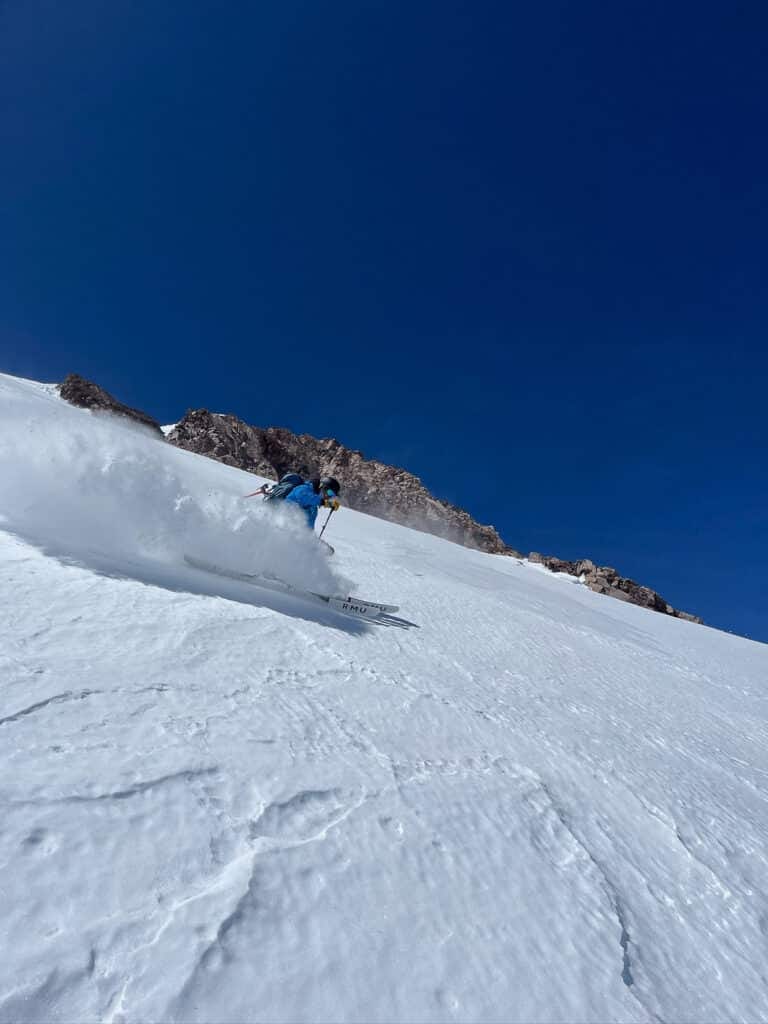
The terrain treadmill feels endless. Bored with what the Wasatch can offer? Quest after the geologically unique basin and range country of Nevada, the proud, classically beautiful skiing of the Tetons, or the red rock skiing of southern Utah. There is always another feature, another vista, or another challenge the mountains can offer you, another adventure.
The snow in Macedonia this past spring sucked. Breakable crust on bushes. Among the worst I’ve skied. And the locals were laughing at us. “Why did you come all this way to ski this?” A good point, but plane tickets are hard to change. And the terrain, let me tell you. Domed peaks rolling over into funnels and geometric couloirs framed by huge sails of weathered shale. And there was our guide, Mihai, with liquor and a hand-rolled cigarette for lunch. But the skiing sucked. I’m going back.
Progression along these tracks is different, too. A powder chaser becomes more savvy at pushing avalanche conditions, finding either the deepest stable snow on a given day or the biggest terrain in great conditions. Both involve a sort of daily tussle with the unpredictable nature of new snow. And they require urgency, an ingredient often fatal to sensible decisions. Now or never. It snowed 4’ last night, dude. It’s. Gonna. Be. All. Time.
A terrain chaser faces different risks, but they are neither every day nor are they framed quite so starkly against the inexorable march of time. Patience, rather than urgency, is a key trait for the terrain-based skier. Terrain chasing can lead one to dangerous places, sometimes objectively more hazardous than anything a powder skier will seek, but it is a rare bird that finds themselves in the truly dangerous places. Big doesn’t always mean bigger. It can just mean different.
Leave a Reply
You must be logged in to post a comment.