
It’s now been about three weeks since I watched Everest: The Other Side. I walked into the theater with some opinions. Roughly two hours later, I left with new ones. But instead of writing a knee-jerk review, I let it sit. By now, whether through marketing, hype, or a viewing, you likely know a bit about the documentary. If you check none of these boxes, note: there are spoilers incoming.
I had a difficult time thinking about or discussing the film as a whole. At times, the film connected for me; other times, I was left flummoxed, trying to discern the directors’ intent.
So I schooled myself, in a cursory fashion, on the art of documentary. I kept coming across this term coined in the 1930s by Scottish filmmaker John Grierson: “Creative treatment of actuality.” On one hand, filmmakers present actual footage, presumably unstaged. On the other hand, filmmakers make intentional choices; they shape the material and, ultimately, the film. What I wrestled with was my own interpretation of what I saw and heard. Rather than a single cohesive opinion about the film, and for lack of a better format, I broke the film into discrete lanes.
If you want the one-sentence review and to get on with things, here it is: See Everest: The Other Side; it has gobsmacking visuals of Everest’s north side, some audacious shots of Morrison scratching down the Super Direct, and a hard-to-imagine narrative arc, mostly, for me, about grief.
The film follows Hilaree Nelson and Jim Morrison as they plan to climb and ski the Super Direct on Everest’s north side. But like any Little Monsters Film—under the guidance of principals Chai Vasarhelyi and Jimmy Chin—there’s more to it than the action. We get select scenes of Nelson as an adventurer, partner, and parent. It’s the same for Morrison. Chin breaks the fourth wall and becomes a central character. The bottom line, and pivoting back to the idea of taking what I am seeing on screen as literal and then processing it, is that this film is not a Nelson hagiography. Like anyone, she comes off as complex.
So let’s start with that lane: Nelson. Undoubtedly a unicorn ski-mountaineer, Nelson was motivated. Technically sound. A calculated risk taker. Inspiration to scores of crushers. We see all these in the film. We also see someone trying to juggle two kids, a failing marriage, then a partnership with Morrison, sponsor obligations, and, yes, skiing. We are introduced to Nelson as she and the kids rush to eat breakfast and make it to the school bus on time. Not an uncommon experience for anyone who has raised kids. But I felt the froth. An underlying tension permeated the scene: must get kids out the door. And then it was off to skiing. I was rattled by how hurried it all was. Again, the directors chose to lead with that scene, and I had my impression of it.
Many scenes later, we see Nelson and her youngest child have a verbal exchange high on Mount Rainier. While the child summited, it was clear he’d rather be anywhere else. Nelson’s frustration was palpable. Again, I was rattled. Maybe it was because the hurried breakfast and Rainier scenes may have mirrored my own parenting—I was the primary caregiver. So bummed at what I saw, the first thing I did the next morning was call my oldest child and ask if I had ever pushed him too hard in the mountains.
His response was a hard no. I should take him at his word. Parenting is a tough proposition, though, so throwing my insecurities aside, maybe he was appeasing me, letting me know, in a loving way, I had not let him down.
Right away in Everest, I wrestled with who I thought Nelson was and how the scenes Vasarhelyi and Chin chose to include portrayed her. I had spoken to Nelson once or twice for an article, and she was nothing but stellar to speak with: generous with her time and open with her thoughts. As noted, a complex person.
The Morrison Lane
The film’s action zeros in on Morrison’s effort to climb and ski the Super Direct, which consists of the Horbein Couloir stacked on the Japanese Couloir for a 9,000-foot punch of technical mountaineering and skiing.
Morrison’s calling to ski the line and his grief drove the film forward. I had followed Morrison’s comings and goings over the years. So I knew much of the movie’s plot; both the highs and the lows. He and Nelson’s 2018 ski descent of the Lhotse Couloir was a high point.
The first gut punch comes when Nelson dies in a fall near the top of Manaslu in 2022. She and Morrison had summited moments before. Shortly after the fall, Morrison enters what seems to be a hotel room and falls onto Chin’s shoulder, sobbing—pure grief.
Long before committing to a life with Nelson, Morrison was a married father of two young children. In events the film details after Nelson’s fall, Morrison’s wife—a pilot—and two children were killed in a plane crash. With a deft touch, the film exposes viewers to Morrison’s barely-get-out-of-bed grief.
Morrison moving forward with his life is a testament to his hardened, beautiful resilience and grace.
The Style Lane
Maybe you eyerolled at the mention of style. And here, we are not talking about the sartorial overabundance of yellow-down-suit style. As a The North Face-supported film, you’ll get more than your share of TNF YELLOW. We are talking about how folks climb mountains.
A few things to get across. This is the north face of Everest. It’s hard to access and has no routine beta, unlike the south side. A Japanese team of 12 first climbed the Super Direct in 1980, using supplemental oxygen and fixed ropes. In 1986, Swiss alpinists Erhard Loretan and Jean Troillet climbed the route from basecamp to basecamp in a 42-hour push with no fixed ropes, no supplemental oxygen, and razor-thin margins. Proof of concept. Minimalism and modern tactics go.
If you were thinking, yeah, but this was a ski descent! I hear you. But this is also a movie review, after all. So bear with me.
Massive resources were thrown at the mountain. Notably, Sherpas, who, for all intents and purposes, along with crusher guides on the second and successful attempt, Esteban “Topo” Mena, Carla Pérez, and Roberto “Tico” Morales, put up the fixed lines, carried the bottled oxygen, fixed rappels, and made this climb, and by default, film, work. I suppose this might be a “me” thing. And most general-audience viewers don’t care. It’s just not often I see or read about modern climbs or descents that get this much attention and rely on such heavy tactics. Vision questers out there, there’s room for improvement.
Yes, again, I’m hearing, dude, it’s the Horbein, on skis. All true. The line, in total, is incredible. No argument there. Morrison’s style worked. He gets to claim “first.”
The Visual Lane
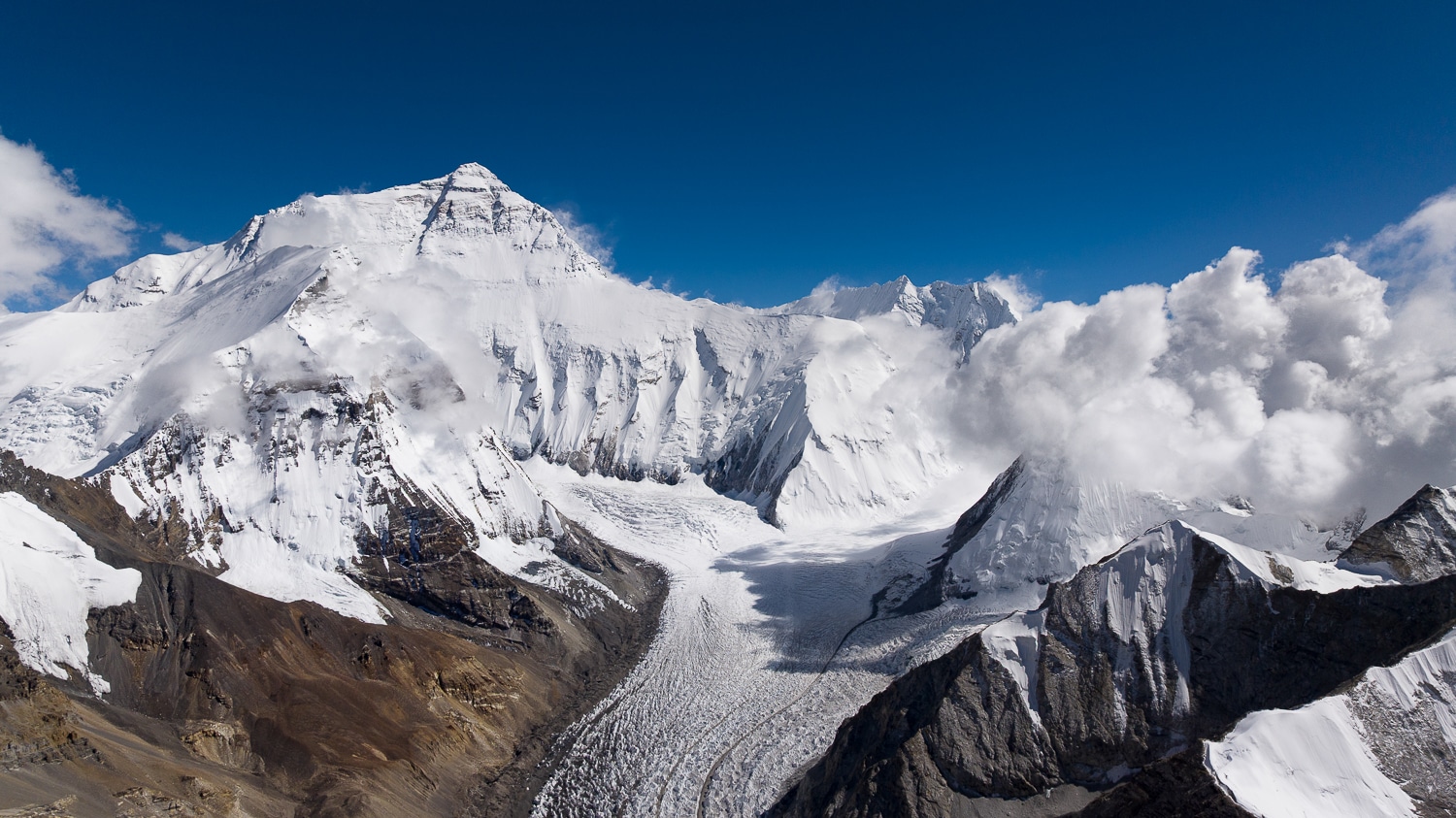
In a word, stunning. For someone like myself who re-reads Tom Hornbein’s classic The West Ridge, seeing Everest’s north face up close, and in IMAX (cost me $30) was pretty mind-blowing.
The Skiing Lane
Piggybacking on the visuals, there are some downright spicy turns. And great footage. Was it as nerve-racking as Free Solo, even though we know Honnold holds on? Not for me. And during the skiing sequence, we get similar blow-by-blows from the seemingly excellent person and cameraman Mikey Schaefer. Those fear-laden blow-by-blows were earnest and timely in Free Solo; they seemed played in Everest.
For the gear nerds, during the skiing scenes (I do love how some refer to the ski descent as a “ski segment” a la TGR or something), I thought, I am glad tech bindings actually work. The proof is here, in this film, on the Super Direct; those little pins and springs work.
The Addiction Lane
Walking out of the theater, I responded to my friend when asked about Everest, “I felt like I just watched a bunch of addicts.” A visceral response to a visceral film. It’s something I’m still thinking about. I’m not sure I have it right. But after someone lives long enough, either themselves or a loved one or a friend becomes addicted to something that alters them and, in some cases, becomes destructive. Addiction is not far from many lives.
I don’t want to throw stones—I’ll count myself among those addicted to certain activities—and close to the harshest kind of addiction. And here at The High Route, it can feel like we, too, are pedaling the drug to the addicts among us.
Undoubtedly, a throughline in Everest is the lives impacted by either death in the mountains or the intense anxiety loved ones feel when a family member is on expedition.
As far as mountain endeavors, I suppose we all do things for our own reasons. Risk is a personal choice, and so is how risk-takers’ families respond to it. Everest illustrates that kids complicate the matter: a parent has to live a fulfilling life, but it raises the question of how much agency children have (or should/shouldn’t have) over their parent’s choices.
Addiction is when a person cannot stop destructive behavior. To stop, they need support. Unlike how we often treat heroin addicts, for example, the addiction we see in the mountains, which can be as destructive, is often celebrated.
The Closing Lane
I’ll close by bringing up the phrase “creative treatment of actuality” again. Much of the film is like a well-crafted documentary—actualities intentionally and creatively pieced together. Other times, it felt like a massive-budget big-studio motion picture. In those moments, including portions of the climbing and skiing, it all seemed too fantastic or dramatic, as if some scenes had been scripted in advance.
I’ll also weigh in on the inclusion of the Manaslu scene, when Nelson skis over a small pocket of wind slab that cracks and sends her to her death. I first read about this scene in a NYT review that, in short, focuses on the film’s solipsism. It’s titled “‘Everest: The Other Side’ Review: Chancing Death.” The reviewer called the Manaslu scene’s inclusion “exploitation.”
As much as this film is, in a sense, creative non-fiction, seeing the seemingly innocuous pocket crack (Morrison had just skied on or near the pocket) and Nelson slide out of the camera’s frame showed the rather fickle and wicked and finite endeavor all of this is. Perched above 8,000 meters on Manaslu, or at the local steep shot on a touchy day, none of this is a game. And Vasarhelyi and Chin don’t treat it as such.
Clearly, since I parsed out all these lanes for public consumption, Everest was not just entertainment. Maybe that’s the sign of a great documentary. It’s hard to give a film like this a blanket thumbs up or down. You’ll have to decide where it stands. I do think it’s possible to see the film, be engrossed, and leave both reflecting on the lives explored and being inspired. That just wasn’t me. Call me uninspired, but not unmoved.

Leave a Reply
You must be logged in to post a comment.