

If the Titan submersible disaster taught us anything, it’s that carbon isn’t the right material for every job. Also, narcissistic autocracy isn’t a great CEO model. Still, even the Titan’s pressure hull was capable of withstanding 3000 psi of pressure, roughly half of that at which it imploded. Incidentally, that’s also the filling pressure of an avalanche airbag canister.
But first, why even consider canisters? Most of modern airbag marketing is focused on electronic, fan-based systems. Most of these battery- or capacitor-based fans are capable of multiple deployments on a single charge, and they also get by without the annoyance of compressed gas, which can complicate air travel and necessitate refills after deployments. In the US, you can’t fly with a filled canister, which makes traveling with your airbag a pain. Thus the move towards the convenience offered by electricity.
Still, without fanfare, the last ten years of airbag use have been overwhelmingly powered by cylinders of compressed gas. Why? They are reliable, and they are simple. I became an advocate for gas-based systems after an experience with a first generation JetForce airbag that left me with a nonfunctioning airbag for an entire hut trip, and not for lack of battery power. I like to know with both high certainty and understanding that when I pull on the handle, the airbag will inflate. The cable -> puncture -> discharge chain is simpler and harder to break than anything that involves electronics. This is my bias. I prefer gas. But I also hate carrying around the scuba tanks.
With the exception of the Alpride system, which uses small, single-use canisters akin to bicycle CO2 canisters, all airbag systems in the US have until recently been stuck using large metal cylinders. They’re heavy, consume space in the body of the pack, and have always seemed to me like cumbersome, unrefined technology. As a weight-conscious skier, the weight of an airbag system influences my decision about when to use it. This means that a heavy canister reduces my ready adoption of a proven safety technology, and aside from cost, weight is the complaint that I hear leveled against airbags most often by the non-user. Lighter, smaller, sexier, that’s what we need.
Enter carbon. Available for years in Europe, and now from one manufacturer in the US, the carbon cartridge is smaller, lighter, and definitely sexier.
Why has this technology been so slow to come to the US? Isn’t it safer to have a pressure gauge on your tank? Let’s dive in.
Mammut Aluminum Cartridge
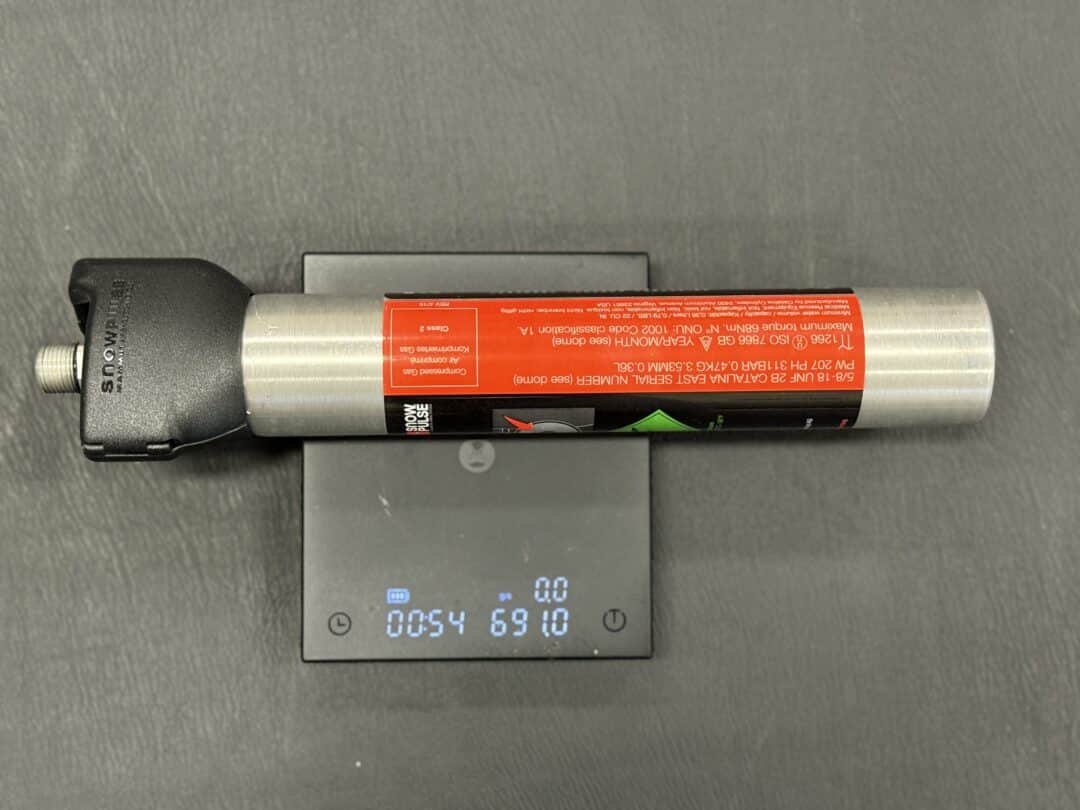
Weight full (stated/measured): 700g / 691.0g
Price ($): 229.95
Available in the US?: Yes
Refillable in the US? Yes
Refillable in the EU?: Yes
Fill: Compressed Air
US Air Travel: Only empty with cap off
EU Air Travel: Yes
Readily available in the US and Europe, this aluminum canister is the heaviest of the three in my quiver (1.5 lbs). It is refillable at various filling centers in the US and Europe, including dive shops. It’s voluminous, heavy, clunky. Its contents are verified using a minute pressure gauge to ensure it has retained appropriate pressure. It comes with 3 “refill kits” containing the small parts needed to refill it anywhere that compressed air is found. It meets standards to fly while filled in Europe, but not in the US.
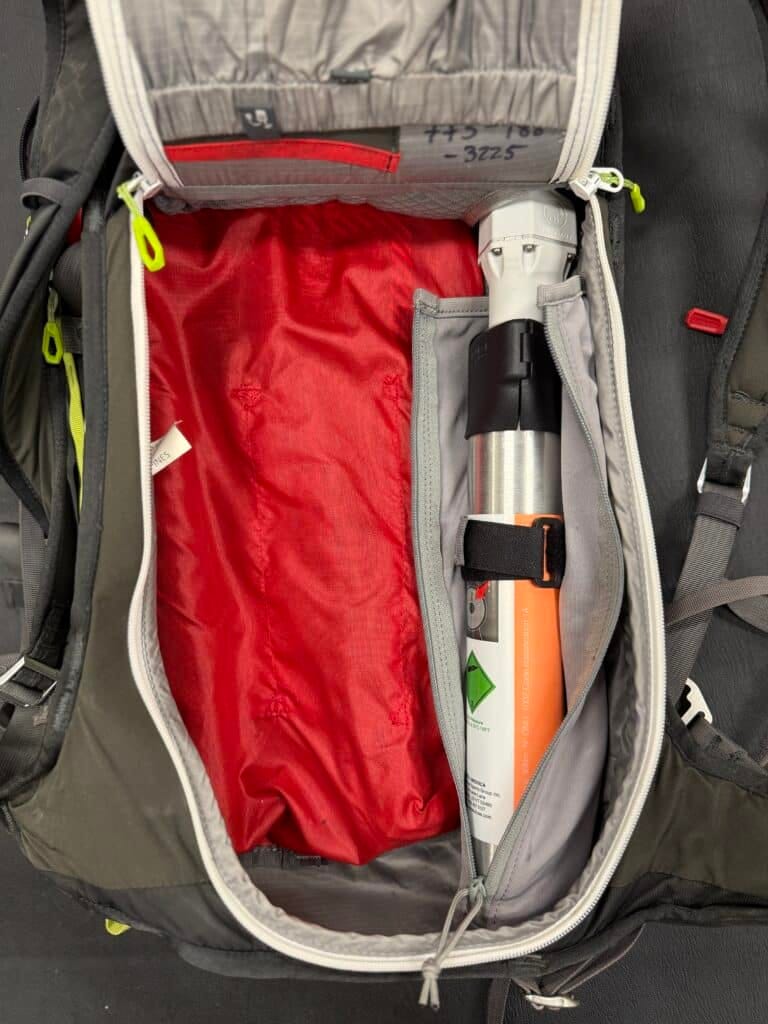
The compressed air canister is the standard in the US out of convenience. “The only reason that in North America we use compressed air is because people want to be able to refill”, says Doug Workman, Mammut North America‘s Snow and Avalanche Technical Representative. The ease of filling comes from added hardware that allows use of compressed air filling systems that are widespread in the US, used in industry, scuba, and paintball applications among others. But this convenience comes at a price: “Looking at a typical US refillable air canister with a gauge, from end to end there will be 5-7 potential failure point, with the gauge being one”, says Jeremy Jolley, US Market Manager at Arva Equipment, “[In the US] people are used to trading convenience for performance whether they realize it or not”. Arva does offer a refillable steel canister in the US, but it does not have a pressure gauge. The Backcountry Access Float cylinder, in contrast, seems to be half gauge and filling hardware.
But carbon is out there, and it has been the standard in Europe for more than a decade. Why not here?
Mammut Carbon Cartridge
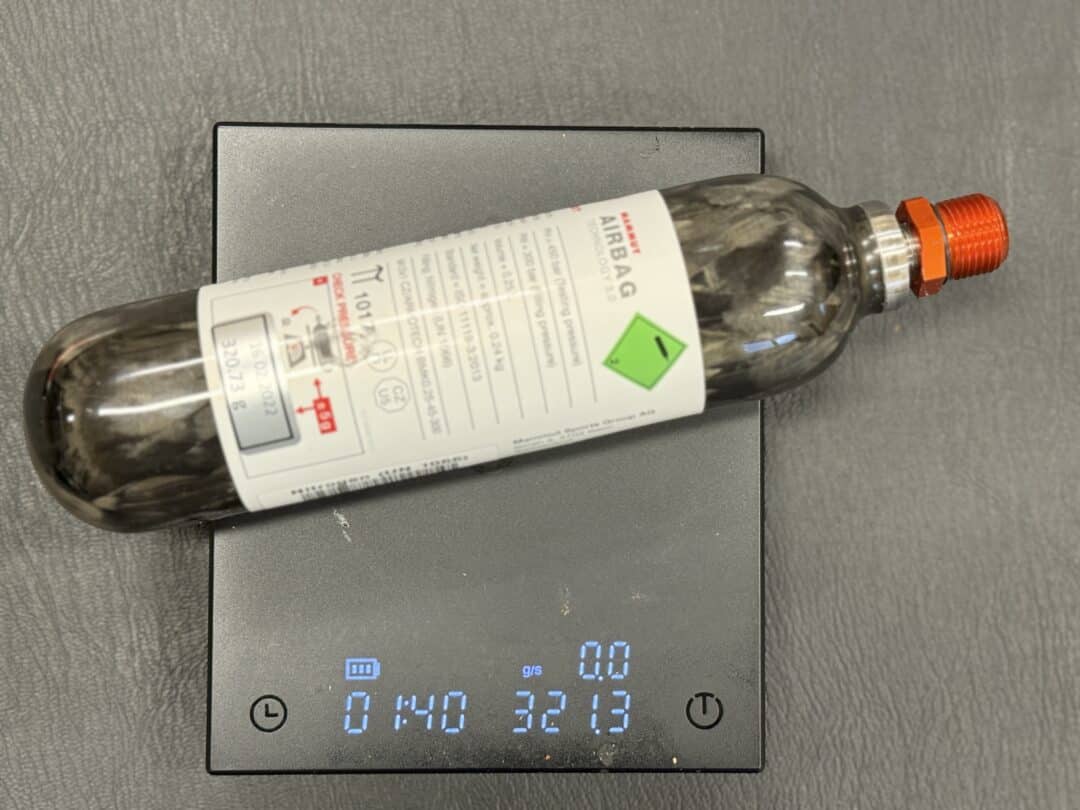
Weight full (stated/measured): 310g / 321.3g
Price ($): ~192 (165 Euro)
Available in the US?: No
Refillable in the US?: No
Refillable in the EU?: Yes (exchangeable)
Fill: Nitrogen
US Air Travel: No
EU Air Travel: Yes
Available throughout the EU, but not permissible for sale to the US. Online retailers have gotten wise and will no longer ship them to US addresses. The canister pictured here was purchased in France and checked in luggage flown into the US. They’re permissible to fly in the EU, not permitted in the US.
But the weight! The Mammut carbon cartridge is less than half that of the aluminum cartridge, and much smaller. To be refilled it has to exchanged by Mammut in Europe, after which returning it to the US is similarly difficult to buying a new one. Lacking a gauge, its contents are verified by weighing the cartridge to +/- 5g of the factory fill weight.
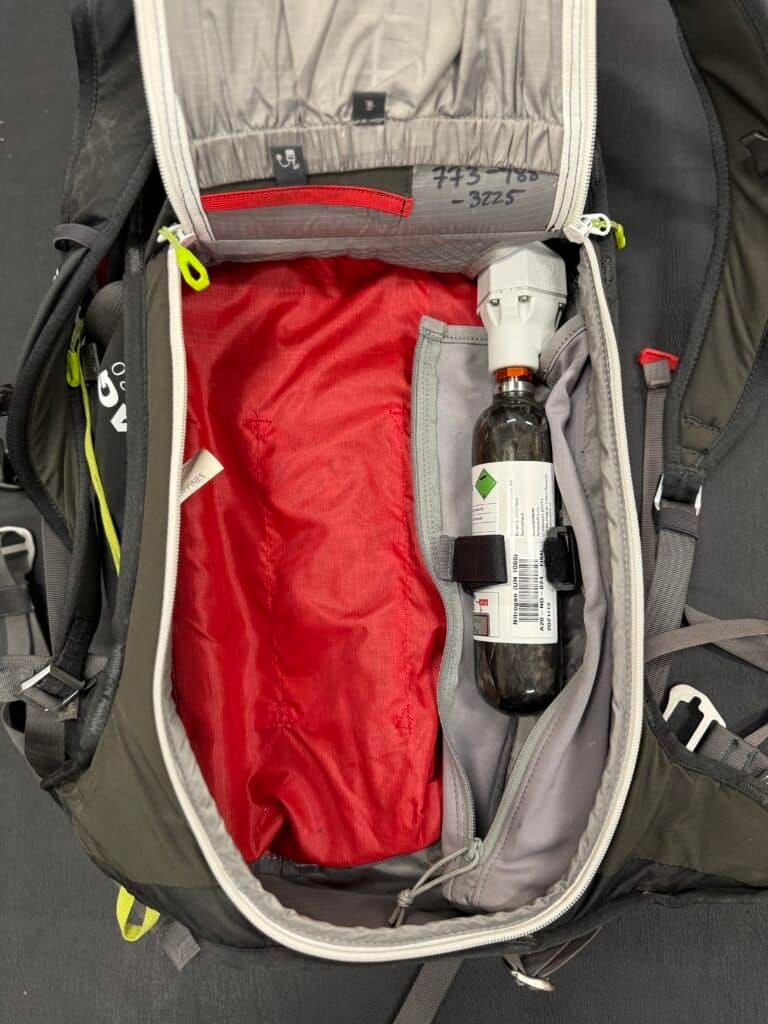
In comparison to the aluminum canister, the carbon canister restores an almost comical amount of usable space within the pack.
Without a gauge and a filling nipple, the carbon canister is a simpler and shorter assembly at the neck. The filling process is more complicated and requires specialized equipment, and the Mammut canister needs to be refilled by the manufacturer after use.
The carbon cartridge is also filled with nitrogen. “Nitrogen is a more stable gas, so the pressure fluctuates less with temperature changes, so nitrogen really is better” says Workman. Jolley confirms: “You fill your car tires with it if you have the choice of one of the other; nitrogen’s less susceptible to temperature change, it’s a more stable molecule, and it’s more dense.”
So why doesn’t Mammut bring this beautiful product to the US? It all comes down to the department of transportation (DOT). In the rest of the world, cylinders are constructed to international standards ISO 11119-2 and ISO 11119-3—particularly ISO 11119-3 for fully wrapped composites. The US does not adhere to these standards and instead has DOT standards of its own for the transporting and refilling of gas cylinders. A manufacturer, like Mammut, that produces a carbon cylinder for sale in Europe, can’t sell that canister in the US unless they apply for a DOT permit. While the two standards aren’t significantly different in their requirements, they’re different enough that it would require an entirely different product from Mammut, making it too expensive to do so. An industry employee speaking on background said that attempts to collaborate to bring a carbon cartridge from the European market to the US were torpedoed due to costs in the 6-digits.
Because they haven’t been available in the US, it has become a common, if stealthy practice to bring these canisters back from Europe in airline luggage. “I have a dozen of them already by every single time I go to Europe I bring one back. Every time I have a friend coming back, I say ‘here’s hundred dollars, get me one’, because I know everybody wants some” said Workman, “I’ve had plenty of them confiscated when departing the US, but never coming in. I used to fly everywhere domestically with them because I know for a fact there’s no hazard”.
But what about producing a new product only for the US? Wouldn’t that create a monopoly? Enter Arva Equipment, who have done just that. The Arva reactor refillable carbon cartridge is DOT compliant and available in the US:
Arva US Carbon Canister
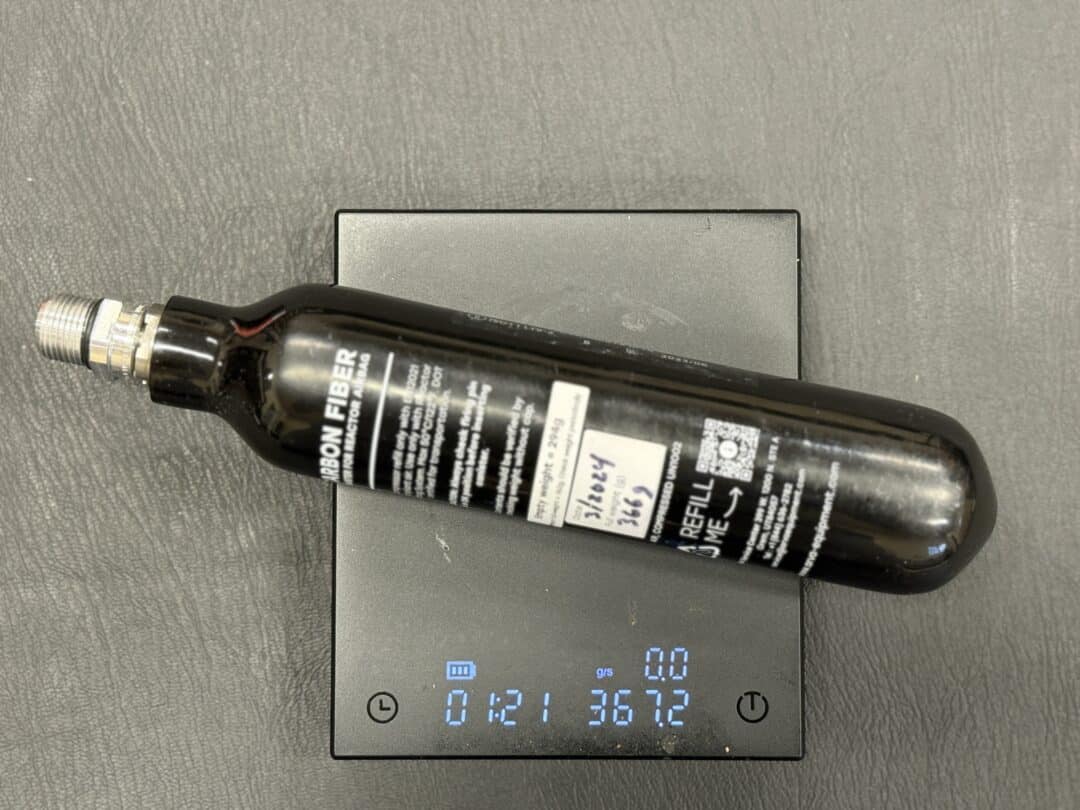
Weight full (stated/measured): 370g / 367.2g
Price ($): 299.95
Available in the US?: Yes
Refillable in the US?: Yes
Refillable in the EU?: No, but Arva does have a European equivalent.
Fill: Compressed Air
US Air Travel: Only empty with cap off
EU Air Travel: Yes
Arva’s DOT approved carbon canister is currently the only option for sale in North America that that is legal to ship and refill in the US. It is 60g heavier the European options, but still noticeably lighter than any other option available on this side of the pond. Though it can be shipped by mail, sadly it still can’t fly within the US.
This US-specific carbon cartridge is DOT compliant and can be refilled at around 30 Arva partners throughout the US, like Skimo Co in Salt Lake City, UT, and Powder House in Bend, OR. “We wanted to do this with the full support of specialty retailers, because they’re losing traffic to the online giants, so we can help to bring customers to those specialty stores”, says Jolley, “I always joke at my clinics that for years we’ve been sending our customers to the scuba shops, but if you think about it, they’re not sending us their customers.” A retail carbon cartridge comes with a coupon for a free refill.
Arva did elect to use compressed air for the US cartridge, though they acknowledge the superiority of nitrogen for the application. “We’ve designed the volume of the canister and the efficiency of the venturi around refillable air because in US, and Canada for that matter, as nitrogen is not as readily available”. The pressure in the canister is verified by weighing the canister, just like the Mammut system.
Paired with Arva’s Tour 28 UL Airbag backpack, the US carbon cartridge system 1650g. Compared to the Mammut Ultralight Removal Airbag that has been off-market for a couple of years, you get 8L more volume in the pack for 289g less. It’s a slick system.
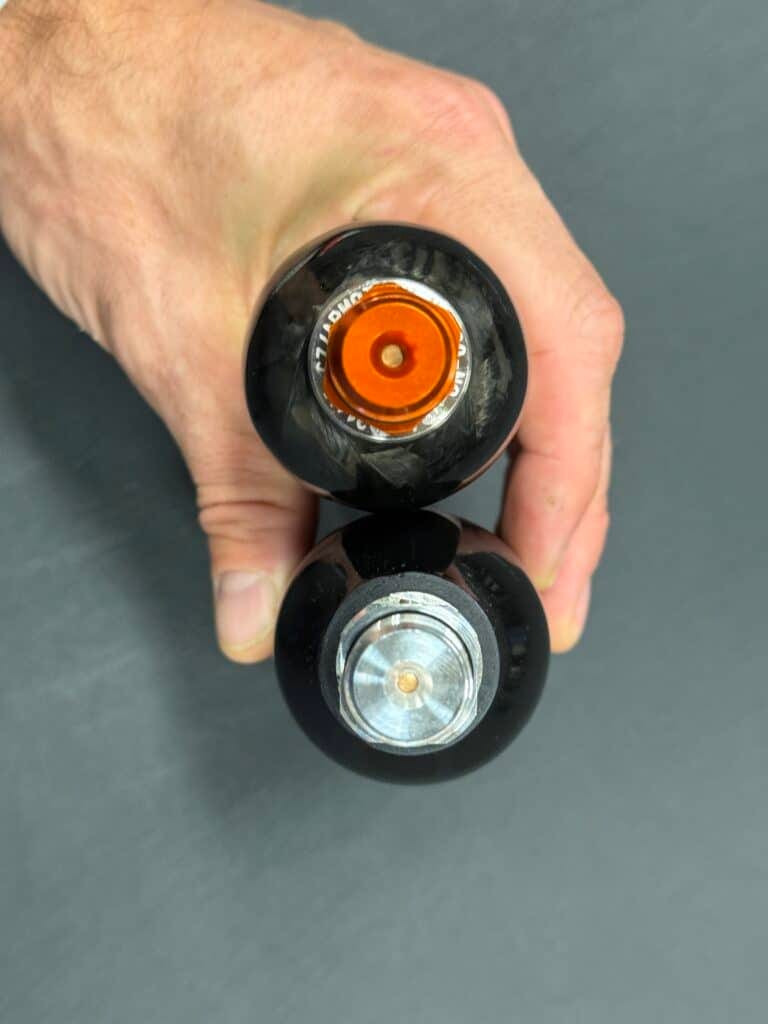
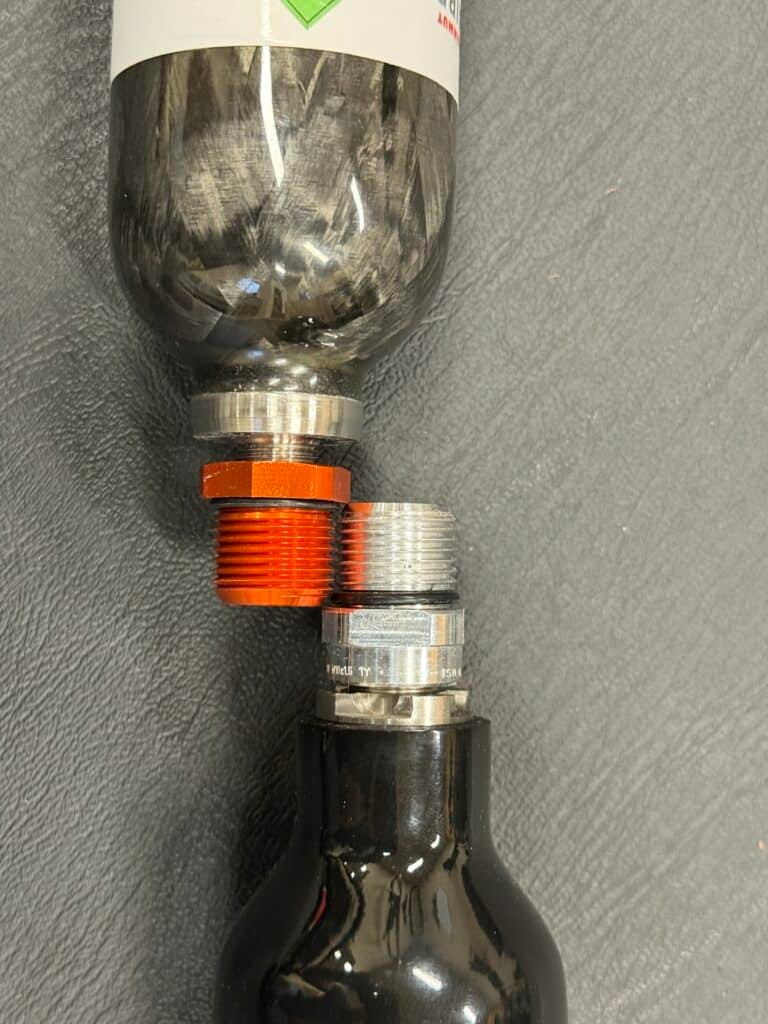
An astute observer will note that Arva and Mammut use the same head on the canister: same thread width, pitch, length. This is due to standards within the gas cylinder industry that preceded these products. Filled with different gasses, to different pressures, and with different burst discs, they shouldn’t be used interchangeably unless manufacturer testing proves otherwise.
The Future
The carbon canister uses simplified design to reduce points of failure and superior material to reduce weight and volume. It makes the metal canisters look like caveman tech.
I hope that more manufacturers will make the jump to meet DOT standards. Until the cost, weight, and size of electronic systems becomes more manageable, carbon canisters are a sweet upgrade to existing pack systems. I can keep using the Mammut bag that I very much like, but now have 0.8 lbs less on my back and more space in my pack, all at a reasonable price. I’ve also been using the Arva Tour 28UL, and we’ll have a review of the pack later this year.
For now, I prefer the reliability of gas canisters to electronic systems. The chain of events between the trigger and the canister is understandable, the system is easily inspected and tested, it’s light, and it brings good filling power to the airbag. Electronic systems may eventually match some of these features, but I will always struggle with the unknowable nature of the computer that is involved. I like to see the lines on my parachute.




Leave a Reply
You must be logged in to post a comment.