
In another time’s forgotten space, I was overly concerned with weight. The heaviness of it all slowed me down. There could have been many reasons for this dynamic: I may have been out of shape; The gear could have been legitimately (and burdensomely) heavy—it was. And so, at the cost of many things, like my savings account, I bought carbon things. There was a mountain bike. Fancy Swix Triac nordic poles (I’d buy those again) and a carbon-glass kayak paddle (an original AT paddle) that still sees some occasional action. But my mostly carbon skis never saw much action, aside from a few-year-old pair of Pagoda Tour RP 112s that honestly don’t feel carbon-y at all. Translate that as pingy, too stiff, with a very narrow range for awesome sensations. But, about the uphill, you might ask. It was sweet and lithe—or so I tell myself—with these carbon reinforced weave or stringered planks. And once upon a time in that forgotten space, I used a pair of Movement Alp Tracks 100 for a season or two. In my home portion of the Cascades, I found them not damp enough in variable snow (to be expected) and too chattery on firm spring snow. When I made that purchase, I should have opted for the 106mm underfoot Alp Tracks and reserved them for light powder days. Which, had I lived in the Wasatch, would have been more practical.
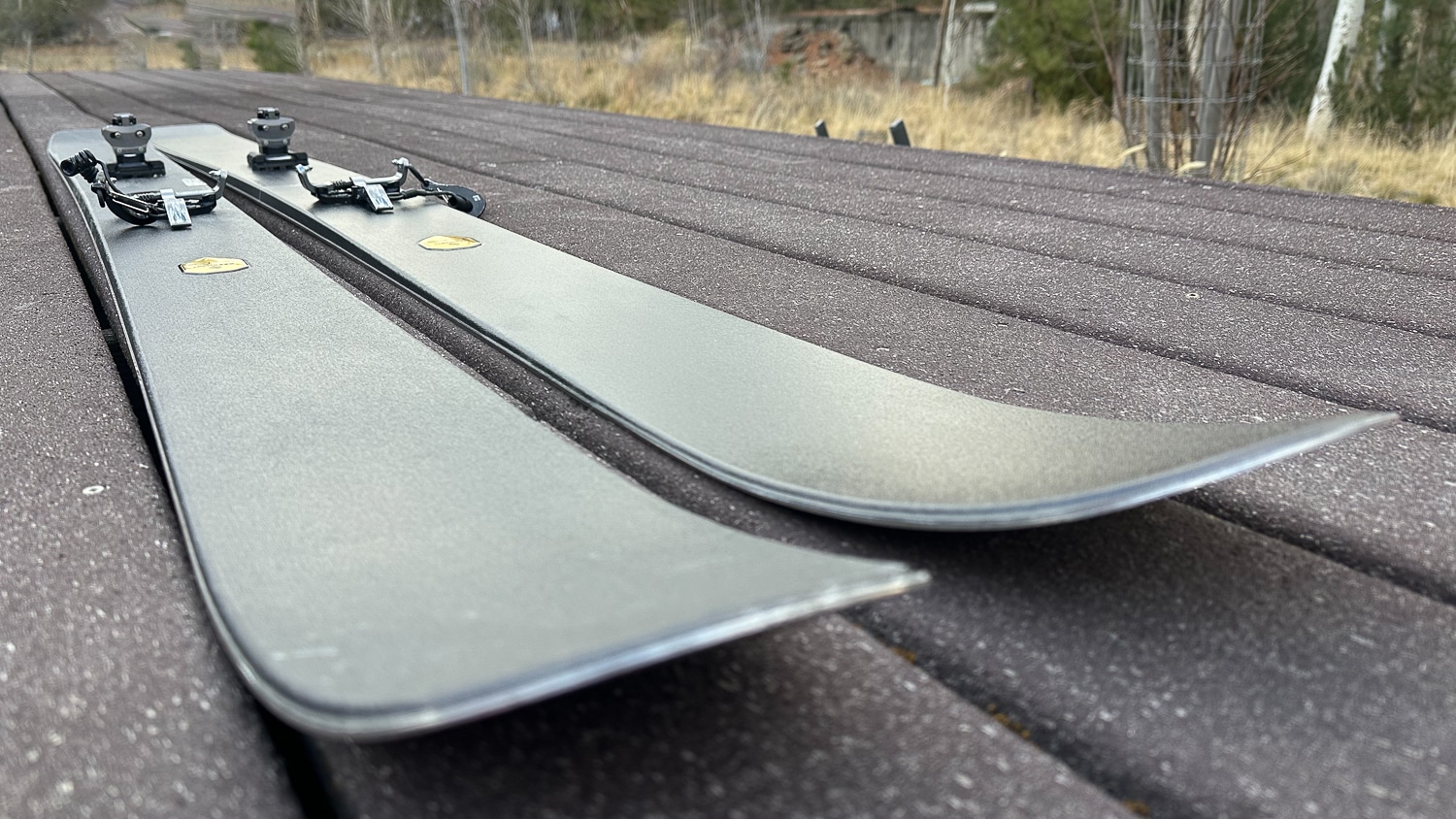
Last winter, I was passing through Wilson, Wyoming, and I took a gander into Gavin’s gear shed. There was a lonely pair of Moonlight Cruiser Carbon Superlight skis sitting in the corner. These two data points set the tone for what I saw and felt: 114mm underfoot and a claimed weight of 1160g/ski (177cm length). (The Cruiser Carbon Superlight comes in a second length, 186mm, with a proportionally wider width at 1120mm.) Although the skis weren’t levitating, the thought of seemingly levitating up the skintrack had me curious. I won’t go into all the details, but the skis needed a home. My intent was to review them last year.
Then last year, up in Big Cottonwood Canyon, I got ansty and unsmart, messed around, and made a costly mistake: I snapped one of the Cruiser Carbon Superlights nearly in half. I was doing nothing cool. Nothing even remotely close to powder skiing and nothing I am willing to repeat with such pricey planks—they currently retail for $1440, and that’s before paying duties, as the skis are made in Norway. I did not beg for forgiveness, but I did ask Moonlight if they had a single ski I could purchase. Initially, they did not. Then, a few weeks later, they pinged, and I scored a single replacement before the tariffs kicked in. So 1 ski + 1 ski = a pair. This allows me to review the skis this winter.
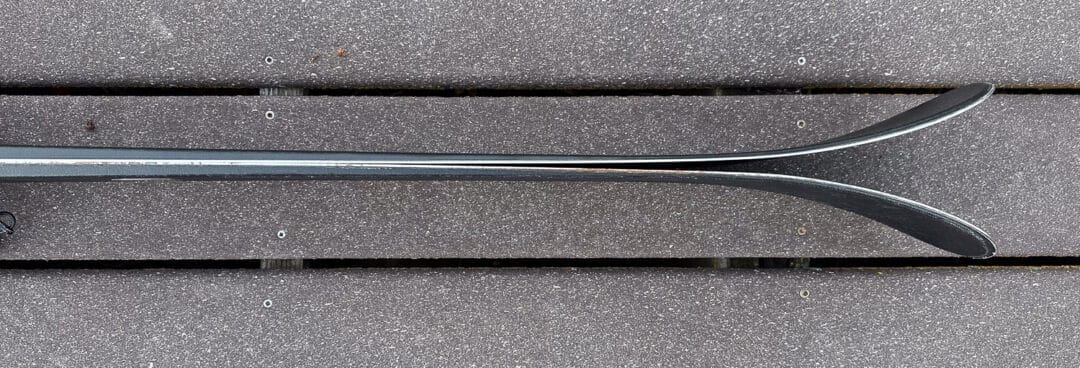
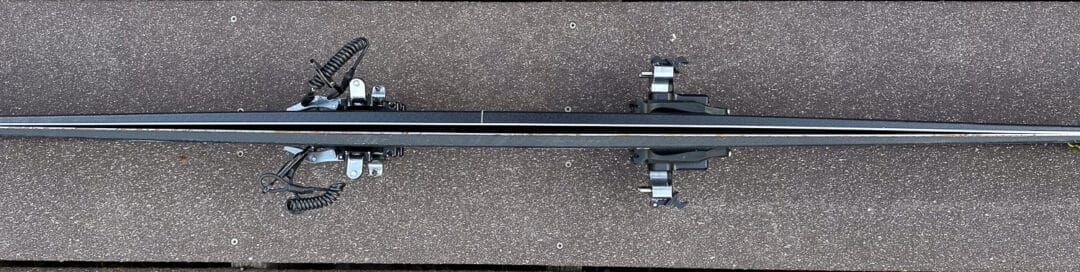
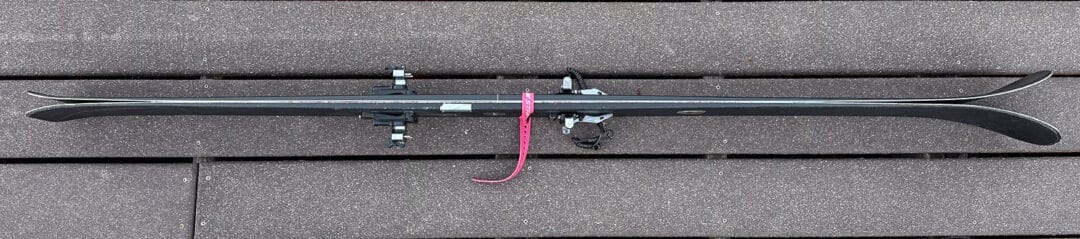
By snapping the ski nearly in half, I was able to do some forensics. The ski’s innards contains lots of foam, and thus, it is featherweight. Moonlight calls the construction a “FJÆRECORE+ construction, a hybrid foam and wood structure reinforced with four layers of carbon stringers.” They have a cap construction and, evidently, bamboo sidewalls. The hand flex is stiff in the tip and tail, and, FWIW, it takes a modest effort to close out the camber, but we’ll test the relative stiffness when the snow flies, which it did as soon as I bolted town for Bozeman. I’ll dive more into the construction and shape in the full review.
One key item to mention. Oftentimes, the gear we review has an intended purpose. For example, all aluminium crampons function well on snow and sometimes soft ice. They, however, are more insecure than steel front-pointed crampons on alpine/water ice. I bring this up because this is a niche ski. And I can tell you right now that its lightness will be a negative attribute in less-than-ideal powder snow. The intent here is to find a ski that is uber light, has plenty of surface area to keep me afloat, and works well with a lightish boot.
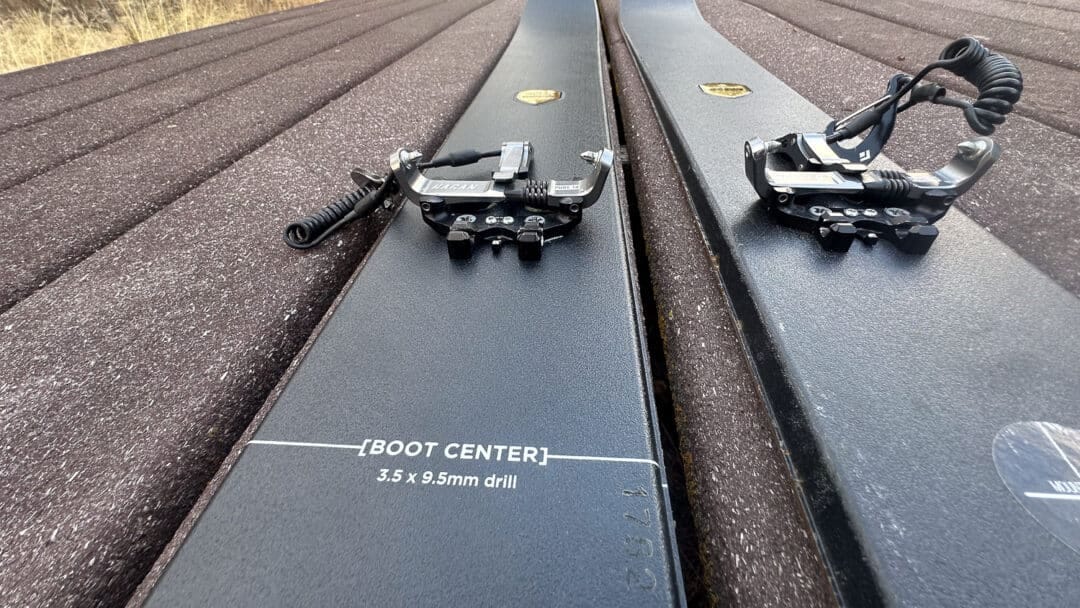
Last season, before I snapped the Moonlight ski, I paired the skis with the new Fischer Travers Carbon to good effect on a very fun 4-5” just-more-than-dust-on-crust outing. The boots I plan to use with the Moonlights are the La Sportiva Kilo at 1136g and Dynafit Blacklight 2 at 1293g—both boots are a 27.5 shell, whereas the Kilo has a 27.5 liner, the Blacklight 2 a 27. Although I usually pair bigger, heavier, wider skis with a Zero G Tour Pro boot—which is not much heavier than the Blacklight 2—the four-buckle + power strap awesomeness this boot provides seems a bit much for the feathery Moonlights. And the walkability of the Kilo and Blacklight 2 is impressive; I might as well optimize all that gram-counting nothingness the Cruiser Carbon Superlights offer on the skintrack with a high ROM low-friction boot.
Am I doing a 180 and moving away from the heavier mid-winter setups I’ve been on the last few seasons? Ahhhh no. But I am eager to put in more vert on more perfect powder days. The Carbon Superlights might help with that goal. For perspective, mid-winter I use an older Atomic Backland 107 (184 at ~1650g/ski), the DPS Pagoda Tour RP 112 (184 at ~1590g/ski), and the Blackcrows Nocta (177 at ~1950g/ski).
So, dear THR reader/subscriber, the Moonlights do seem sweet, but they also seem very much like a boutique item for the lightest-of-powder-snow days. I say this not to denigrate an otherwise cool-looking and (from my limited testing) fun ski, but because outfitting such a ski with skins and bindings can all of a sudden push the whole package into the near $2k range. That’s a lot of cheddar/gram.
Specs (Provided by Moonlight)
Available lengths (cm): 177 and 186
Weight: 1160g (177) and 1300g (186)
Dimensions (mm): 139-114-129 (177) and 145-120-135 (186)
Turn radius (m): 26 and 26
Camber (mm): 4 and 5
Shape: A very long turn radius, and long and subtle tip and tail rocker.
Tip Rocker Length (mm): 580 and 600
Tail Rocker Length (mm): 285 and 300
Leave a Reply
You must be logged in to post a comment.