
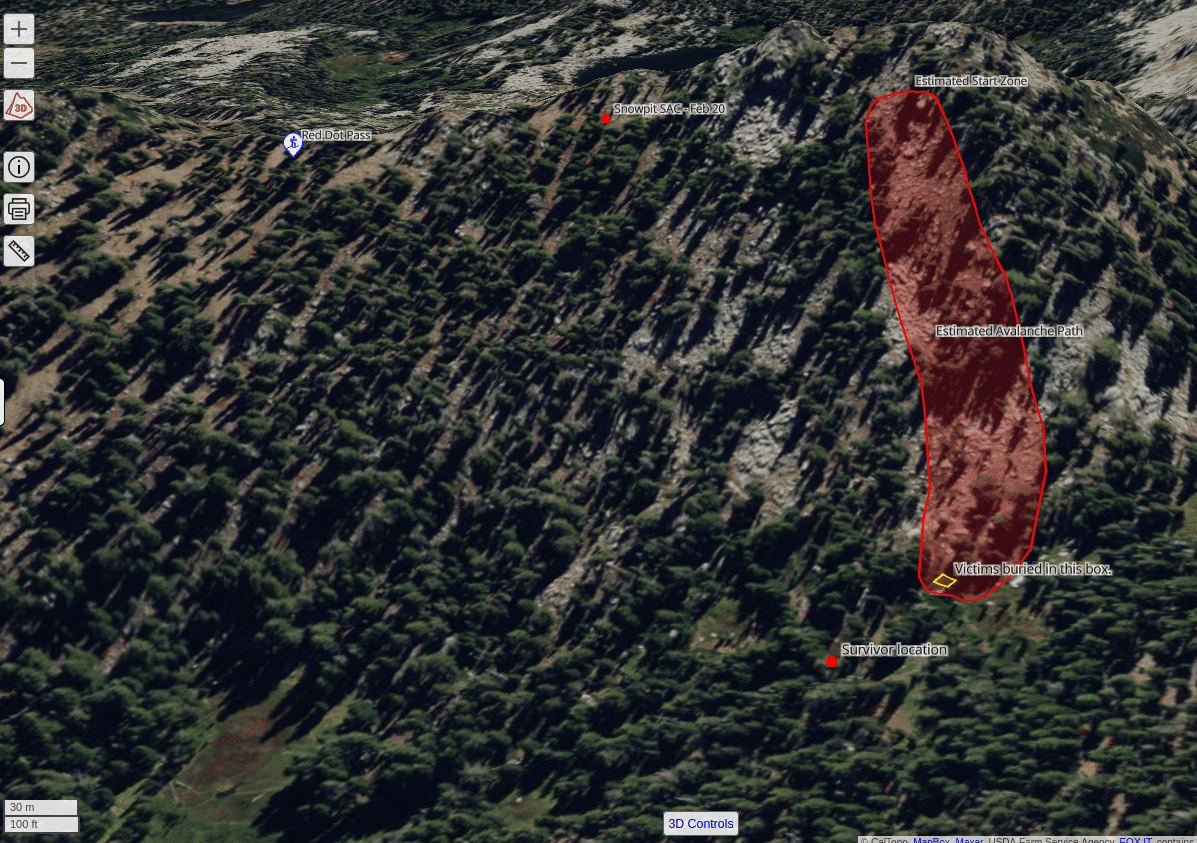
Last season, there were 23 avalanche fatalities in the U.S. and 13 in Canada. In particular, the nine avalanche deaths on the north side of Perry Peak near California’s Donner Summit became national news for several reasons. First, the raw total of lives lost was heavy. Second, the avalanche involved a guided group.
Last week, Blackbird Mountain Guides released a press release and report titled “Supplemental Key Findings and Clarifications from Independent Preliminary Report regarding the February 17, 2026 Avalanche on Perry’s Peak,” and an accompanying “Independent Preliminary Report,” prepared by Don Sharaf. Sharaf is a longtime avalanche educator and former owner of the American Avalanche Institute.
While the report does not assign blame to any one individual or decision made by the guides, Blackbird’s “Key Findings and Clarifications” asserts that the guides made several attempts to cross a creek at the base of Perry Peak, which would have allowed the group of 15 tourers to route further away from the slope that eventually slid. According to page 20 of Sharaf’s report, “Examining Choo’s Strava track (Figure 12) from 2/17/2026, the group appeared to make 2 to 3 separate attempts to cross to the far side of the creek, but were most likely turned back by open water and vertical creek sidewalls.” (Choo refers to Nicole Choo, one of three guides working for Blackbird who died.)
We should note that two of the avalanche survivors told the NYTs after the report was released that they did not recall “any attempts or discussions about crossing the creek, though both men were at the tail end of the group.”
The key questions remain: Why did the group venture out into the storm instead of remaining in the Frog Lake Huts until conditions became safer? Why did they not take other potential exit routes that morning? What specifically was discussed at the morning’s guide meeting?
For now, no civil lawsuit has been filed. The zeitgeist of this incident, however, suggests that litigation is pending. Also late last week, the California Division of Occupational Safety and Health Administration (Cal/OSHA) made its findings public. The Cal/OSHA Citation and Notification of penalty assessed fines totaling $151,300. (There are 7 violations in total. We’ll dive into this document later in the week and provide more details.) Blackbird Mountain Guides has appealed the workplace safety findings.
The forums and threads focused on Blackbird, the incident details, and, of course, how vague or accurate one’s Monday-morning quarterbacking is, are a mixed bag between level-headedness and toxicity. (No surprise there.)
This specific incident has stayed on our minds for several reasons. Primairly, as with any tragedy, seeking learning opportunities is often the best possible outcome. We’re still keeping our ears to the ground to synthesize those outcomes.
Last week, readers may also have noticed some resolution to a March 2023 Swiss avalanche incident involving the deaths of two high school students from a boarding school. The story gained news here in the U.S. after the Washington Post published a feature story about the incident. That piece focused on Emily Franciose, an American and one of the students killed, her grieving parents, and the nuances of the day’s two off-piste runs that ended in tragedy. A guide, Lucas Iten, and an experienced teacher/outdoor educator at the school, Guido Bieri, led the student group. (According to the IFMGA database, Iten is a certified IFMGA guide.)
The court proceedings focused on the group’s two runs and evidence that snowpack analysis and terrain selection were flawed on the second run, exposing the group to more consequential terrain.
A Swiss court found Iten guilty of “negligent homicide.” He has been fined and will serve two years of probation. In Switzerland, the Wiki tells us that negligent homicide (fahrlässige Tötung) “occurs when a person causes the death of another unintentionally through a careless act or a failure to act where a legal duty of care existed.”
Bieri, on the other hand, was cleared of any charges.
Needless to say, the court systems in Switzerland and the U.S. differ markedly. Both cultures have their own takes on risk, liability, personal liability, etc. We also have different guiding cultures and different ideas about what endeavors like touring entail, including what personal risks a client assumes when signing on with a guide.
Just like in driving or crossing a road, and even in seemingly low-consequence touring, there is no such thing as zero risk. Hazards and consequences sometimes present themselves long before a group steps out of the warm confines of a lodge. Sometimes, hazards and consequences strike in an instant. Other times, a series of small events and decisions—the seemingly inconsequential contributing factors—stack up and fail catastrophically.
As noted, we’ll spend more time looking at the documents involved with the Perry’s Peak avalanche later in the week.
Leave a Reply
You must be logged in to post a comment.