
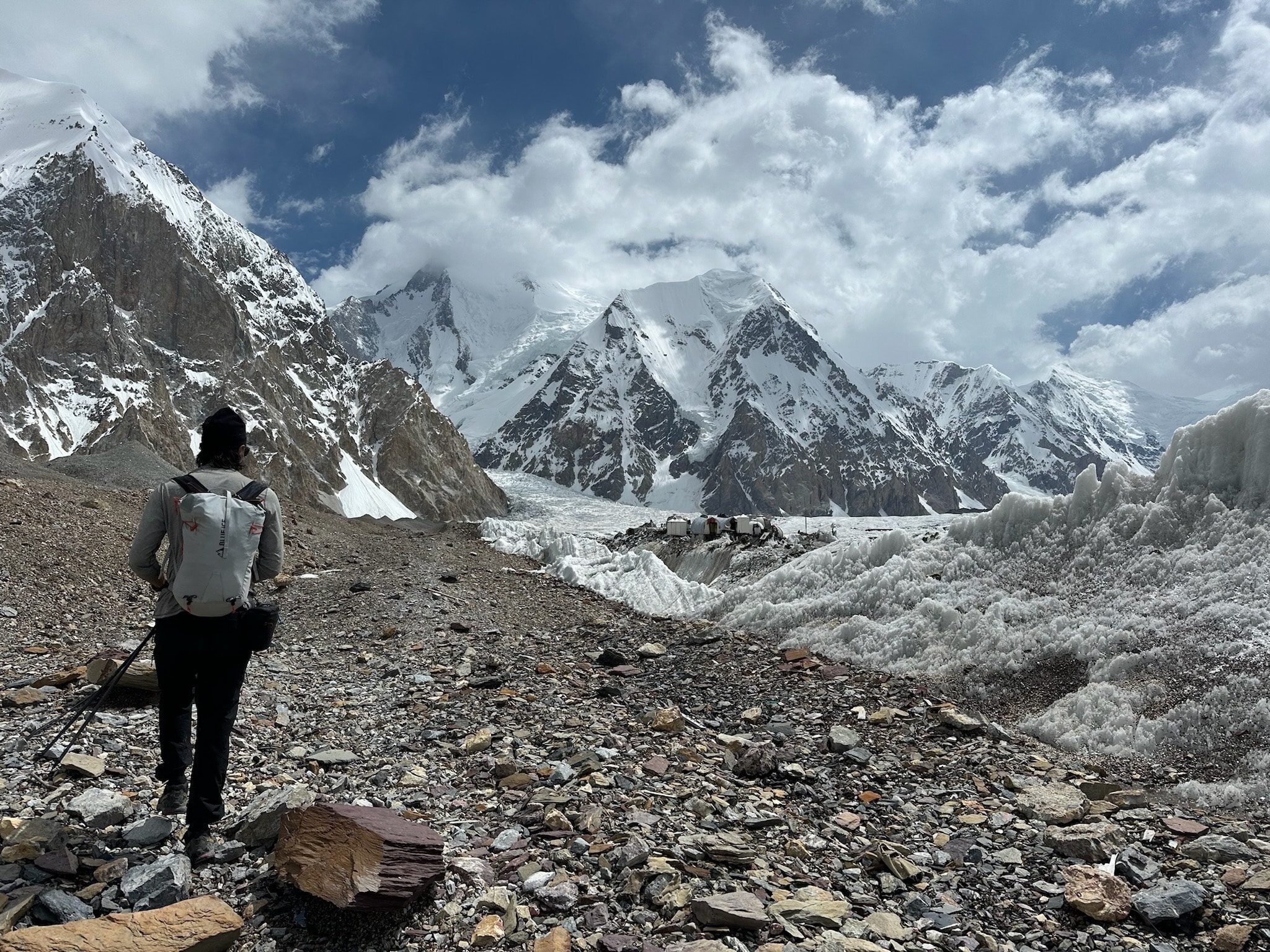
Part 2 of this three-part series on big mountain mindsets, frontloading psychologically and experientially for big mountain terrain.
This summer, as part of a larger project exploring the evolution of expeditionary skiing and riding, we connected with Haas, a THR founder/contributor, to discuss certain aspects of the big mountain scene. In part one of our conversation, which can be found here, we frame what Haas refers to as a mindset shift when thinking about and entering larger, higher, and potentially more extreme mountain environments. Part 3 explores partnerships.
Preparing for the Mindset Shift
THR: In part 1, you spoke at length about the mindset shift in the bigger mountains. Let’s focus here on some prep work potential big mountain skiers/riders can do at home, so when the time comes for the real deal, you are prepared for the task—the mindset shift. First and foremost, this requires a huge degree of independence. As noted in Part 1, the big mountains, by definition, are data poor.
Haas: We don’t teach how to forecast in very remote environments in the more basic avalanche courses, including Rec 2 and even the pro courses. Realistically, how to forecast is not covered. Even if a course does touch on self-forecasting, the reality is that almost everyone taking these classes will be somewhat reliant on an avalanche center, observations, and weather data for their trip planning. No doubt, I think those things are helpful.
It’s also definitely helpful to have an understanding of the different avalanche problems and how they form. First and foremost, I recommend that people entering these types of environments for the first time, or even those who’ve been in them before and want to improve, further their avalanche education.
Just because you’re going into a big mountain environment—a remote, high altitude situation—it doesn’t mean you need to change your risk margins. You don’t need to all of a sudden become reckless.
I don’t change my risk calculus. I’m not sitting there, 300 feet below the summit of Gasherbrum II, being like, “Man, I’m just gonna go for it. If I die. I die.”
I stay within my same accepted risk thresholds—at least I try to at all times. I have and do fall out of them every now and then by accident. But I recognize that and try to manage it for next time.
However, my point is that I think you can maintain the same levels of acceptable risk as you transition from a local range to the larger mountains. One way to accomplish this is to approach a big mountain environment with a much more cautious mindset. In contrast, here in the Wasatch, I may go ski a big line after a two-foot storm because I have high confidence. This confidence stems from easily gathering information. I know the day and time the storm occurred and what happened during the storm. I have telemetry available to me. I have snow data available. I have almost constant observations available from my colleagues, friends, and the broader community.
Compare that to the same two-foot storm in a big mountain environment; I’m going to give it 48 hours to settle out, no matter what. Sure, it could all be totally fine, but I’m data-poor. So, I adopt a much more conservative posture and return to more established rules. Those rules might be, as noted, the 48-hour wait time. It’s basic statistics. I can generally say with confidence that, 48 hours after a large loading event, any new snow-related hazard, except for additional wind slab formation, is probably okay. I think it’s around 90% of all avalanche activity will occur within 48 hours of the storm cycle. It’s not necessarily something that you apply in your home range. You apply that in a big mountain scene.
THR: That all makes sense. But what would you say to someone who’s either new to the big mountain scene, they’re going to South America, they’re going to Alaska or wherever, or they’ve been to those places, but they’re going to up the objective, things are going to get more technical in terms of remoteness, in terms of the actual climbing and skiing. How do you suggest people evolve into that? Are there scenarios that you can create in your home range that replicate a big mountain experience, like you go into non-threatening terrain that you might be semi-familiar with on a very low-hazard day, but you’re going without a forecast?
Haas: I don’t think you should ever drop a forecast. If you have access to one, use it. I don’t think that’s necessarily a good way to practice. But it does start in the home range every time there’s an outing. I would say it’s a philosophy I live by in skiing and climbing in the mountains. I like to think that one of the most important things you do: Choose the right objective; choose the right line, the right skintrack, the right aspects. Choose the right team. Set yourself up for success before you even launch. Get into a habit with your team. It’s all an opportunity to learn and improve, much like working on a progression.
I think as you’re learning, it is important not to go from I’ve done a few tours, and even a season or two, and now I’m going to go ski Denali.
True, that learning curve is a curve, and it will look different for everyone. Much of that has to do with the available time to commit, their base level, where they’re starting from, their inherent athleticism, and their inherent understanding and comprehension of these risk management topics. There are many factors that will determine this. It comes down to choosing the right objective at the right time during the right season. Don’t try to force things; that is the most important way to set yourself up for success. And all this development of skills and patience can happen at home.
I’m going to make this binary for a moment, as in you either send an objective or you don’t. In preparing for this so-called big mountain mindset, it is important to reflect on the no-sends. This type of reflection prepares you and your team for the inevitable setbacks you will encounter on a big mountain expedition.
A no-send doesn’t necessarily mean you had an accident, or that it all hit the fan. If you have experienced repeated no-sends, I believe you are exposing yourself to hazards or a potential setup for a catastrophe.
THR: Talk about that. Because I think no-sending isn’t the end of the world. In fact, it might be the start of something beautiful. I’ll hop on board here as part of this thought experiment and embrace the idea that a no-send, or repeated no-sends, are a sign of something potentially amiss.
Haas: Here’s how I look at it. If you keep trying and it doesn’t go well, that’s okay. But I’m here to split hairs. A no-send doesn’t always mean it doesn’t go well. But it also might mean it didn’t go well, or even worse. The no-send might be a result of misreading or misforecasting the weather. Perhaps you misread or overestimated the group’s ability to move quickly and efficiently in technical terrain. Maybe you misread the route and the conditions. You definitely misread something.
THR: Sure, but sometimes the weather doesn’t cooperate.
Haas: Ok. Yeah, you just got foul weather, and you were shut down. But that’s a weather misread.
Let’s take this into the big mountain context. If you give yourself a month to climb Denali and you don’t send, there’s a better chance, and this is going to hurt some people’s feelings, but if you gave yourself a month or three weeks, let’s say the average trip gives themselves about three weeks to climb Denali, there’s a better chance than not that that’s more on you than it was the weather. Certainly, there are other factors. For example, if this is your first experience at high altitudes and acclimating is difficult, even with proper strategies employed, a summit becomes problematic. If poor acclimatizing is a repeat problem, that’s a sign of a poor big mountain mindset.
In short, if you have repeated issues accomplishing objectives, that’s not an anomalous weather event or poor acclimatization, etc.
You’re doing something wrong. That is the time to reassess and reflect. To change the mindset.
THR: I guess I don’t often use the term no-send. I’m laughing…it’s about the experience, right? Anyhow, I do understand. I backed off a local ski line four times before I skied it this past season. That was all a function of being in the proper mindset (although I was scared and shaky) and, of course, waiting for the proper slope softening. It took me five times to hit the right conditions. So I hear what you’re preaching: that the mindset can begin at home, and no-sends could, for all the wrong reasons, mean a person/team is unprepared.
But this idea of no-sends possibly portending something catastrophic, can you expand on that?
Probably, yeah. I mean, I’m wrapping my brain around it. So I guess my question would be, you said you’re setting yourself up for a kind of cataclysmic event, possibly, right? You said something like that. So, yeah, what you’re setting yourself up for is a catastrophic error, because you’re going to push it the next time, because you want to send, and so you put yourself in a compromised position?
Haas: No, I don’t think it makes you hungrier to send. What repeated no-sends lead me to believe is that you’re not ready for the objectives you’re trying, and it’s very easy in the mountains to let someone who’s underprepared in any which way to get in a little too far. It’s really easy, if you want to relate it to climbing, to be a 5.6 climber and end up on runout 5.12 in a mountain setting.
THR:Yeah, makes sense, but you young folks are strong…5.6 to 5.12, that’s a big leap, even when going off route. Can we just call it sustained runout 5.10?
Haas: Like in climbing, in big mountain skiing/riding, generally, once it starts to get beyond your ability to physically move upwards, you just can’t move upwards. But in the mountains, on snow in particular, you could get in over your head very quickly, very easily.
Now there’s a counterargument there, that if you have a bunch of sense, they could have just been lucky, or you could have just scooted by. There’s the idea of that negative feedback loop where you’re actually screwing up big time.
So there’s the downside that you could just be getting lucky a bunch, and nothing ever happens, and you have these sends, and you’re also still misreading it.
And that is one of the hardest things in skiing, in particular, and in big mountain skiing in particular. At the end of the day, any skier/rider (well, most) can go out and chisel down something and call it a send. And they could have been on the brink of catastrophe the entire day. They don’t know that, but that’s how it is. Nine times out of 10, they’re going to be okay.
So, the question I’m always asked is, “How do you combat that?” That’s a hard one.
I think you combat that by taking this stuff exceptionally seriously and understanding that this is an inherently dangerous sport. There aren’t many other sports out there where you spend as much time thinking about risk management for a recreational activity. Maybe free diving?
Take deep-sea offshore fishing. I don’t think they take classes on risk management. You obtain a boater’s license, and that’s it.
We go to symposiums every year. We take these classes, and we read articles. We have a dedicated section on The High Route, specifically focused on snow safety and how to stay safe in the mountains.
I think that’s one way we can combat this potential negative feedback loop. I think in avalanche classes, we refer to it as a wicked learning environment. So understanding how dangerous this stuff is, and how seriously we need to approach it and if you have a laissez faire attitude towards this endeavor, then maybe pushing into more complex, remote, big mountain terrain isn’t necessarily for you, and that’s just, that’s just how it’s going to be.
But you don’t need to quit your job and disown your family to take up backcountry skiing. That’s not the point here. But in a big mountain situation, take it as seriously as if you wanted to learn how to fly an airplane.
Leave a Reply
You must be logged in to post a comment.