
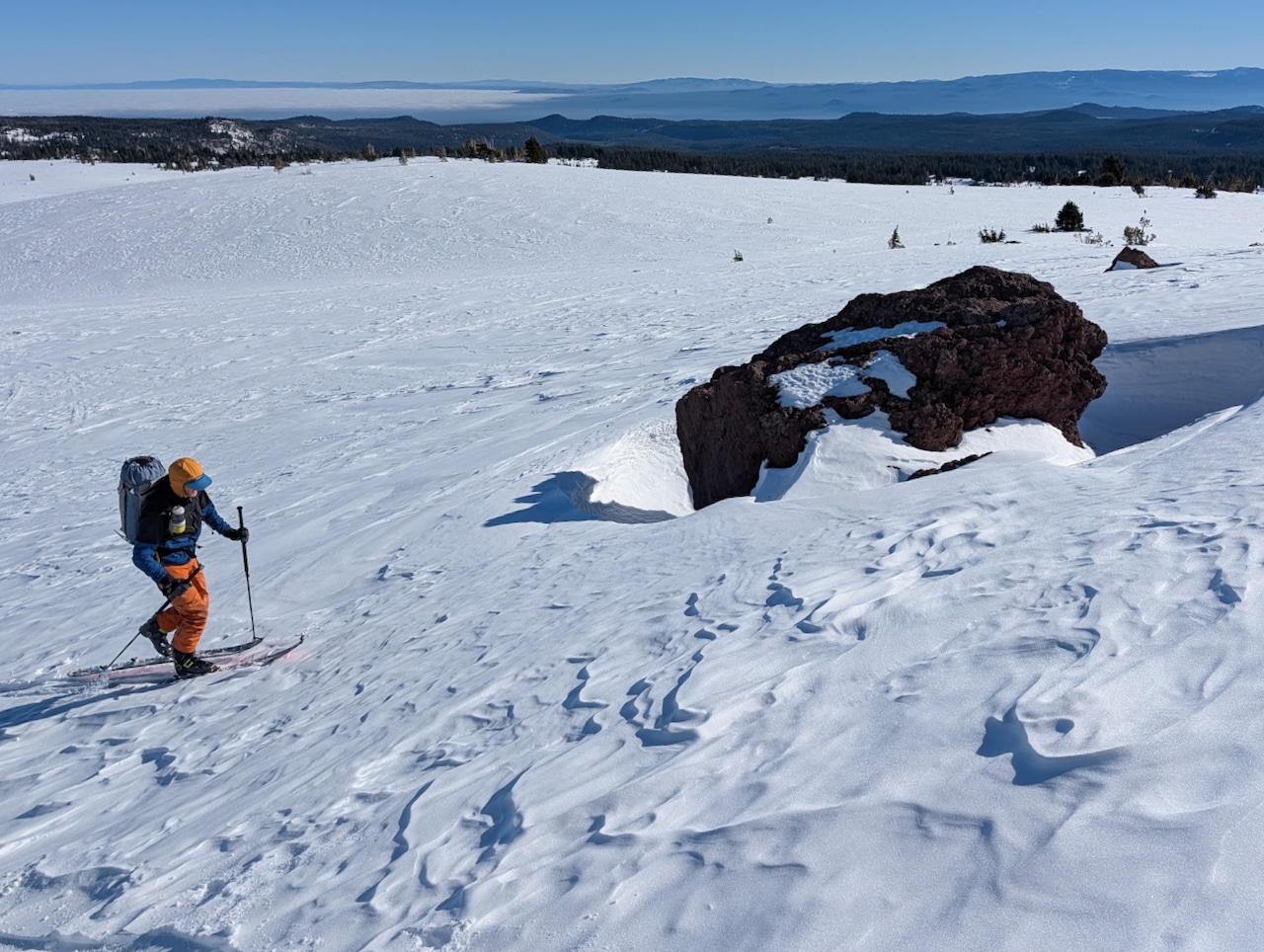
A somewhat public secret amongst my close friends: I have a touring boot problem and a jacket problem. Not real problems in the darkest sense, but a compulsion to find a jacket or boot that is just so. And all of it can be nuanced. Thus, the deep collection of boots and jackets over the years is routinely culled (begrudgingly).
I usually spend much of a season in clothing or gear before putting my thoughts down in a review. It’s mid-January. I’ve had Patagonia’s Nano-Air Ultralight (NAUL) Freeride Jacket in my rotation (which hasn’t been much of one, as I’ve lived in it for touring) for about two months this season and a solid month last spring. My mind is made up—I’m digging the NAUL Freeride.
In my first look, I ran through my experience with jackets marketed as active insulation. Active insulation does not block 100% of the wind. An active insulation piece has a higher CFM (cubic feet/minute), a rating measuring the volume of air passing through the fabric in a minute, than, say, a hardshell or a lighter windbreaker, which usually blocks the wind entirely. A higher CFM also means a piece should be more breathable. While jackets like the NAUL Freeride do not have CFM ratings on their spec sheets, they are higher-CFM pieces. And, as noted in the first look, the NAUL Freeride, like its cousin, the Nano-Air Ultralight, has minimal insulation (20g FullRange insulation), which is also mapped on the torso.
Tune this out if you’ve heard/read it already. Most active insulation pieces are too hot for me. The usual suspects run 60g or 40g of synthetic insulation. Prior to getting my hands on a Nano-Air Ultralight for a traverse many moons ago, effective active insulation for me equated to a very light baselayer and a TNF Futurelight Fleece Hoody. Fast forward a few years, and at the NAUL Freeride, we have a purpose-built active-insulation jacket designed for ski tourers that works. It breathes when the tempo is high, and depending on how you slice it, allows ample airflow with modest wind.
My bar for active insulation, if it is true active insulation, is pretty low, and until recently, aspirational. I should be able to use my full complement of uphill gears and not sweat out under typical touring conditions. In fact, I should remain pretty comfortable up to a point. Check all the above in the NAUL Freeride.
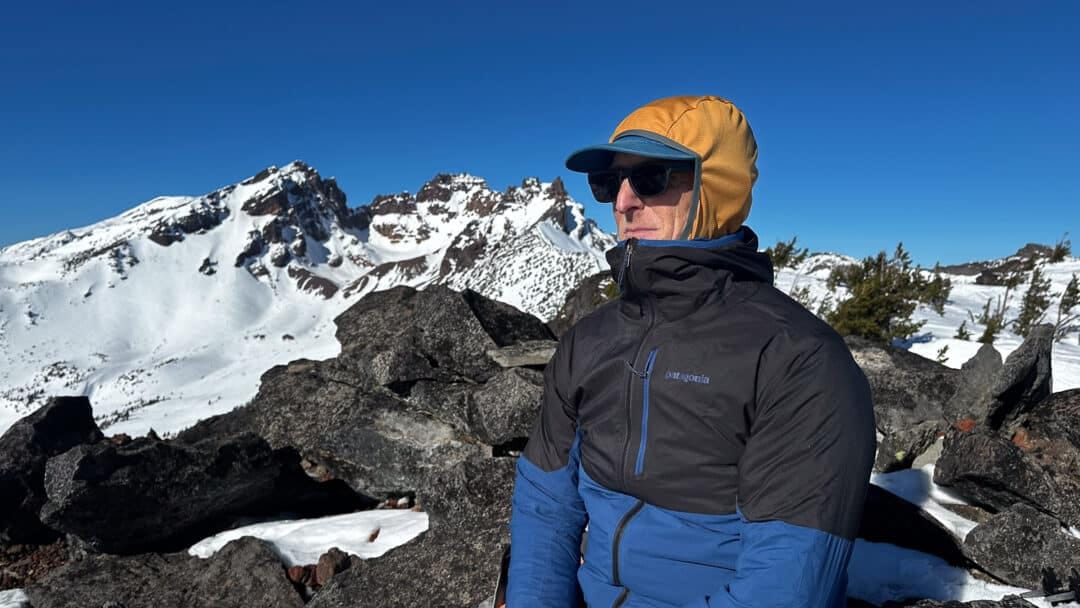
Sadly, we’ve had some wonky days here in the Central Cascades. Wonky translates to rain here and there and some downright warm-temperature high pressure. Like the NAUL, the NAUL Freeride has a sweet, but wide, spot for uphill travel: below-freezing temps with a breeze, and the jackjet’s performance is optimized. (Note: keep the baselayer very thin; this helps with the optimization.) And if the temps are in the 20s (Fahrenheit), then even better. I find myself almost never having to stop and change out my layering system, while, yes, I’ve watched many partners swap on and off this or that layer to either dump or trap heat. If I have to dump some heat, then the full zip is effective.
Here’s another comment on my layering with the NAUL Freeride while uphilling. I also don’t overdo it with the hat/touque. Most days, I begin with a mostly mesh ballcap, with a buff pulled up if it’s notably cold. And if it’s chilly out, and I have not stoked my engine yet, the jacket’s hood fits nicely over the cap in a snug and comfortable way, which helps to insulate and break some wind, especially if it is a downhill start to the day, which, if I’m taking a certain route into the high country, is downhill for a mile or so.
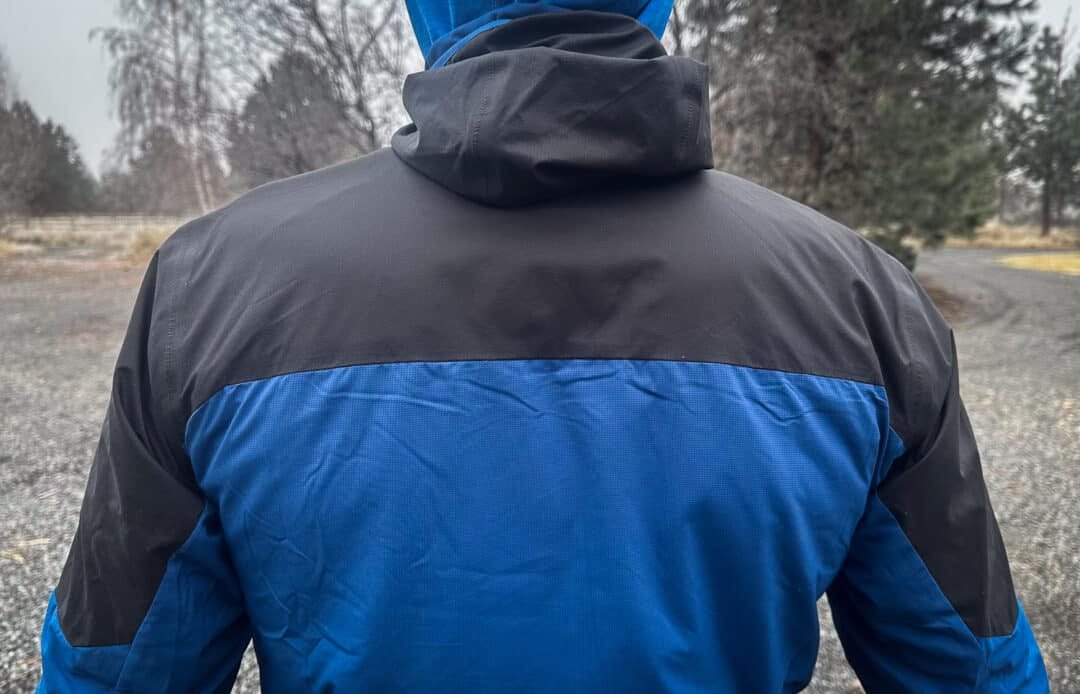
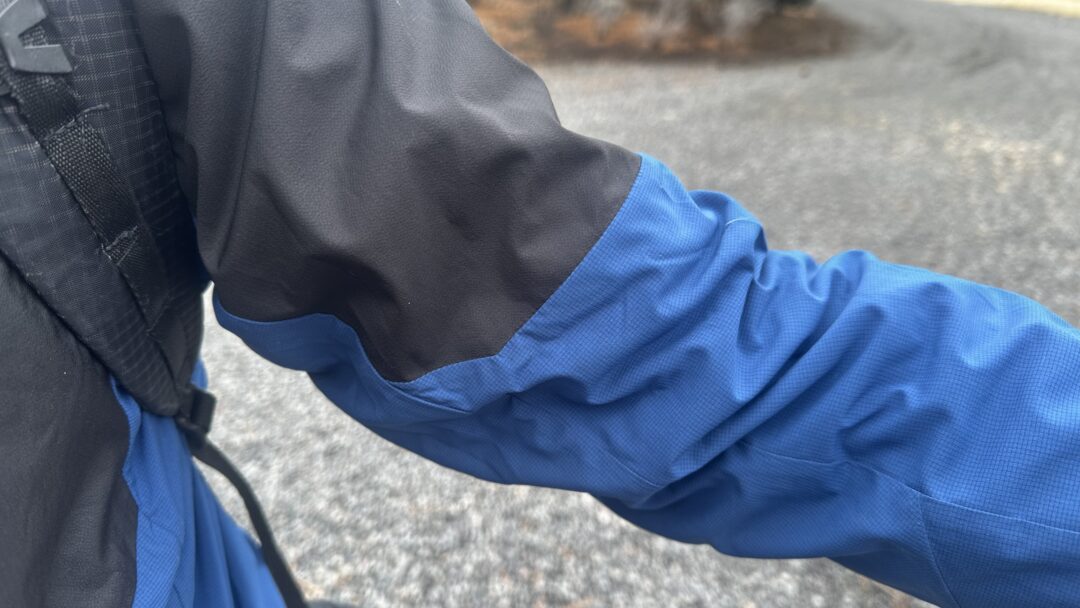
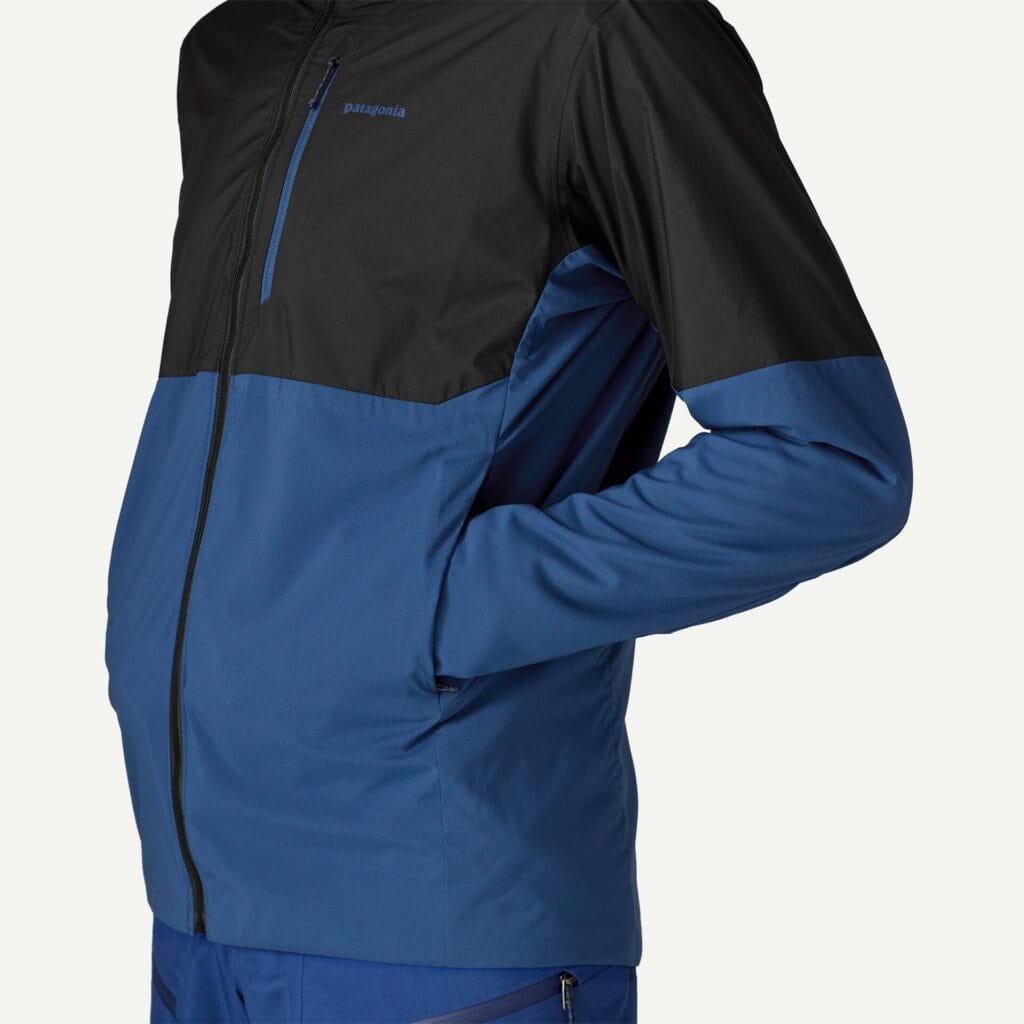
Let’s get into the design a bit. As mentioned in the first look, the NAUL Freeride is body-mapped with insulated and uninsulated panels. The yoke, upper arms, and underarms are insulation-free. The yoke/upper’s face fabric is a 2.4-oz recycled nylon stretch ripstop. This is bonded to a knit backer and is treated with a DWR finish. This mapped portion of the jacket offers some weatherproofing when it’s either snowing or, as I’ve experienced, raining lightly. While the body, lower arms, and back are 1.6-oz 30-denier air-permeable shadow stretch ripstop with a DWR finish, it seems a bit less weather-resistant. Over the months I’ve worn the jacket, I would call it sufficient for light precipitation, but it is not to be confused with a stormproof hardshell. And to be clear, the jacket is not marketed as such—Patagonia even calls this piece a midlayer, which, I suppose, it is, if you consider the totality of the new PowSlayer kit, which features a Gore-Tex Pro ePE jacket and pants.
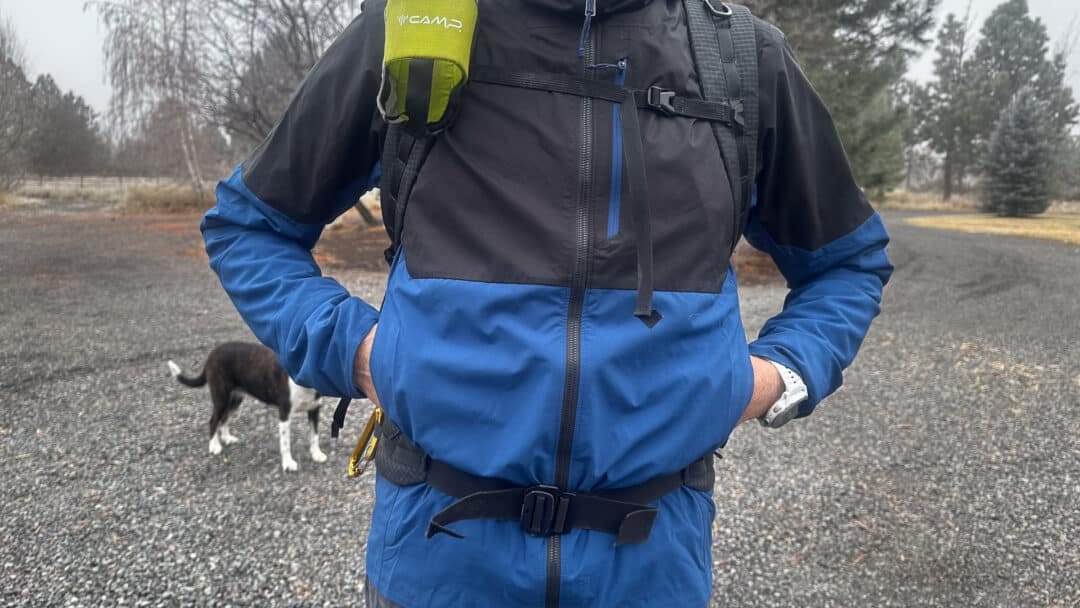
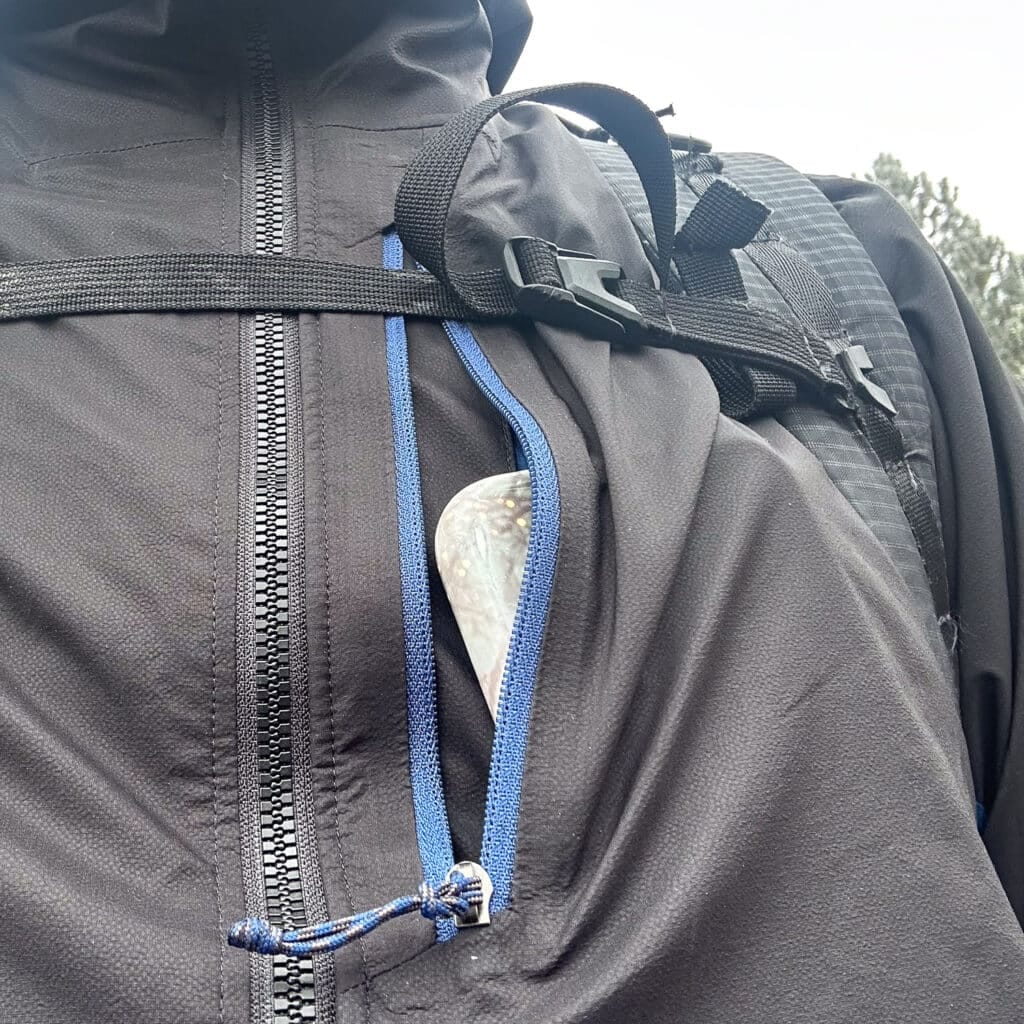
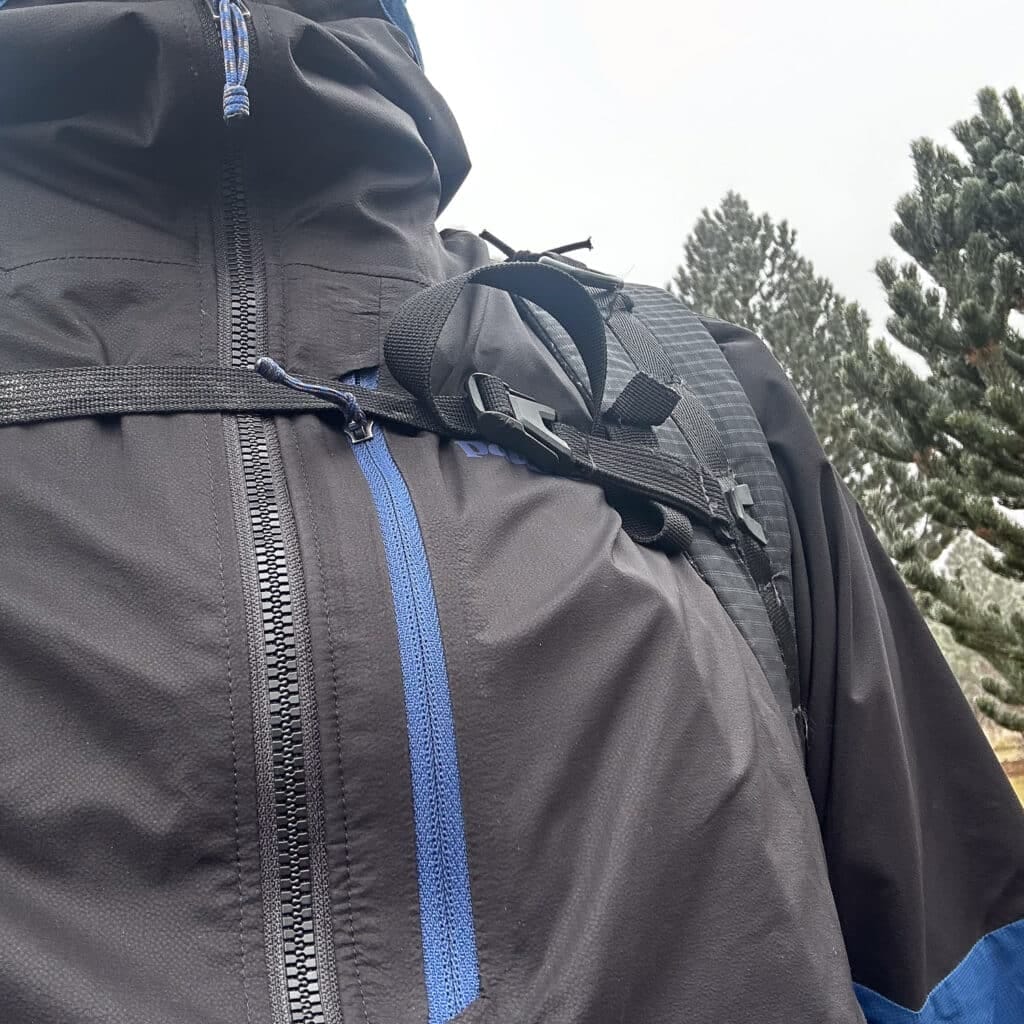
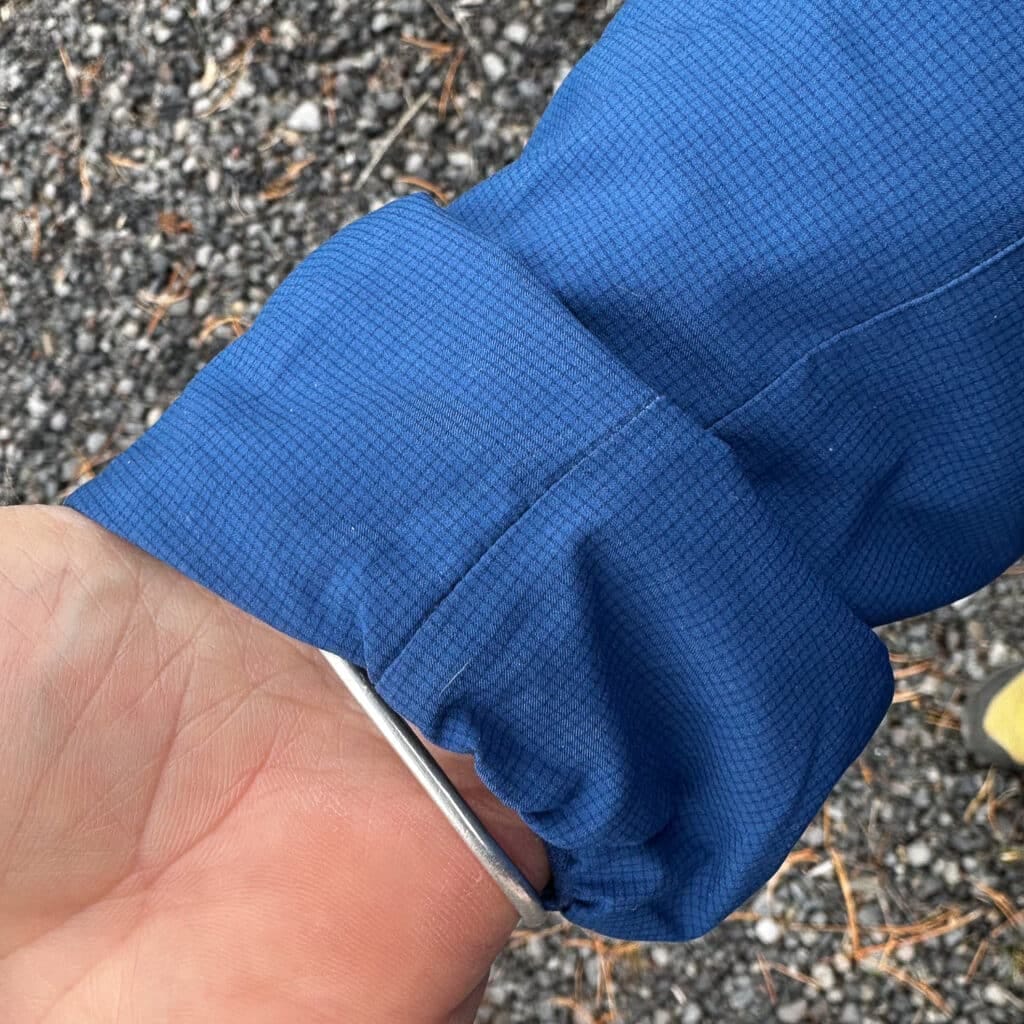
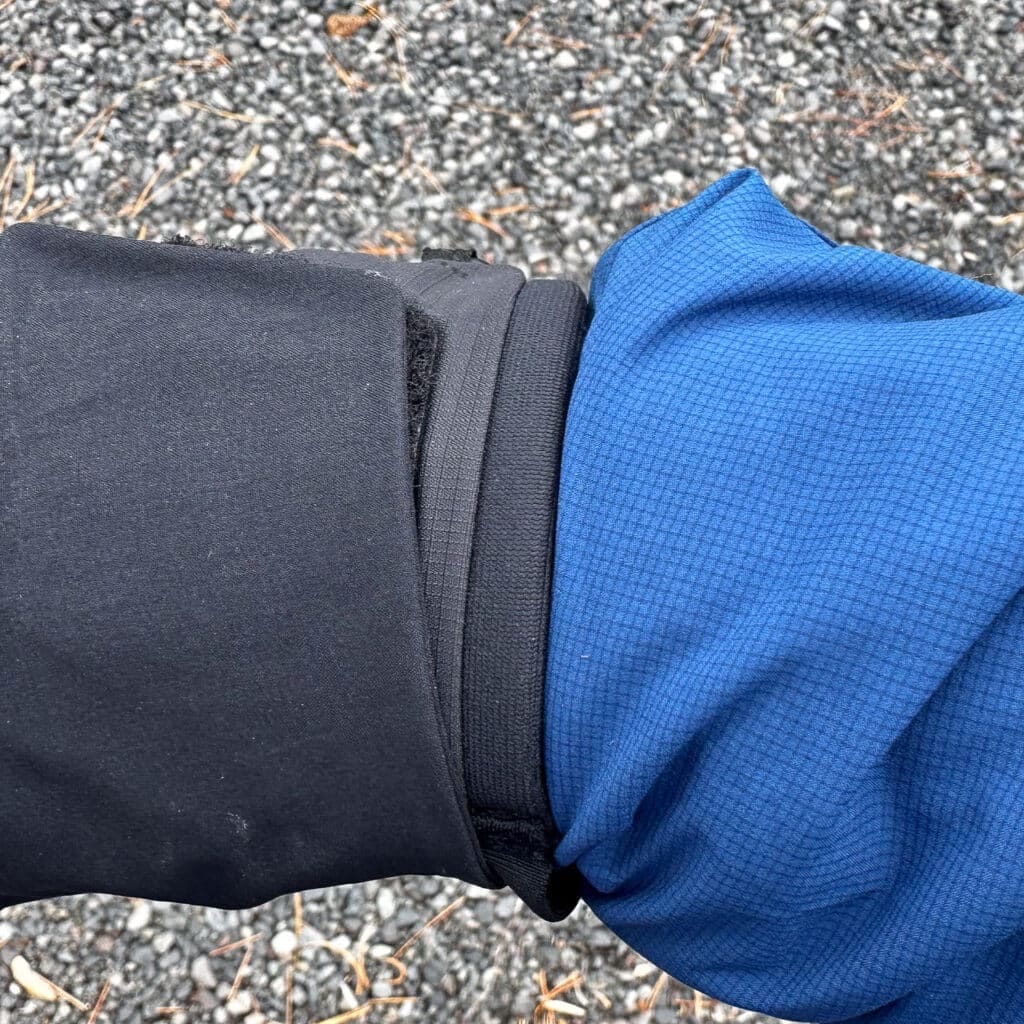
There are three pockets: one Napoleon-style (vertical zip) pocket that can swallow a phone and a bar for a quick-hit snack, and two hand-zip pockets, which are accessible while wearing a pack with a waistbelt. The arms, for me, have good coverage, with low-profile cuffs that really do slide right into a glove with even small gauntlets. The hood is basic and fitted, which means it is designed to fit under a helmet, and it does not have (or need) any independent adjustment cords. The hood is simple and effective. There is no cinch on the hem. Naysayers are saying this is a miss. While I do like a hem cinch on puffies and hardshells (I’m putting those on for weather protection or to trap in all the heat), I’ve not missed it. Furthermore, I’m always wearing a pack with a cinched waistbelt. No harm, no foul…it keeps the NAUL Freeride simple. Which I like.
And, if you take the jacket off, it’s pretty darn stuffable. Read as it doesn’t take up much room in my pack.
Which raises the question, what is the point of the NAUL Freeride? The point, as I see it, is a jacket you rarely have to take off. Thankfully, this jacket is designed to be worn most of the time. Which, if you layer toward (as noted already) a very light baselayer in all but Arctic temps, is easy to realize. For me, active insulation with more insulation (the 60g or 40g variety) sits mostly in my pack or remains at home.
The System
As tourers, we are used to working hard on the uphills. I think it’s fine to push the throttle, but not at the cost of sweating profusely and having to change baselayers on every lap to avoid a mighty uncomfortable chill. In proper conditions, as in coldish and trending toward cold, you can push the throttle in the NAUL Freeride and maintain a regulated body temperature. I write this with the understanding that some like pit zips; I’ve never felt the need for them in this jacket. Atop the climb, if it is breezy and cold, the NAUL Freeride is trim enough to fit under a puffy and/or windbreaker/hardshell. Further, the jacket’s cut is roomy enough (I’m in a men’s medium), and I can layer a fleece hoody, the Nano-Air Ultralight Full-Zip Hoody, or a lightweight down jacket (Mountain Hardware Ghost Whisperer) under it. And depending on the day, I might bring a superlight or insulated vest to increase the jacket’s range. The fit is great for touring: call it a trim-baggy fit. The mobility is sweet and unimpeded.
The fabric and insulation dry sufficiently fast when wet, whether hung to dry or used continuously (body heat does its thing).
Hear Ye Hear Ye
Until the original Nano-Air Ultralight, and now the NAUL Freeride dropped, the distinction between active and not-active insulation, for my taste, just wasn’t distinct. The NAUL Freeride is incredibly versatile because it has a thin layer of insulaiton insulation and is breathable. Nothing feels gimmicky about the jacket. It remains understated, with only a few bells and whistles. But, ironically, the NAUL Freeride is a high-functioning piece of kit.
In my review of the Nano-Air Ultalight Full-Zip Hoody, I wrote this: “The main thing here regarding the NAUL’s high function is its fidelity to what it actually is: active insulation.” The same can be said of the NAUL Freeride, except that the feature set and cut are more in line with touring, whether on skis or a splitboard. For example, shoving large skins under the NAUL, with its slimmer fit, is a struggle; that’s not the case with the NAUL Freeride. Go ahead, shove those big and wide skins against your chest to save some transition time at the bottom.
The NAUL Freeride is a pricey piece. Tapping your card or phone or clicking “buy now” will cost $329. (Deep breath… .) At 317g in a men’s medium, the per-gram cost is getting up there. On the flip side, this is not a jacket that will sit idle during the touring season. My guess is, once you realize its wide range of best use cases, it will be coming along on most tours. I imagine it will take on the patina of a beloved and beat-to-hoo-hash jacket. Which, in my estimation, is as it should be with such a versatile piece. As mentioned at the beginning, I have a jacket problem. But with the NAUL Freeride as a mainstay in the quiver, I now feel like I can do a proper assessment and cull that quiver down.
I’m 5’10” and in the 150-160 range, depending on the holiday season. The medium is a perfect fit for me. My taller child, 6’5” and tipping toward 190, wears an XL. The NAUL Freeride also comes in a women’s-specific fit.
Leave a Reply
You must be logged in to post a comment.