
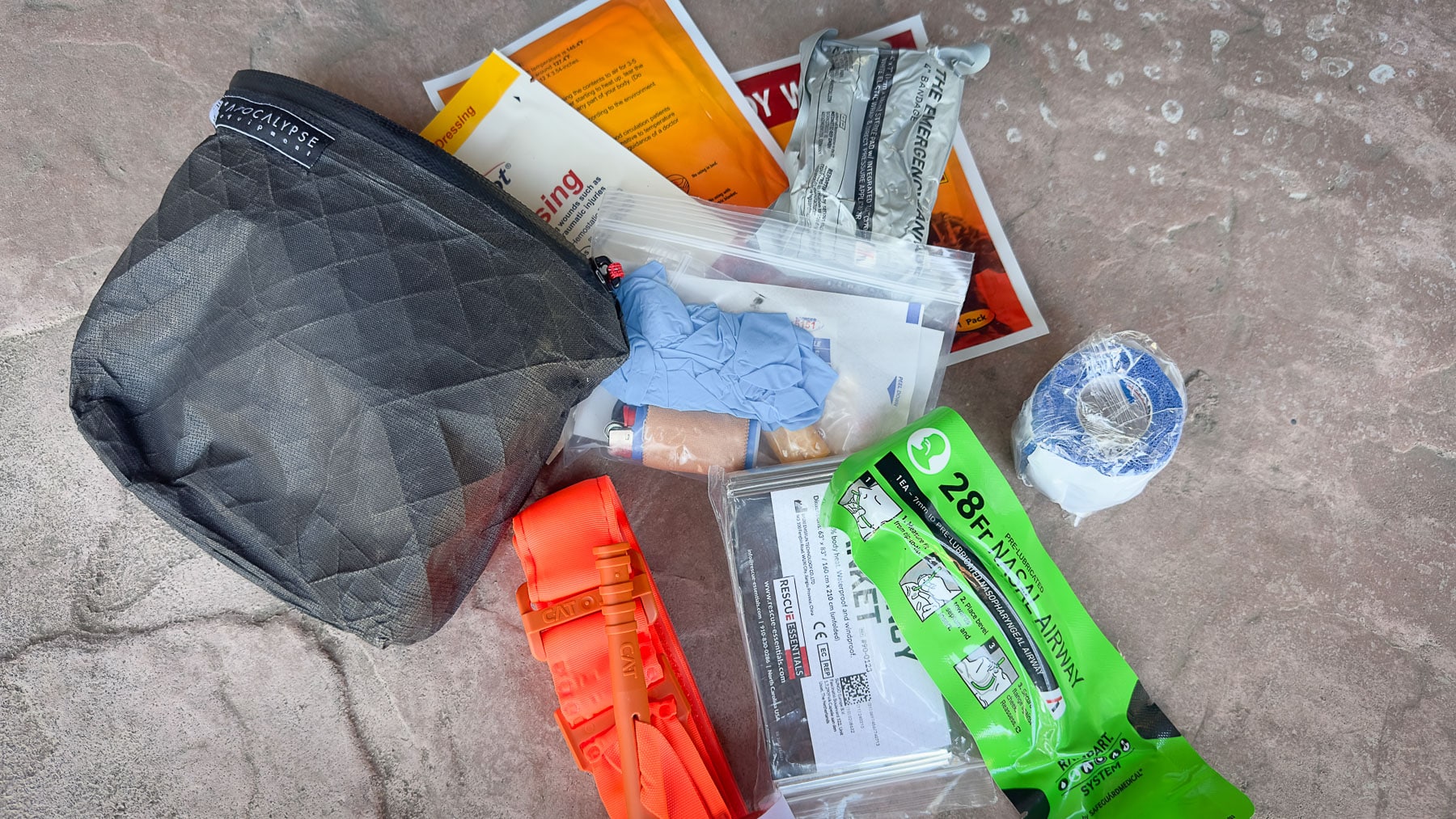
So early in the season. So much time to procrastinate—this includes putting off checking last season’s first aid kit. Early September is the time to check on such things. Don’t be beset by the inertia of the boring stuff. The last-minute-get-ready once the snow flies adds stress and opportunities to cut corners. We’d all rather be scraping storage wax off skis and smelling the hope of early-season turns rather than fiddling with organizing or resupplying a first-aid kit
Last season, THR put together an excellent series on first-aid kits. If this is all new to you, we’ll direct you to those resources. We have one kit from a guide (Gavin Hess), one from a practicing ER doc, Dr. Patrick Fink, and one from a regular (although advanced) tourer like the rest of us, Teague Holmes.
The Resources
Let’s begin with our official/semi-official medical director here at The High Route, Dr. Fink. We reached out and asked him to provide some basic information about when he carries a minimalist vs. a more robust first-aid kit and what skills we should revisit in the run-up to snowfall.
If I don’t expect to spend any amount of time in a place, and I’m on the move, and if something bad were to happen and I have a reasonable expectation that a significant amount of help or an evacuation will occur within a couple of hours, that’s a good situation for a minimalist first-aid kit. I think of it this way: A minimalist first-aid kit should be able to address immediate life threats that are expected and can be treated.
Those life threats include bleeding and airway compromise. For example, someone stops breathing because they are buried in an avalanche, hit by lightning, and less commonly, cardiac arrest—just a random heart attack, or a head injury, where someone has hit a tree and has a significant closed head injury, a depressed level of consciousness, and isn’t breathing terribly well for themselves. Their heart is still beating, blood still going round and round, but without help, they’re snoring and choking on their tongue.
My minimalist first-aid kit would address life-threatening bleeding with a tourniquet and maybe a pressure dressing. Airway-wise, if we’re talking minimalist, I have a CPR mask and maybe an oral or nasal airway with an OPA and NPA, respectively.
That’s my super minimalist first-aid kit. But that’s pretty darn close to what I carry with me skiing all the time.
Middle of the road Kit:
These types of first-aid kits make addressing life-threatening situations easier, allowing you to care for a patient for a longer period. But more importantly, I think what most people would include in their middle-of-the-road first-aid kit is the ability to address common and annoying issues that are not life-threatening. I might add to a minimalist kit some minor bandaging supplies, like band aids, treatment for blisters, moleskin tape, pain medications—either over-the-counter or prescription narcotic pain medication. Then, considering splinting in a ski context, it is actually less important to add more first-aid supplies, even though it’s a very common practice. Someone in your group might have a Tib Fib break or break a wrist. On most ski days, I often have the necessary items to make a splint without needing to add anything extra to my medical kit. I carry long, rigid items. I have straps and bulky padding.
Season Skills Refresher
For the season skills refresher, I would definitely review the basics of CPR, ensuring I know how to use a mask and position someone for it, as well as how to deliver quality compressions. I’d review the 30:2 ratio of chest compressions to breaths and understand the difference between jaw thrust and head tilt-chin lift, as well as how to appropriately open the airway to deliver a reasonable breath. Basically, understand the basics of CPR and the microskills associated with that. I would also review proper tourniquet application. If there’s life-threatening arterial bleeding, do I know where to put the tourniquet, and do you know how to use the tourniquet in my kit?
One more thing I’d add, which is more conceptual, is understanding what medical care you’re going to give a victim after getting them out of an avalanche. How are you going to manage hypothermia? These are the two big medical issues I think about for backcountry users.
The Kits
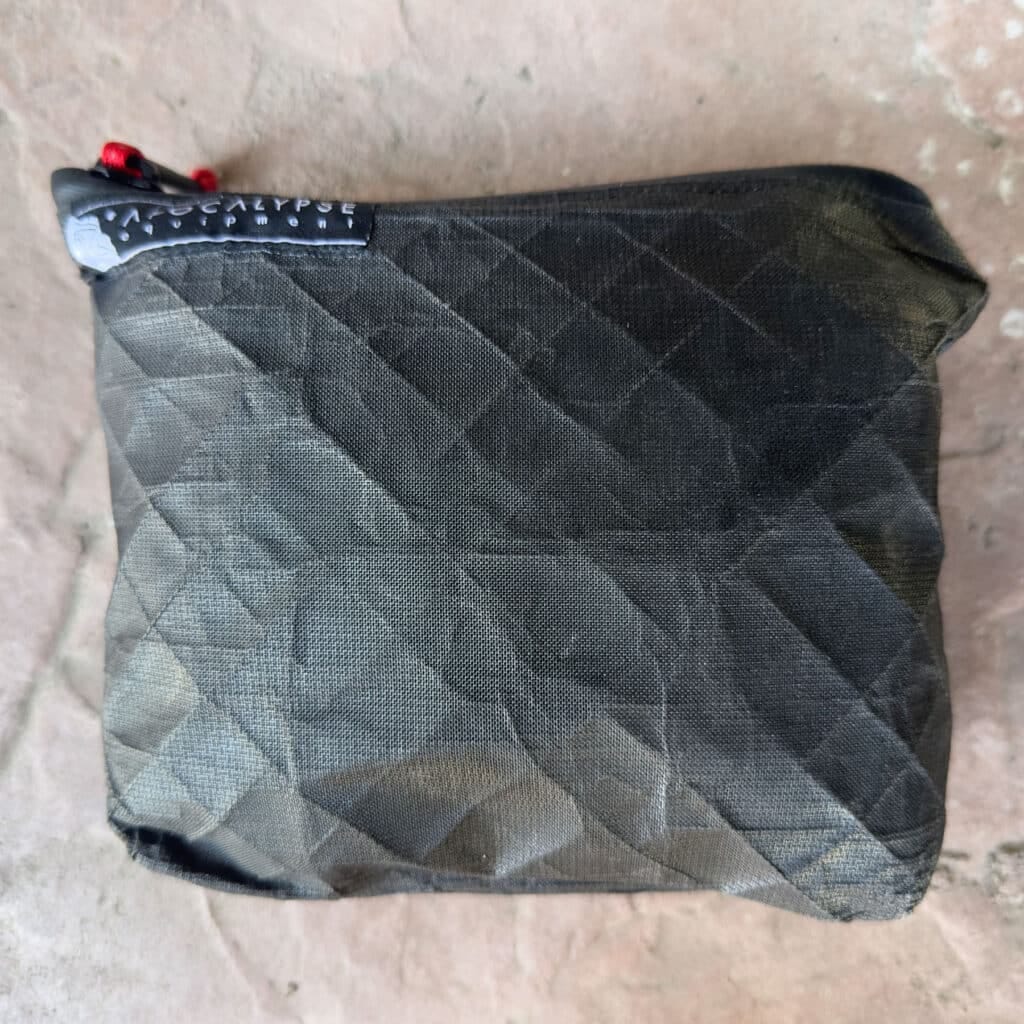
Fink has developed his “Shit Kit.” No, this is not all about human waste in the backcountry, or Wag Bags, or trowels. It is for when the *%$! hits the fan from a medical perspective. Either way, you’ll see that this kit is minimalist. And it also provides for some basic gear failures, as it includes a pared-down Leatherman.
One item to zero in on, for which Fink’s rationale for carrying is evident, is a CPR mask. He writes of this roughly $7-$10 item: “In my view, [it is] the one indispensable piece of backcountry first aid gear. Since asphyxia tends to kill avalanche victims who don’t die of trauma, CPR can be a life-saving measure for people that you pull out of the snow. Having the mask, which, while the bulkiest item in the kit is actually one of the lightest, lets you deliver high-quality rescue breaths.”
Gavin Hess presents his “middle” of the road first-aid kit. His “middle” build-out covers most manageable medical emergencies one might expect for a longer or more involved day trip or an extended trip. If you plan to head out on an expedition, the supply list would be more extensive.
This kit covers the tools/supplies necessary to manage injuries involving modest amounts of bleeding (including a CAT tourniquet), airway obstructions, injuries requiring a splint, and packaging the patient. In total, his kit weighs ~512g.
Editor’s Note: For years, I’ve been carrying a pretty minimalist first-aid kit. As I began to wake up to some realities regarding the kit’s insufficiencies, I bumped up to a more middle-of-the-road kit, like Gavin’s. In the past, I was prepared for things like blisters, but ill-prepared for issues involving airway obstructions or real-life bleeding management beyond band-aid type bleeding. And frankly, for several multi-day traverses in very remote zones, in hindsight, I was ill-prepared. Now I think nothing of carrying slightly over one pound (~454g) of first-aid supplies on any mission. Sure, it takes up slightly more room in my pack, but the costs outweigh the potential benefits. I mention this here because I am carrying new-to-me tools. And I’ll be taking the time this preseason to better understand how to use them and what their best use cases are.
The final resource comes from Holmes, our non-guide, non-medical professional.
His kit includes supplies/tools for medical and gear-failure scenarios. We’re reminded here to carry some baling wire, a spare pole basket, a spare skin tail and tip kit, and that all-encompassing fix-it-all tape—Duct Tape.

Leave a Reply
You must be logged in to post a comment.