
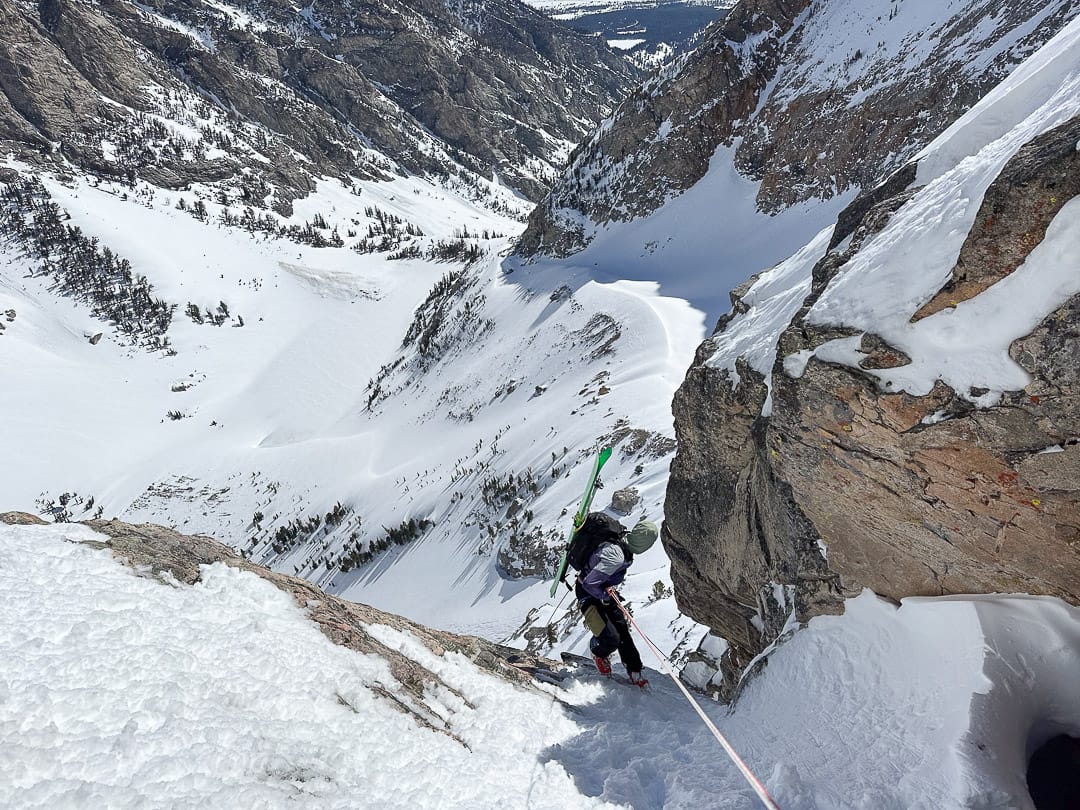
Ski ropes, skinny ropes, Rad lines, tag lines, whatever you want to call them, we are here to dive deep on ropes for technical ski touring. Ropes were among the first gear topics we dove deep on in episode 1 of the Gear Shed podcast, and we have continued to learn and evolve over the last few years, building experience with a variety of ropes, discovering new options, and diving even deeper/nerdier in last month’s Gear Shed podcast with Shawn Breaux from Glacier Black.
Somewhat ironically, I’ve made it this far down the rope rabbit hole without ever owning the Kleenex of ski ropes, the Petzl Rad line. More and more, ski ropes are like climbing ropes—there are lots of options with different strengths and weaknesses. The “gold line” era of ski ropes is over; it’s time to assess our options.

Last fall, we previewed the options in our quiver with some qualitative assessment of their pros and cons. Notably, we tracked down some new-to-market options from the likes of CE4Y, and later in the season, Glacier Black. Continuing this explosion of options, we now have a whole slew of options from HowNot2’s Arete brand, offering a variety of diameters and materials with their own strength testing to back them up. We haven’t gotten our hands on any of the HowNot2 cord yet, but I imagine the 5mm Armadillo cord would make for a great ski rope.
We verified the weights per meter and diameter for all the ropes in question, and made an honest attempt to quantify rappelling friction to provide a somewhat well-rounded quantitative analysis of these ropes. The purpose here isn’t to declare a winner, but hopefully to paint a more data-driven picture of the market landscape. Some options certainly fare better than others.
Weight
A couple of grams per meter may not seem like much, but consider that over a 60m rope, 4 g/m is about a half pound of weight in your pack. Weight is the whole reason we are talking skinny ropes in the first place. Rappelling on a 9mm dynamic rope is simple and safer, but damn, it’s heavy the rest of the day in your pack.
We measured the rope’s exact length and divided it by its measured weight to get a “verified weight” metric. Just about all my measurements come in slightly higher than claimed, and there’s likely some variance between measurement techniques and batches of rope, so no harm, no foul.
Diameter
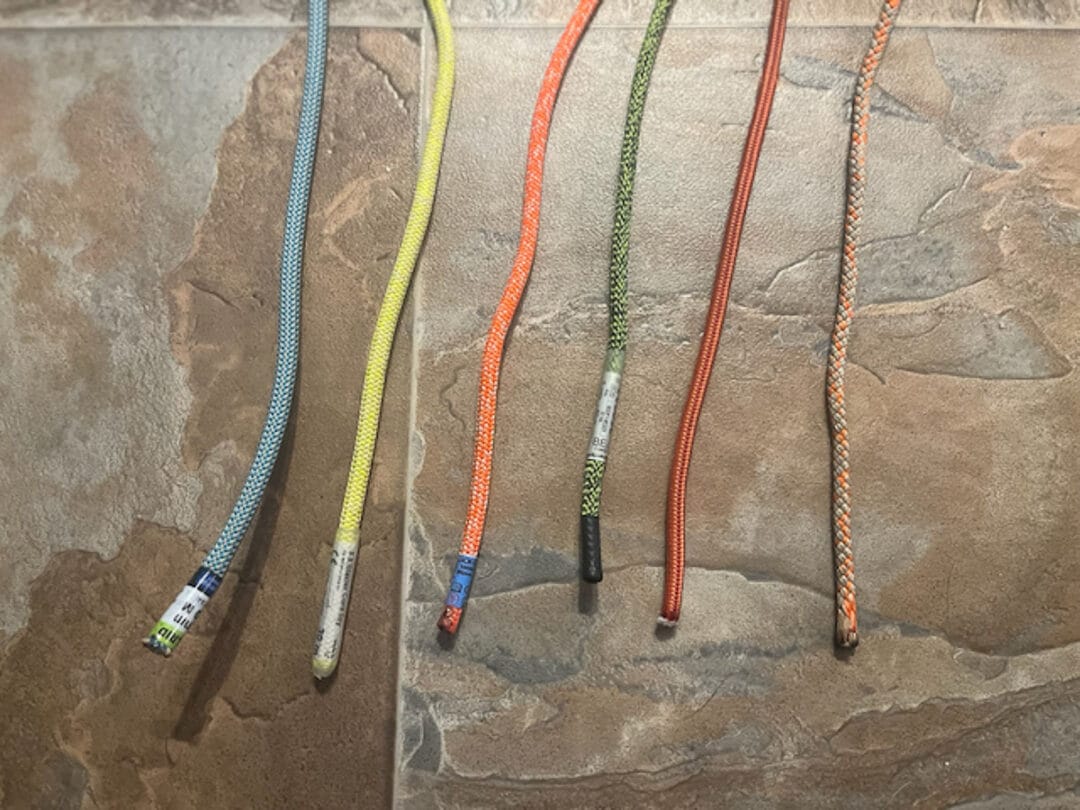
Diameter and weight are strongly correlated here. In a somewhat linear manner, weight increases with diameter. More use of high-tech/lower-density fibers like Dyneema helps keep weights lower, but diameter seems to be the main factor. I measured with calipers and went just tight enough that the rope could still slide through the jaws without friction. It probably matters less with these very static ropes, but the standard diameter measurement is with a small mass hanging from it, so my numbers ought to be a bit high (and even more so for the somewhat dynamic Edelrid rope).
Strength
Has anyone caught wind of a real-world failure (breakage) of a 6mm ski rope in the field? I never have.
Despite this, strength is often a big hang-up when it comes to these skinny ropes. Most noteworthy are the high strengths of the Glacier Black and CE4Y ropes at ~20kN. Also notable is the Rad line at 12kN and the Edelrid Rap line at 10kN. Particularly with the non EN564 ropes, the reported numbers may not be entirely comparable brand to brand, but in combination with this study (rappel forces are examined about ⅔ down the page) from Black Diamond, we can surmise that 12kN or 20kN (or as low as 7.1kN when knotted) is strong enough for rappelling uses, though we should note that the safety factor is lower in many cases (as low as 2:1 in the case of the knotted backup line and the most aggressive rappel in the BD study).
Perhaps a good takeaway here is that while these ropes are strong, they don’t deserve the same unimpeachable confidence while rappelling that a thick climbing rope may. Wear, damage, and exposure should be taken seriously with these ropes, and they ought to be replaced or retired when they show any signs of damage.
Length
It’s worth noting that I measured lengths and compared them to the manufacturer’s stated lengths. My rope-measurement device is old and uncalibrated, and the ropes in question are all new-ish, though some have seen more use and gotten wet more often than others. All to say, every rope measured shorter than stated, and the more used ones tended to be shorter than the less used ones. Ropes seem to shrink over time, which is worth paying attention to when we sometimes have rope-stretching rappels and don’t want to haul around extra rope. Having enough is pretty important.
Friction
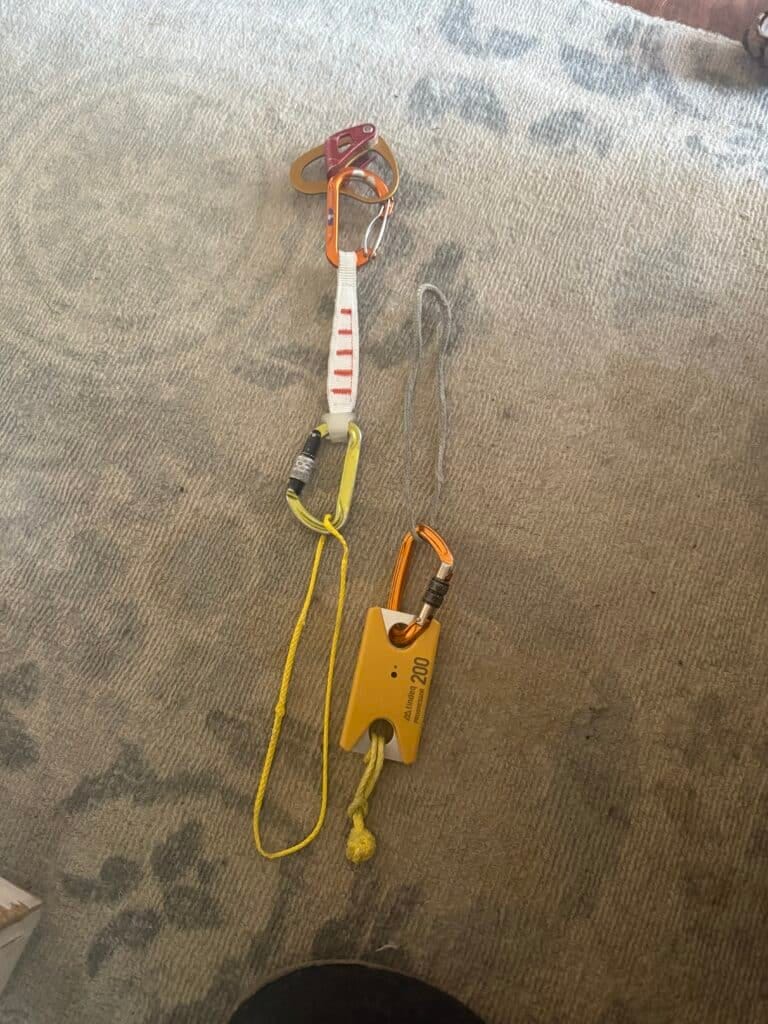
This is where we start to go into more uncharted waters. I’m not sure if my methods here are 100% sound, but they seem to accurately reflect my qualitative assessments of how tricky/slick rappelling can be on these ropes. I set up an extended rappel with a Petzl Reversino (it seems important that the device doesn’t have a V-groove with teeth, like the Edelrid Nanojul). I backed up the rappel with a 3mm Vectran friction hitch, which I attached to my harness with a Tindeq dynamometer to measure the force on the friction hitch. I then descended a few feet of free-hanging rappel while capturing the force data between the friction hitch and my harness. I figure this provides a representation of how hard one needs to hold the brake strand below a rappel device for a given rope.
The results, as expected, are correlated with diameter. The Poliwog stands out for its strong weight-to-friction performance.
Tractor Device Compatibility
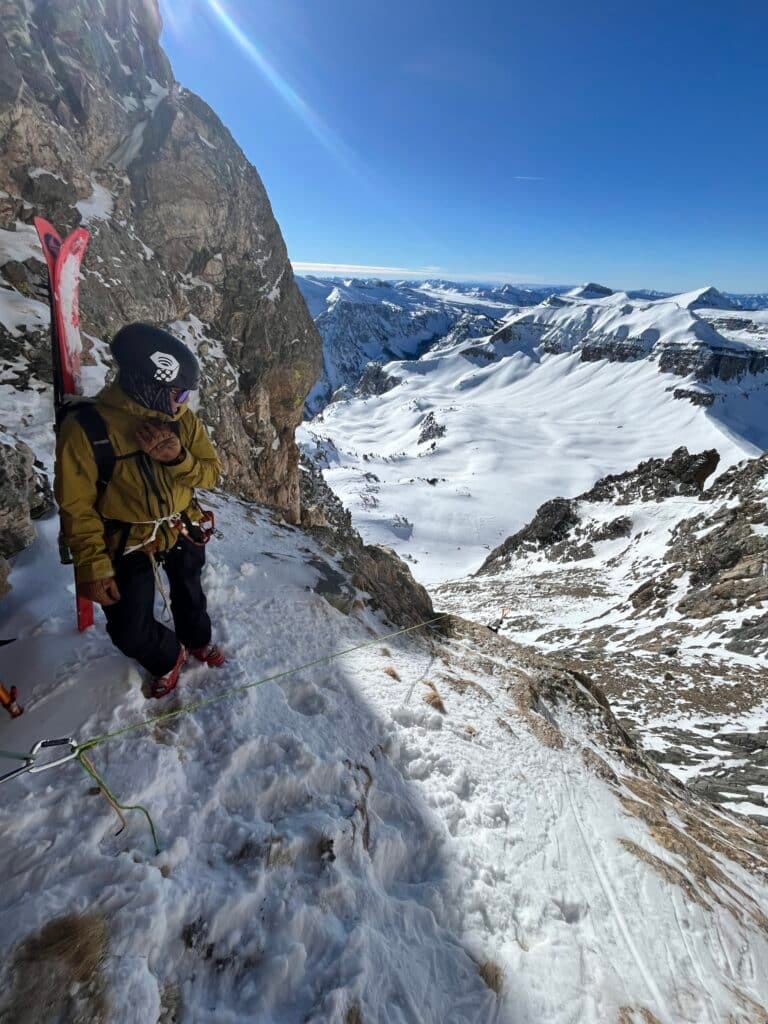
We’ve mostly talked about ropes in a rappelling context—you can blame our Teton-centric viewpoints for that. Glacier travel is a whole can of worms that we can dive more into at a later date. In the big picture, some of these ropes are well-suited to glacier travel/crevasse rescue in some contexts, while others probably aren’t. There is a significant personal onus on using these ropes and systems as they are more nuanced than standard practices and gear. For example, I likely wouldn’t take the Sterling V-TX on a glacier—the sheath slippage could be a significant issue using toothed devices, and it seems to ice up easily. Meanwhile, the CE4Y and Poliwog are great choices for me in many glacier contexts as they are robust and have worked well in practice scenarios and testing devices. Meanwhile, something like the R8 works pretty well in a Nanotraxion, but poorly in a Microtraxion and/or with standard prussic loops like a HollowBlock. Maybe I would choose the R8 for a huge outing where my partners and I are shaving every last gram and have every piece of kit dialed, but I wouldn’t dare show up to an AMGA exam with it.
There has been some chatter among some guiding colleagues about European guide/research groups continuing to recommend dynamic ropes for glacier travel. My experience has been that European climbers and skiers are significantly less likely to default to hyperstatic/skinny ropes in many instances where they have become standard in the US. Part of this likely relates to the luxuries of tram-access travel, making weight less of a concern, but they seem to view these ropes as a far more specialized tool for weight-critical outings. I think it’s important to keep track of these practices—the Alps are home to some of the most highly trafficked glaciers in the world, as well as many of the most skilled skiers and climbers. The consensus seems to be that while catching a crevasse fall is possible with hyperstatic ropes, the forces are often higher and peak faster, making a fall “less intuitive” to arrest. All to say that perhaps we should rethink defaulting to hyperstatic ropes in glacier travel, particularly for those with minimal or no experience arresting falls. Here is a link to ENSA’s most recent study on this matter.
Materials
A quick rundown of the various materials used in many of these ropes. Note that most dynamic climbing ropes are made with nylon due to its combination of strength and stretch. High-tech fibers are showing up more and more in dynamic ropes to bolster cut resistance, but remain somewhat rare. These high-tech fibers are the key to making these ropes strong and cut-resistant enough for our uses in situations where a 5-6mm nylon accessory cord probably isn’t sufficient/advised.
Polyester—Less stretchy and less water absorption than nylon.
Dyneema/HMPE/UHMWPE—Many names for the same fiber. This is the stuff that elicits the tacky “stronger than steel” tag lines in marketing copy. It is notably useful in ropes for its high strength and cut resistance, as well as low weight and water absorption. Its worst attribute in a rope (perhaps aside from price) is slipperiness—a pure Dyneema rope like the Petzl Pur line can be problematic to generate enough friction for safe rappelling.
Aramid—Somewhat broad category of high-strength, heat-resistant polymers. Often, aramids used in ropes seem to have shorter fiber lengths, which leads to some fuzziness when abraded. Aramids include Technora and Kevlar. Historically, some aramids suffered from flex fatigue—essentially from self-abrasion within the cord. These are used in ropes due to their heat resistance and roughness, which helps with friction. The main downside of aramids is the premature fuzz that often appears on these ropes.
Vectran—Vectran is a fiber that uses a Liquid Crystal Polymer (LCP) Polyester makeup. It lacks the incredible heat resistance and roughness of aramids, but offers a nice blend of good friction and heat resistance, longer fibers that fuzz less, high cut and abrasion resistance, and excellent flex fatigue resistance.
As we can see here, a single perfect fiber doesn’t exist for ski ropes. Therefore, a blend makes sense in many cases. It seems like a Dyneema core makes a lot of sense, essentially something like Amsteel as a core providing the backbone of extremely high strength. Different approaches have been taken by various companies to sheath materials, where weight, abrasion, friction, heat resistance, and water absorption all factor into the decision making.
Skinny Rope Data
| Rope | Claimed Specs | Verified Specs | Progress capture approved by manufacturer | materials (Sheath/core) | ||||||||||
|---|---|---|---|---|---|---|---|---|---|---|---|---|---|---|
| Weight (g/m) | Diameter (mm) | Strength (kN) | Length (m) | Cost ($/m) | Strength (kN) * | Weight(g) | Weight (g/m) | Diameter (mm) | Length (ft) | Length(m) | Friction (kg) ** | |||
| Petzl Rad Line | 22 | 6 | 12 | yes | HMPE-Poly/HMPE | |||||||||
| Petzl Pur Line | 20 | 6 | 15 | 5 | 12/8 | yes | Dyneema/dyneema | |||||||
| Beal Backup | 21 | 5.1 | 13.8 | 40 | $4.00 | 13.8/7.1 | 887 | 22.6 | 5.77 | 128.75 | 39.2 | 23.5 | yes (Beal Tract up, nanotrax works great) | Nylon-aramid/aramid |
| Glacier Black Poliwog | 23 | 6.5 | 22 | 60 | $3.00 | 1317 | 24.0 | 6.32 | 180 | 54.9 | 19.8 | no (but works great) | Dyneema-vectran-poly/dyneema | |
| Mammut Glacier Cord | 25 | 6 | 14 | 30 | $8.60 | 813 | 27.8 | 6.58 | 95.8 | 29.2 | 20.5 | yes | Poly-aramid/Dyneema | |
| CE4Y Slick Line | 23 | 6 | 20 | 40 | $5.00 | 20/11 | 970 | 25.7 | 6.54 | 124.07 | 37.8 | 19 | no (works great) | Vectran-poly/Dyneema |
| Sterling V-TX | 20 | 5.4 | 15 | 60 | $4.96 | 14.3/8.6 | 1211 | 20.7 | 5.82 | 192.25 | 58.6 | 23.9 | no | Poly/Dyneema |
| Marlow R8 | 16.5 | 5 | 11.8 | 40 | $4.43 | 654 | 17.2 | 5.14 | 125 | 38.1 | 24.9 | does not work with mircotrax, Nanotrax works | Aramid-poly/Dyneema | |
| Edelrid Rap Line | 31 | 6 | 10 | 60 | $3.92 | 2093 | 35.5 | 7.31 | 193.55 | 59.0 | 19.2 | yes | Poly-Aramid |
*Diverter/tied in figure 8
**Friction is measured by the force required to hold still w/ 3mm friction hitch, 4 wrap kliemheist, and Reversino on a 50cm extension; numbers are comparative at best.
Conclusion
Whew, that was a deep dive. Hopefully, this satisfies our collective rope information needs for the time being. The main takeaway for some may simply be that there are other, more affordable options than the Rad line. For others, comparing friction measurements and verified weight between the Marlow R8 and Glacier Black Poliwog may help them decide which ski rope to choose. If there are any measurements you’d like to see taken with these ropes, or any further ideas on the subject, let us know in the comments; I’ve got a duffel bag full of ropes ready for further testing.

Leave a Reply
You must be logged in to post a comment.