
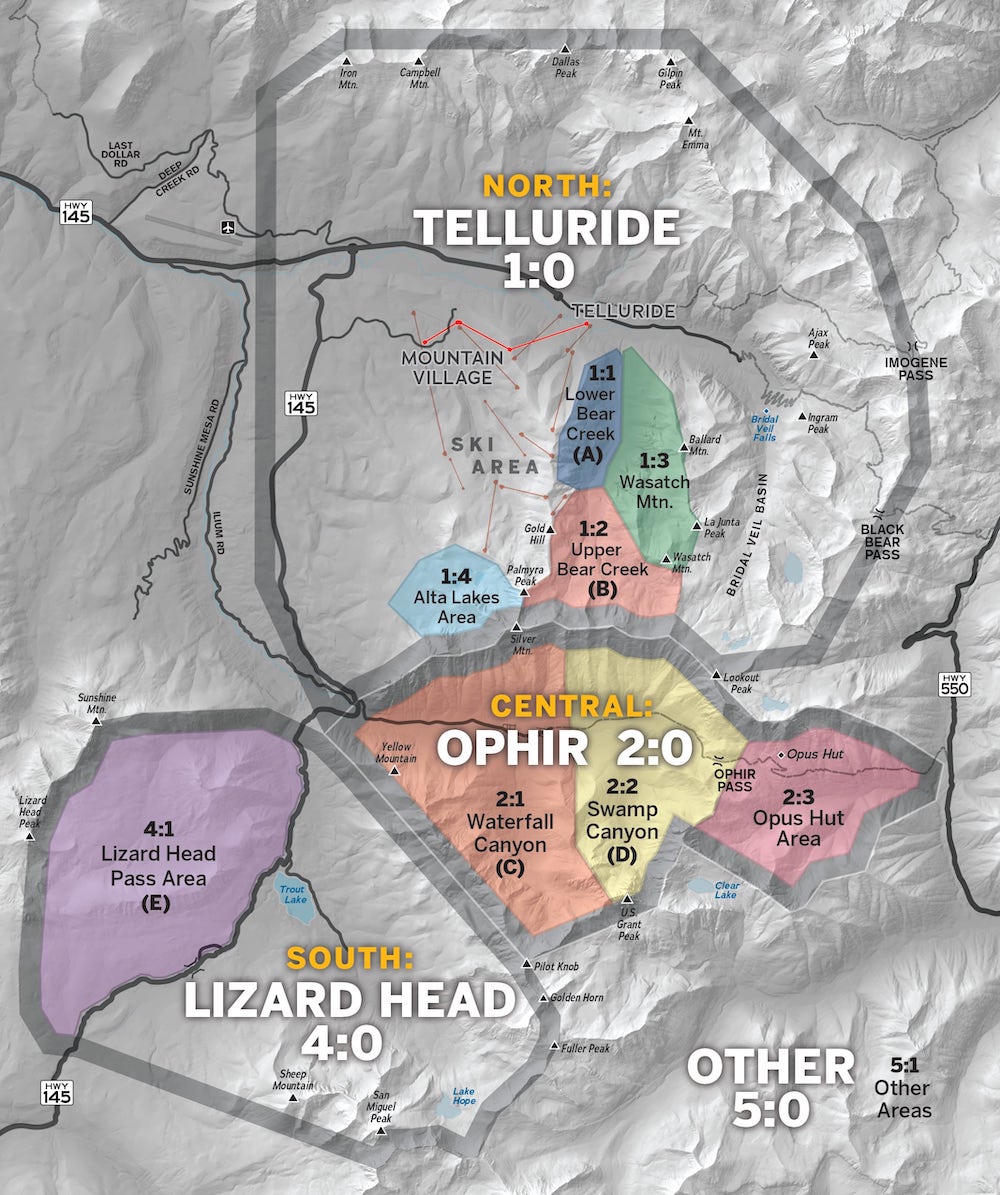
When reaching out to the Telluride Mountain Club to discuss their Telluride Backcountry Radio Program, we were put in touch with Matt Steen. During the 2014-2015 season, Steen motivated and helped energize a nascent backcountry community channel program. That program mapped out five backcountry zones, with six channels designated to serve those zones. Since that time, the program has expanded to include nine zones (each with its own main channel/sub-channel).
If you are new to radio use and community channels, it’s not too complicated. The primary purpose of community channels is to facilitate inter-group communication. In potentially crowded terrain posing avalanche risks, participants can make and listen to transmissions between groups. For example, if you are about to drop in on a run, you could call into the group channel and notify anyone in the zone of your intentions. (Steen and Bruce Edgerly authored a paper in 2016 discussing the nascent use of community channels. You can read that here.)
Other communities have adopted similar programs since Telluride’s inception. Lake Tahoe will be the latest community to adopt a community channel program this winter. (We’ll have more on that in a week or so.) Programs in the Wasatch and Snoqualmie Pass have been around for a few years.
Here’s our lightly edited conversation with Matt Steen, currently the Executive Director and lead guide at Telluride Helitrax.
***
The High Route: Can you tell us a bit about the scene when you began thinking about and began the backcountry radio program in Telluride?
Matt Steen: At the time, I was a backcountry avalanche forecaster for the Colorado Avalanche Information Center, and previously I had ski patrolled in Telluride for a decade. The catalyst for all this was that the backcountry access from the ski area was so easily accessible, and there were periods during that decade when this backcountry terrain was inaccessible—the ski area kept backcountry gates closed, and the Forest Service kept areas closed. There were also times when it was secretive. People were ducking ropes. People were dropping in. And then there were times when it was open, and there were backcountry gates to serve as a boundary or warning. Eventually, a ton of people were dropping in on top of each other in pretty high-consequence terrain. It was dangerous.
It got me thinking. How do we address this safety concern? The things that crossed my mind were posting a sign-in form at the trailhead. The idea is that if you’re at the top of some run, you at least have some idea who might be out there. But there are some huge potential information gaps with this model.
Since I came from the professional ski patrol and search and rescue realm, I understood the power and capabilities of just communicating via radios. I started advocating for just getting on a common channel and simply talking to each other. That’s how it started: In high-use backcountry avalanche terrain, use a common channel so you can communicate for safety reasons.
THR: We know the backcountry community, or any core community in general, is a tough nut to crack, especially when it comes to new technologies, and especially those that make us feel like our solitude has been disrupted in the backcountry. What kind of pushback did you experience?
Steen: There was definitely a mixed response in the community. In general, the older crew expressed a sentiment that wasn’t exactly against it, but more along the lines of “I don’t need a radio.” As you know, a younger group replaces the older one as people age. This younger crew was often out there taking photos and already communicating with radios. For them, it did not seem like such a big leap.
In our first year, we had one channel covering a fairly large area, and the biggest complaint was excessive chatter. I understand why someone doesn’t want to be on the common channel; they don’t want to listen to anybody else.
The irony is that’s the whole point of it.
Generally, I think there is good buy-in with the younger groups. We’ve been promoting this for a decade now. I’d say radios have become a piece of equipment that you carry; it’s part of the repertoire of gear. Of course, there’s a crowd out there that probably doesn’t carry a radio, but as a local, it is a part of the scene. I see the majority of people with radios out there, and it’s pretty cool. And then there are some older generation folks who are carrying radios, but there are definitely some who aren’t. But then again, there are people who are still skiing high-consequence terrain solo. They’re just doing their own thing.
When we were pushing this years ago, and now it’s become its own beast, we were targeting some of these generational badasses. The pitch was to draw them into this and get some buy-in. And then we followed up with how they could help encourage radio use among their peers. And it worked.
The channels we initially recommended were just rootsy channels. It didn’t mean there’s some dispatcher out there listening to you, which is still the case; our channels are not officially monitored.
But from a community perspective, a listenership developed. Now, locals often tune into a specific channel, and the channel depends on the town we’re talking about, because each has its own backcountry zone with a designated channel. There are people working from home who turn on the common channel and listen from home all day.
THR: What are some of the issues around the common channel program as it relates to user behavior?
Steen: I’ve heard people say that they’ll chime in on the common channel at the top of a run, but then they switch to their own channel. This practice goes against the whole concept of the program as well. For example, say they’re halfway down the run or at the bottom of a run out, and someone else is at the top chiming in on the common channel, letting everyone know they are about to descend. The person who switched away from the common channel is out of the communication loop. That’s a problem.
There are some challenges with current radio technologies. But there are some radios that do have a scanning function, or a scanning-type function, or a different function altogether, that allows you to monitor one channel but then talk on another. However, using specific channels isn’t so clear-cut. It can still be challenging.
[Editor’s note here. Let’s refer to a statement made by Dr. Patrick Fink in an article last season:
Picking a channel combination that ends in 0 is a recipe for disaster. Program your radio to FRS channel 5, privacy code 0 (5-0), and your radio will monitor all transmissions on channel 5 across some 155 privacy codes. When you transmit, you’ll be transmitting only to radios on 5-0, but you will be constantly bombarded by traffic from other groups. This problem is compounded near ski areas where families with blister-pack radios jam the airwaves, chatting about cocoa breaks. Also, avoid the three most common choices, 5-10, 4-20, 7-11, and you should have a clear channel for your coms.]
Steen: If you have the main channel set and the sub channel [the code] is set to zero, you can listen to all the sub channels, but you don’t necessarily know which transmission sub-channel is being used. So if I heard someone on that channel and I wanted to respond to them, I’d have to cycle through every sub-channel to see if I could get a response. There are still some challenges.
THR: When you are pitching backcountry radio use and the common channel system to folks, what are your main talking points?
Steen: The whole point of this type of program is in high-consequence, high-use avalanche terrain. And you don’t get that combination everywhere. On some mountain passes, it’s just low-angle tree powder skiing, and there aren’t really any big avalanche paths. Common channels don’t come into play there.
The arguments to draw people in are basic. First, in a high-use area in the middle of an avalanche path you’ve been skiing down, and there’s someone you are unaware of, high above you in the start zone, who’s just dropping in. Wouldn’t you want to be able to communicate that? To actually communicate your position before giving them the all clear to drop in.
Second, if you’re injured in the backcountry somewhere, and you are relying on a SAT messenger to call for help, that communication is relayed to a central command, and down the chain. Eventually, local search and rescue will be called in. That often takes a long time for an organized rescue to show up. Now, if someone is on the common channel and within radio communication distance, which usually is pretty close, if someone sounds the SOS and you are capable of going to help and assist and are willing, you could have people within radio earshot who could potentially help with a rescue.
Also, in those high-consequence, high-use avalanche zones, if there’s an incident and someone needs help, and someone needs to reach out to someone else, oftentimes when a common channel is in use, search and rescue can be called off. The incident can be handled internally by the groups present. Having the capability to communicate with each other in the same zone has been an important development. And then, just knowing which channel to go to immediately, to talk to someone, or at least reach out and say, “Hey, is anyone on this channel?” It can keep people out of trouble, and it can make an emergency situation less volatile in some circumstances.
Using radios regularly definitely requires a slightly different mindset. One that accepts that you’re likely not the only one out in the wilderness. However, it comes down to common courtesy to either radio out to get an all-clear in a higher-risk and potentially crowded zone, or communicate that you are no longer descending a particular slope.
THR: I know other communities have a slightly different way of delineating zones and specific channels. Specifically, what are the determining factors here in the Telluride area?
Steen: We’ve come a long way in refining our channels. But the premise is to set a channel to a localized drainage/basin. Then we designate subchannels within that drainage. If you were in that drainage and wanted to listen to everyone in that drainage basin, you could go to the main channel and set the subchannel to zero, allowing you to hear the whole range of run names and delineate where someone was.
Having a different main channel for each drainage is ideal because you’re not listening to someone who’s close enough that you could potentially pick up their radio transmissions, but they’re in an area where you’re not traveling.
For example, in Little Cottonwood Canyon near Salt Lake City, they use channels based on the highway numbers, which works well because they want people to remember which channel to use. But with a single channel for Little Cottonwood Canyon, you’re going to run into too much chatter.
Hopefully, in the future, the technologies will catch up, and we’ll be able to scan and listen to the common channel where you’re skiing, while still maintaining direct communication with your specific partner. You’ll still be able to listen and communicate on the common channel.
The whole point is to be on that common channel the entire time you are in a specific common channel area. However, I’ve encountered this issue: If there’s too much chatter on the radio, we default to using our own channel.
Leave a Reply
You must be logged in to post a comment.