
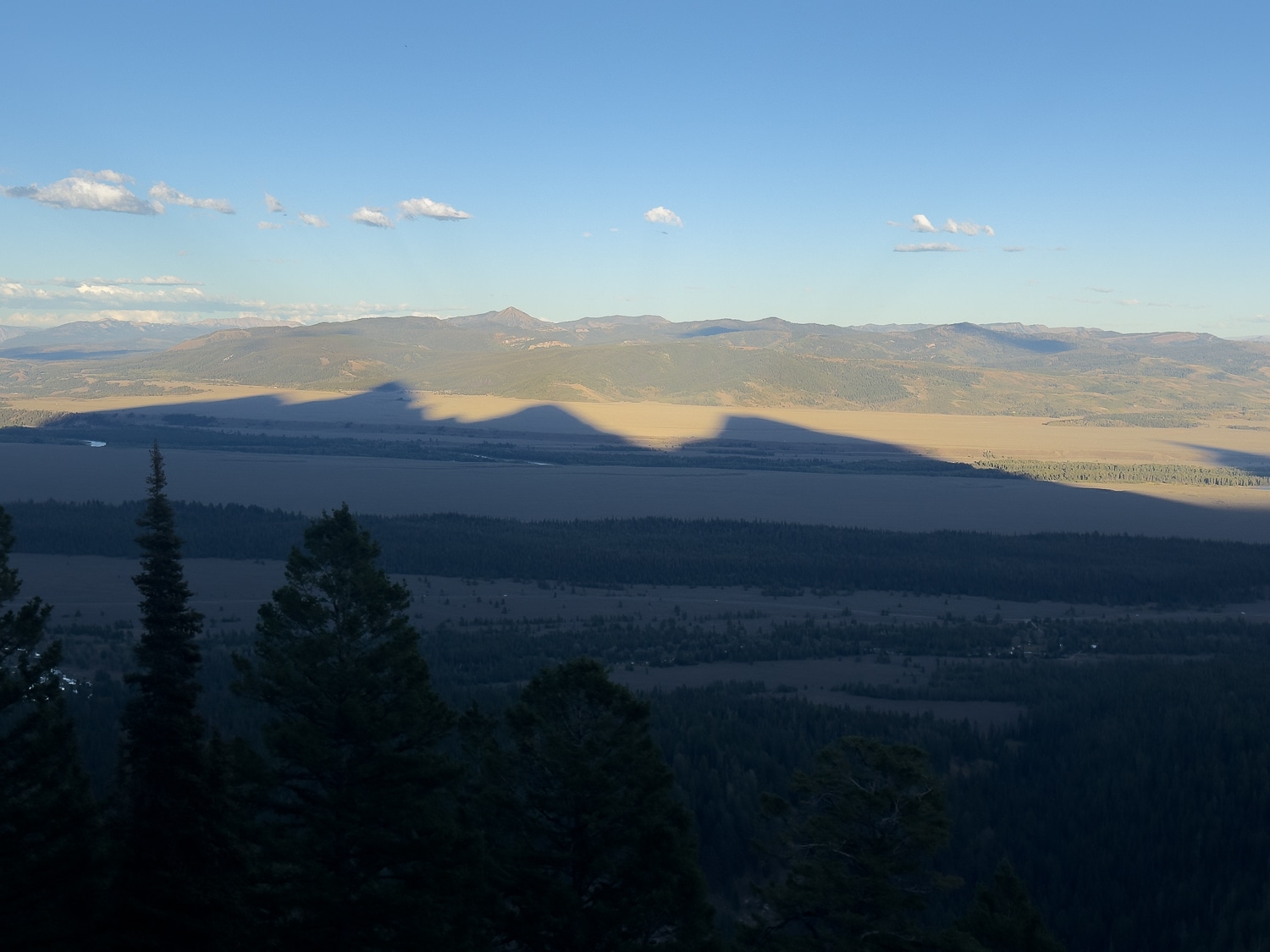
Generally, as ski/splitboard tourists, we gravitate toward open and quiet mountain spaces. In practical terms, words like roadless, illicit places where we are self-reliant. And, perhaps, a wild arena where slop, and scrolling, and the daily humming of our lives are muffled; at least to some extent. And if you’re lucky, while skinning within some roadless swatch, you might see an otter belly-slide across the snow. All this, the joy we find out there climbing then sliding, benefits from some solid policymaking. This is where we’re pivoting (hard) from the daily programming toward some of the political issues facing our public lands.
The current administration has proposed repealing the Roadless Rule, which governs new road construction on National Forests; public comment ends October 6.
In part one, we have a primer on the Roadless Rule. We reached out to the Winter Wildlands Alliance (WWA) with some basic questions.
What is the Roadless Rule?
WWA: The 2001 Roadless Rule protects 45+ million acres of national forest lands from new road construction, commercial logging, and certain forms of development. If you’ve toured in the West, you’ve almost certainly skied an inventoried roadless area, even if you didn’t know it. The original rule was backed by strong public support and went through more than 600 public hearings and received more than 1.6 million comments, with roughly 95% supporting roadless protections.
One important misconception is that “roadless” means that these lands are closed, locked up, or unmanaged. They aren’t. Roadless areas are multiple-use public lands. Forest Service thinning and fuels-reduction projects are allowed, as are grazing, both motorized and non-motorized recreation, and even certain timber harvests. The rule is specifically about maintaining the roadless character of these landscapes for wildlife habitat, clean drinking water, healthy watersheds, and recreation.
Note: Colorado and Idaho have their own state-specific roadless rules, making them exempt from the proposed repeal.
What are the upsides for the touring community if the Roadless Rule remains unchanged?
WWA: The simplest answer to this question is that the Roadless Rule helps keep the backcountry, the backcountry. Without roads to access the inventoried roadless areas, these landscapes can remain wild. It protects the character that backcountry recreationists seek out: a quiet connection with nature, solitude, the opportunity to escape to undeveloped winter landscapes, and the chance to push yourself in the mountains.
But even more than ski terrain, our water supply also depends on roadless forests. Intact forests can hold snow longer, allowing snowmelt to soak in gradually and recharge groundwater. Roads can do the opposite: compact soils, accelerate runoff, fragment forest canopy, and introduce erosion into headwater streams. This is increasingly important as we’re seeing more volatility in western snowpack, earlier melt, and more winter precipitation as rain rather than snow.
What are the downsides if it is changed?
WWA: If we lose a nationwide safeguard that’s protected millions of acres of Forest Service land for 25 years, areas currently free from new road building and commercial logging could become vulnerable to those activities. Once you build a road into an intact landscape, there are cascading impacts on forest health, wildlife habitat, and quiet recreation opportunities.
Our concern isn’t that every one of these places changes tomorrow. It’s that removing a layer of protection that has kept them intact for decades would make it very difficult to put them back together.
The Outdoor Alliance (OA)—a coalition of conservation-related advocacy groups—claims that more than 25,000 miles of trail, 8,500 climbing routes, vast stretches of whitewater, and 10,000 miles of mountain biking trails are at risk of impact if the roadless rule is repealed. (To prove their point, the OA has a handy map illustrating the vast amounts of land that may be affected. More roads increase habitat fragmentation.
***
Travel Management Plans—Where the Rubber Meets the Snow
National Forests manage wintertime travel through winter travel management plans. (As tourists, we often associate winter travel management plans with those zones/roads where there is motorized access. Read: snowmachines.
The 2005 Travel Management Rule required each forest to designate roads, trails, and areas for motor vehicle use. Before that, many forests were effectively “open unless closed,” meaning you could drive off-road anywhere not posted closed.
In 2015, the Over-Snow Vehicle Rule required forests to designate where over-snow vehicles may go, which is what a “winter travel management plan” refers to.
However, the administration has proposed a subtle but potentially significant rewording that will impact Travel Management on National Forests. Josh Hicks, a policy director at The Wilderness Society, helped me parse out the details. He explained that the administration is trying to flip non-winter travel management back to open unless closed. To be clear, “open unless closed” is less restrictive than “closed unless open.”
Open unless closed means motorized travel is allowed anywhere unless the Forest Service has specifically prohibited it. The default is access. If you can get your vehicle somewhere, you can go there, unless an order, sign, or map says otherwise. Closed unless open (also called “closed unless designated open”) reverses the default. Motorized travel is prohibited everywhere except on routes and areas the Forest Service has designated open, usually shown on a Motor Vehicle Use Map.
Note: Designations can vary by vehicle class, season, or purpose (such as firewood cutting or camping access). Hicks explained that one thing remains unclear: Does an open-unless-closed interpretation mean you can go anywhere you can get your machine unless an area is posted closed? Hicks added that no draft rule has been presented or formalized to better understand the potential outcome.
Further, as we understand it, not every forest has completed/formalized a winter travel management plan, and some are silent regarding restrictions on snowmachine use.
Clearly, as the next months unfold, a lot is at stake in the public-lands sector and in how it affects different communities within the outdoor recreation space. Some may applaud a new, less restrictive stance; others may lament it.
As with anything, the underlying nuances matter. And once seemingly unrelated rules like the Roadless Rule and Travel Management Plans may become intertwined. Hicks reminds us that the Roadless Rule helped define large zones. For example, if the rule prevented a swath of forest from being logged, planners sometimes managed these zones for recreation or wildlife. As a policy anchor, if a zone fell under the Roadless Rule umbrella, it may have been more logical to implement more restrictive winter travel rules.
That is, without the rule (as far as this thought experiment goes), managers may default to fewer restrictions as they develop winter travel management plans in an era when the Roadless Rule is null and void.
The slope may not be that slippery. Hicks added that new proposals and modifications to travel management plans would have to go through the NEPA/environmetal impact statement process.
Leave a Reply
You must be logged in to post a comment.