
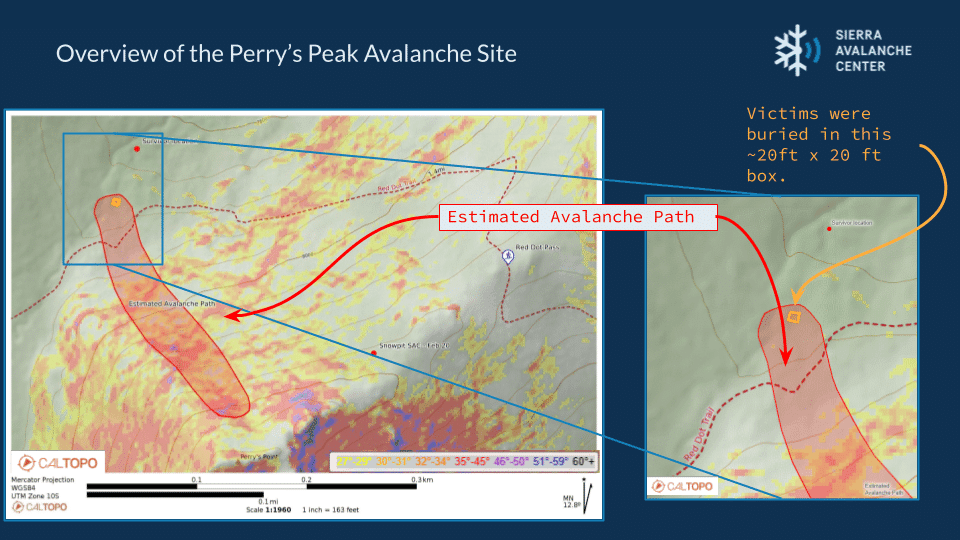
CAL/OSHA, the California Division of Occupational Safety and Health, issued Blackbird Mountain Guides (BMG) and its successors a list of citations, violations, and fines totaling $151,300 on 8/12/26. CAL/OSHA is the state agency responsible for setting and enforcing workplace safety standards. The fines were handed down as a result of BMG’s involvement on 2/17/26 in the death of nine tourers in an avalanche on the NW face of Perry Peak. The group included 15 skiers total, nine clients and four guides. Three of the deceased tourers were BMG guides. We won’t roll through all the incident details here, but the group was caught during a period of high avalanche danger as they exited from the Frog Lake Backcountry huts, where they had been staying for several days. The storm, which still raged while the group made for an exit, had been predicted.
Sierra Avalanche Center’s accident report stated, “The forecast for the area on 02/17/2026 was rated at High (level 4 of 5) at all elevations. The primary problem was Storm Slab avalanches on all aspects at all elevations. The likelihood was very likely, and the expected size was large to very large (D2 to D3). The bottom line read: ‘Travel in, near, or below avalanche terrain is not recommended today. A widespread natural avalanche cycle is expected over the next 24 hours. Large avalanches may run through treed areas. If attempting travel today in non-avalanche terrain, be certain that there are no steeper slopes connected to the terrain you are traveling, either above or to the side.’”
While no litigation has been publicly filed against BMG, the CAL/OSHA fines come days after BMG released an independent report they commissioned to detail the events surrounding the avalanche.
CAL/OSHA cited BMG for six specific labor code violations. After receiving notice of the violations and fines, BMG appealed the findings and the fines.
Here, we’ll list out the specific violations and violation-specific fines.
Citation 1
The first citation was for a failure to “immediately” report the death of three employees (the guides) to the proper authorities—the Division of Occupational Safety and Health. According to the CAL/OSHA citation, “immediate” means, “As soon as practically possible but not longer than 8 hours after the employer knows or with diligent inquiry would have known of the death or serious injury or illness. If the employer can demonstrate that exigent circumstances exist, the time frame for the report may be made no longer than 24 hours after the incident.”
BMG was fined $5,000.
Citation 2.1
While the next citation seems somewhat abstract for a guiding outfit operating in winter and being investigated for its involvement in avalanche-related deaths, BMG was assessed a $500 fine for failing to establish, implement, and maintain an effective heat illness plan. After reviewing the code in question, this may reflect holding BMG responsible for developing and implementing a plan to keep employees safe while working outdoors in excessive heat.
Citation 2.2
The next CAL/OSHA citation is broad in scope, holding BMG responsible for a wide-ranging program to inform and educate employees about workplace safety and hazards. While we’ll refrain from statements about the validity of the citation/violations, after reading the CAL/OSHA report, we assume BMG did not fail to ensure its guides were properly trained and certified in best practices. (What is clear is that mistakes were made: people—guides and clients—were killed.)
The citation found BMG of failing to “establish, implement and maintain an effective written Injury and Illness Prevention Program. The language in this section is broad and general and lists verbatim the code’s definition for what a proper workplace safety plan should include. For example, it states, “a system for ensuring that employees comply with safe and healthy work practices. Substantial compliance with this provision includes recognition of employees who follow safe and healthful work practices, training and retraining programs, disciplinary actions, or any other such means that ensures employee compliance with safe and healthful work practices.”
The fine for this violation was $16,200.
Citation 3
This is where CAL/OSHA weighs in, at least in the language presented in the formal Citation and Notification of Penalty, on ski-touring-specific activities. To prevent misrepresenting the findings, here is the full text of the violation (in italics):
1. The employer failed to effectively and accurately identify, assess, and anticipate the dangers of employees conducting guided ski tours in conditions in which avalanche hazard warning assessed the hazard to be ” high.” The employer failed to ensure that the risk in the field was minimized and managed, ensuring effective decision making for safe working conditions and work practices.
2. The employer failed to implement effective procedures to manage and minimize risk to employees while working in the field when made aware of the change in avalanche danger from “considerable” to ” high” for backcountry travelers with a recommendation not to travel in, near, or below avalanche terrain.
3. The employer failed to identify and evaluate the hazards of combining two guided tour groups together to travel through backcountry terrain with a high avalanche danger rating.
4. The employer failed to inspect and evaluate the AM operational Hazard and Risk Forms to ensure they were being filled out completely and correctly to reduce risk and human error and increase consistency and safety.
As a result, on or about February 17, 2026, three employees were fatally injured when they were struck by an avalanche while traveling in , near, or below avalanche terrain.
The penalty for this violation was $16,200.
Citation 4
Here too, we’ll let the CAL/OSHA language do the communicating regarding BMG’s specific failure to implement and maintain another aspect of their Illness and Prevention Program, and to train employees on specific ski-guiding protocols. (Cal/OSHA language in italics.)
1. The employer failed to provide effective training and instruction on their risk mitigation operational system to reduce risk and human error, ensuring that AM/PM forms were filled out accurately and completely, to efficiently and effectively minimize and manage risks in the field.
2. The employer failed to provide effective training and instruction to employees engaged in emergency response to ensure that employees coordinated with law enforcement and did not bypass established Incident Command Post.
BMG was assessed a $16,200 penalty for this violation.
The intent here is not to muddy the waters. BMG did not oversee the search and rescue operations; while this was a multi-agency response, the Nevada County Sheriff’s Search and Rescue team supervised the efforts. It has been reported that the owner of BMG and an employee first began breaking trail to the accident scene. (No doubt an arduous task.) Eventually, with the relative ease of following a track, some SAR members caught up to the trailbreakers. What seems to have happened, at least according to CAL/OSHA, is that BMG representatives, in some form or fashion, began a rescue attempt at the accident scene. This appears to have violated the Nevada County Sheriff’s Department’s operational procedures.
Citation 5
This citation deals specifically with PPE—personal protective equipment. It also relates to backcountry-touring-specific PPE: avalanche airbags and Avalungs. Black Diamond Equipment developed and sold Avalungs, yet they have not been available in the marketplace for many years. While there are accounts of Avalungs saving lives, and we are not here to debate their efficacy, they were not widely adopted. The premise of the Avalung was to allow a buried victim to inhale air (through a tube) and exhale through an exhaust valve that routed the CO2-rich air toward the Avalung pack’s bottom or back panel, thus delaying the onset of CO2 poisoning.
The fifth citation and violation read as follows (again, we’ll use italics to denote CAL/OSHA verbiage:
Citation: (1) The employer shall assess the workplace to determine if hazards are present, or are likely to be present, which necessitates the use of personal protective equipment ( PPE). If such hazards are present, or likely to be present, the employer shall: (A) Select, and have each affected employee use, the types of PPE that will protect the affected employee from the hazards identified in the hazard assessment;
Violation: Prior to and during the course of the investigation, including, but not limited to, on February 19, 2026, the employer failed to effectively assess the workplace hazards of employees traveling in or near avalanche terrain with highly anticipated avalanche conditions and failed to ensure that the types of PPE that will protect the affected employees from the identified hazards, such as Avalanche airbags and AvaLungs, were selected and used.
A penalty of $16,200 was assessed.
Citation 6
The last citation noted in the filing relates again to a section of CAL/OSHA’s Injury and Illness Prevention Program requirements. In particular, the fine and citation zero in on the “severity of the hazard” faced by employees (in this case a High avalanche danger rating) and a failure for BMG to have a hardened template for action/decision-making in such cases.
Below is the violation verbatim, again in italics.
Violation: Prior to and during the course of the inspection, the employer failed to implement and maintain an effective Injury and Illness Prevention Program that would ensure that identified hazards were corrected in the following instances:
1. The employer failed to implement effective methods or procedures to correct the identified imminent hazard of employees traveling in the backcountry with a high rising avalanche danger, when the employer failed to ensure that exposed employees were removed from the area of the hazard, in, near, or below avalanche terrain, or failed to ensure employees did not make decisions contrary to forecast recommendation, until the existing conditions were corrected. As a result, on or about February 17, 2026, three employees were fatally injured when they were struck by an avalanche while traveling in avalanche terrain.
2. On or about February 17, 2026, the employer failed to correct the unsafe conditions and work practices of employees by allowing an employee to bypass an Incident Command Post and enter into an identified high-risk avalanche area that was being managed under an Incident Command System, against the recommendation of local law enforcement.
Allow us to editorialize for a moment. While the violations cited and fines assessed in this specific instance might be a watershed moment for how U.S. guiding companies operate, CAL/OSHA seems to consider SAC’s High avalanche rating in the Perry Peak zone to be an official decree that somehow should have prohibited BMG (or any guide company for that matter) from operating under the rating. At least that is one take. As we understand backcountry travel, an avalanche forecast is one of several pieces of information to consider when developing a route plan and executing it in the field. It cannot be denied, however, that in this case the group was exposed to an area of high hazard and serious consequence.
Leave a Reply
You must be logged in to post a comment.