
Over the years, IFMGA guide Joe Stock has written several books. We’ve reviewed The Avalanche Factor. His guide, The Alaska Factor: Backcountry Skiing in Southcentral Alaska, and the Recreational Avalanche Decision Making Field Book have been well received. So when I see an email newsletter from Stock come through, which happened recently, I take note.
Here’s what the newsletter stated:
“I’ve practiced and taught avalanche rescue hundreds of times. I’ve taken 15+ Wilderness First Responder courses. But I’m not a rescue professional. I’ve never done a real avalanche rescue. My experience doesn’t extend much beyond fixing bad blisters. If things go sour, I’ll need help. Checklists and flowcharts help when things get complicated, like in a rescue.
“The 2024 issue of Accidents in North American Climbing had a nice article on avalanche first aid by Buchanan and Hartridge (aftertheavalanche.org). Their avalanche first aid flowchart still didn’t resonate with me, so I modified it. I carry a printed copy in my first aid kit.”
The flow chart Stock developed is below.
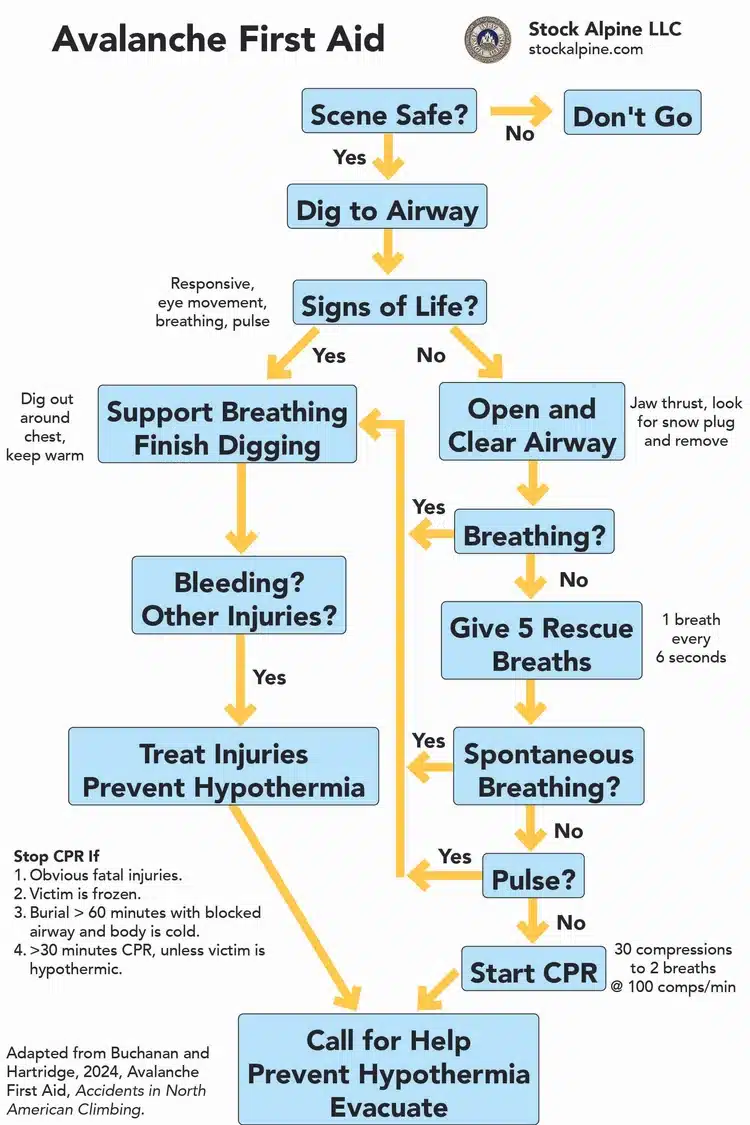
One thing I appreciate about Stock’s approach is that he took something that maybe didn’t resonate with him and presented the rescue process in terms and visuals that did. The key is that evidence-based first aid, resuscitation, and rescue are maintained in the workflow, are then practiced, and actualized in the field.
When asked what motivated him to develop a flowchart that he could comprehend a bit better, Stock explained that he’s taken numerous trainings, but he doesn’t get to practice, for example, with first-aid, with the frequency that a ski patroller might. I can relate to the rustiness that may develop with a lack of practice (especially real-world practice) when it comes to proficiency during the avalanche, the subsequent rescue procedures, and the best actions to take once your partners are discovered.
If you read most ski-related websites, you likely know that the past week has been a heavy one regarding harsh avalanche incidents in Europe and the U.S. Last weekend, six skiers were killed in France, while two skiers amongst a party of four were killed in an avalanche near Longs Pass in Washington. Additionally, an incident in Haiyaha Couloir in Rocky Mountain National Park on 1/10/26 had me gripped. (You can read the report here and see the video capture below.) There was a shoulder dislocation, but thankfully, all those affected were rattled but came back home.
Dr. Patrick Fink has written and spoken about some key aspects of rescue scenarios for The High Route. After reading Joe Stock’s newsletter, I revisited an opinion piece of his and was reminded of this statement:
“Collectively, we’ve come a long way from the days of the avalanche cord as a risk mitigator. The field of avalanche science has shifted its education attention from shear stresses, fracture planes, and crystal types to an emphasis on terrain choice, decision making, heuristic traps, and group dynamics. Technology has followed suit, producing user-friendly beacons and airbag backpacks. Pivoting to focus on the factors that truly improve human survival in avalanche terrain has, on the whole, been a highly successful endeavor, with annual avalanche fatalities remaining essentially level as backcountry ridership has exploded. Lack of medical knowledge remains a gaping hole in avalanche education and may represent the next chance to improve survival after an avalanche.”
Onward.
Leave a Reply
You must be logged in to post a comment.