What do I need to hear?

Editor’s note: After a long-weekend in Bozeman with the older child, I planned to head to SLC to tour with Pete Vordenberg. And, well, as the news from the Tahoe region and more localized slides and accidents became apparent where Pete and I planned to tour in the Wasatch, I headed home to Bend. It’s not that I didn’t trust myself or Pete. It’s simply that I wanted to be less proximal to any potential woomphing, or to tax myself making “wise” choices that are really disguised luck. And, yes, we could have found safe low-angle terrain. That was Monday. Pete and I chatted on the phone that day. We discussed writing something related to all the bad news. (Below is what Pete sent along.)

Then, early Wednesday morning, my phone rang. Unable to locate it immediately, I let the call go. Seconds later, phone in hand, I could see a near-real-time transcription of the message. In short, it was the “call me,” type message. I could tell, without listening, that the tone was morose. Stratton Matteson, a beloved individual here in town, had lost his life in an avalanche on Tuesday. So I sat on Pete’s short essay for a few days. Please proceed with the reading. But, as always, please proceed with caution. But also take a moment to be joyous like Stratton, who was the most stoked out there. 

***

There is deep, soft snow. And there are bold lines drawn upon it. And there have been several deaths and serious injuries in the last few days.

If we have been out backcountry skiing, then it is probably not true to say we have been smarter or better educated than anyone else. It is likely more accurate to say that some of us have been lucky. Some of us have not.

This season, I have been directly under four slides that passed just before and/or just after I was there. As in minutes and in one case maybe an hour.

For now, let’s put away arguments against free-will; we will return to that, but let’s just say that decisions matter. Decisions led me to be in these places, and luck let me walk away.

Some may say, “Hey, you balance risk vs. reward.”

Yes.

And I do not believe there is actually much of an equation there. Because, despite our experience and education, the feedback we get on our risky endeavors is completely skewed. Typically, we weigh an idea of risk or potential consequence against an actual experience of reward. The idea of risk actually weighs nothing. Even with a risk rating, the actual risk is conceptual.

If there is an equation, it might be something like this:

The avalanche danger is this, as rated by yourself and/or others: dangerous or safe.

The choices you have are these: ride it or don’t.

The potential outcomes change greatly, incrementally, or not at all, based on those choices.

Among us backcountry skiers, there are people for whom a pretty high risk is going to be a given. These tourers knowingly choose big risks and are presumably comfortable with that. There are people who take very, very low risks. They do not put themselves in harm’s way, though it still carries some risk. Most of us probably bounce around between these extremes. We are choosing to ride the most fun thing we can, thinking we are wisely mitigating the known risks. We are using our education to some degree, but we are also using our experience. This is the big point: the feedback from our experience has very likely not been accurate. We are alive and unharmed, and so we think we’re making good or at least good enough choices. Our experience is actually working against us, but this does not become apparent until it does.

I am certainly in this middle group. My risk tolerance bounces around based on a shifting conglomeration of factors. I am probably making good choices sometimes within the context of skiing fun terrain. And I know I am also one lucky bastard. 

Is there anything to do here? What do I need to hear or read? Are we simply playing a game where some of us are going to get hurt and die? Should we just do our best and know it may not work out? Or is there something we as a community are missing?

Lack of free will might actually be the argument we should better investigate. Our actions may, in fact, stem from circumstances and conditions set in motion long before they take place. Our decisions may, in fact, only serve to justify what we do. If this is the case, as a community, could we and should we create the conditions that lead to safer actions? Certainly, in a way, this is happening. Because so many people are out skiing and riding, and the number of deaths has not risen correspondingly, things like avalanche forecasts, classes, articles, and so on influence our behavior.

But what about me? My actions are not always in line with coming home. And I am far from alone in that. We have made a circle. Are my actions the result of freely made decisions or pre-determined based on conditioning? Maybe it doesn’t matter. If I want to be sure to come home, I must create the psychological conditions and protocols ahead of time that make the safe choice easier to make. When I am tempted away from the safe terrain I’ve decided on for the day into the steeper terrain I originally crossed off the list, how will I develop a system that overrides a lack of discipline to avoid that temptation? With all that is written, and that I have read, the accidents, the warnings, the ratings, what is it I still need hear?
Responses

  1. Barry Wicks

    Amen Pete.

  2. Peter Vordenberg

    I certainly welcome thoughts and ideas here in the comments.
    I would like to share this nice piece as well:

    https://www.drewhardesty.com/pull-the-andon-cord/

  3. Andrew Ross

    This topic deserves some discussion. I’ll try to contribute, but fair warning: these are some half-baked ideas.

    One of the handful of lessons that stuck with me from my AIARE 1 class was what our instructor said during the debrief of our day in the field: “The most dangerous part of the day was probably the drive to/from the trailhead.”

    According to Bruce Tremper (https://utahavalanchecenter.org/blog/15826), my instructor was probably right.

    Here’s the thing: I usually know when I’ve had a close call in the car. I don’t need to have a full-blown collision to get the negative feedback, and learn a valuable lesson. I’ve got a good sense for when the people around me, or I myself, are driving dangerously.

    But In avalanche terrain, you often only get that negative feedback in the most catastrophic ways (Peter, you made this point well), and it’s only apparent after the fact. It’s too easy to ski something you probably shouldn’t have skied, and get away with it without learning anything.

    I wish I had a better feel for when snow conditions begin to approach dangerous territory, the way I do behind the wheel. I wish I had a better way to compare the risks I take in the backcountry to the risks I encounter elsewhere in life.

  4. Barry Wicks

    Today walking around on my skis in Canada, i heard the wind on the trees, bird chirping in the distance, whumphing snow in flat meadows under my skis, my heart beating in my ears, and the the little voice in my head of my favorite mountain guide Larry saying “if you don’t go some where stupid, nothing stupid will happen.” Maybe what we need to hear, is that skiing, especially backcountry skiing, isn’t actually about skiing. Its just taking our skis walking, seeing the mountains, seeing the clouds, the sky, the snow, the trees, the rocks, the animal tracks, the pine cones. And then every once in a while, we get to float down steep terrain on fluffy snow. But if the floating on fluffy snow is always the point, then we have a problem. We must resist the pull of the powder siren, lash ourselves to the mast, and make the walking and the seeing and the listening the point. The floating on powder is just a bonus if we get lucky. That way, unlucky just means we didn’t float on powder, not that we are dead.

    1. Whit

      I really feel this is key. Years ago I made a bumper sticker, “it’s all about the UP” mocking a BD marketing slogan. Nevermind it mostly resonated with my Michigan friends. Version 2 would be “It’s all about the tour.”

      I’m happy to meadow skip on <30 deg slopes until spring but I certainly have gotten lucky, a lot.

  5. David Hubbell

    You can simplify it. If bad structure exists which could allow for an avalanche, you are relying on luck on or under +30 degree slopes. If you ride a lot, don’t rely on luck.

    For example, I won’t be on steeps on the shady sides until the weak layers are a solid four fingers plus, and probably not until I’ve seen some new snow avalanches not step down in to the January basement.

    There are so many good things to read. “Yin, Yang and You” by Roger Atkins strikes me as one of the best mindset articles for a long life of riding wild slopes.

  6. John B

    This is probably paraphrased at this point but I once saw something Doug Krause wrote/said “some days are good days to stay at home and make soup”. I try to make plenty of soup through winter but my version of soup is not always made in the kitchen. Sometimes it’s getting a beer with a buddy, flogging myself on my Nordic skis, taking the dog for a nice walk or eating acid and howling at the moon.

    I try to tilt the odds in my favor a bit by being willing not to get out in the backcountry on days where I’m not feeling this. This typically results in me skiing a bit less than I want, but I know my dog appreciates the long hikes.

  7. Kam DH

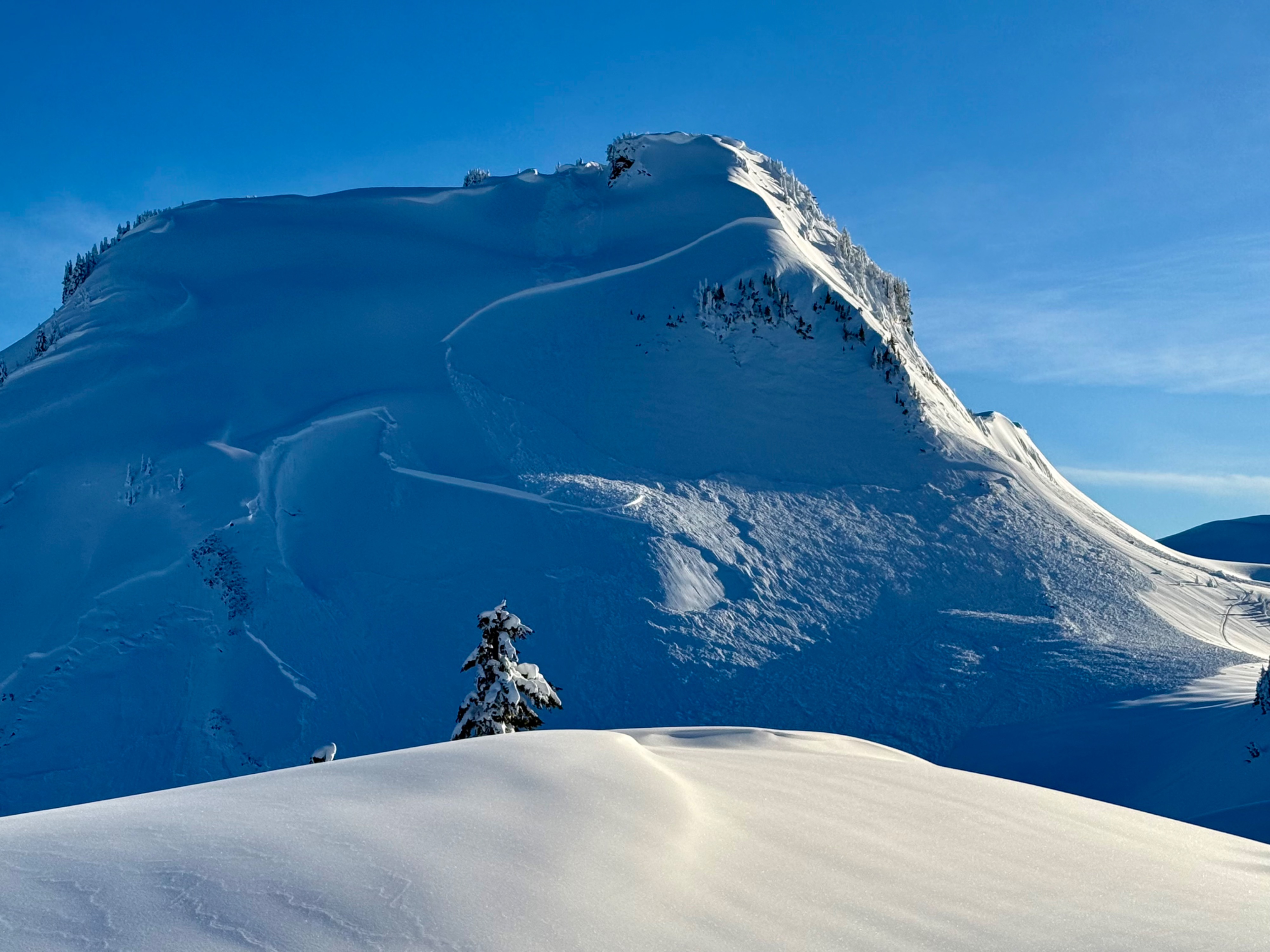
    Washington also finds itself with widespread, if inconsistent, weak snow throughout the range. Some friends were out for a beautiful bluebird powder day (with no PWL avalanche problems listed) and narrowly missed getting smoked by a D3 natural that took out multiple skintracks (https://avalanche-org-media.s3.us-west-2.amazonaws.com/IMG_5594_69a395983a90d.jpeg). Big warming came in that day, and the buried dragons woke up and showed themselves.

    By chance, I had met Stratton around the corner from there just 3 weeks ago. Our groups were enjoying another bluebird powder day. That stretch of clear days may have been the cause of the weak layers in the large avalanche my friends observed this weekend. And Stratton had just helped in a rescue of a solo rider who had been caught, carried, and injured the day before.

    In a low probability high consequence setup, I agree it’s certainly luck that keeps you safe or gets you in trouble when exposed to steep slopes. Most of the times, you can be ok–it’s low probability. But best not to rely on that dice roll too many times. If it’s a 1/100 chance of something bad, you only expect to be able to roll that die 100 times before bad things happen, and you’re running a good probability of them happening earlier.

    Condolences to the friends and family of all the people who have been killed this year

  8. Scotsman

    Are we simply playing a game where some of us are going to get hurt and die? Should we just do our best and know it may not work out?

    For me, this is the sentence that sums it up.

    I’m a backcountry skier/ Ski mountaineer and I accept the risk involved. I do everything I can to reduce that risk by education, experience and critical thinking.
    I know I can play it safe by skiing in non-avy terrain and still have fun but sometimes I choose not to.

    Fact is, I enjoy the risk and accept that even on a successful day ( Nice line, nobody got hurt) I may just have been lucky. However, experience does help mitigate the risks and I enjoy trying to master the necessary skills.

    My risk tolerance has changed, when my son was growing up, I kept it low.
    Now( and I’m in my probably the final decade of my high level skiing life) my son is grown and my wife and family understands the risk I am choosing to take.

    Free will.

  9. Jerry Johnson

    I like the fact that people are thinking about risk. One thing we found in our hundreds of GPS tracks and skier surveys is that risky behavior is mostly contingent on the avalanche danger rating. As I say in our book Making Decisions in Avalanche Terrain (https://www.avalanche-decisions.com), most people are not skiing the risky slopes when danger is considerable or higher – they dial it back just like they do when they drive icy roads, have sex, or engage in other risky behaviors. In addition, most people just don’t do these things. One problem I have with the avalanche community is the overemphasis on death and hero skiing. There is not all that much of either but the sport seems to take a certain level of self-worth from the perceived danger. That has gotten worse with social media. Having a close call with four avalanches in a single season that isn’t yet over isn’t luck, it’s not paying attention.

    1. Jason Albert

      Hey Jerry, thanks for jumping in here and adding your perspective.

Leave a Reply

We are a reader supported independent project. You are beginning your free-article count on The High Route. Thanks for stopping by.