
Disclosing one’s trip before it’s complete might be bad form. The kids call it spray. Old folks call it weak. Either way, I’m planning a late-March traverse in Canada. If you’re reading this first look around the original post date, assume the mission is still incomplete. The traverse will last 7-9 days under optimal conditions. There are a few faster youngsters on the team, and their dads. I’m one of the dads. Being very early spring, just past the apex of the spring Equinox, we’re not expecting balmy temps. So, in considering our sleep systems, shelter, and extra puffy clothes (I’ll have a robust down jacket and synthetic pants to supplement the 10-degree Feathered Friends bag), we hemmed and hawed. The hemming and hawing focused much on the shelter, which, as you know, on a more-than-one-person trip, is group gear.
My son and I settled on bringing a mid. And we’re hoping that was the correct choice. Part of the rationale is the prior use of mids on two of three longer multi-day traverses. Mids are great considering how spacious they are, the ability to cook/melt snow inside, and their ability to withstand most high-wind scenarios and maintain shape under most snow loads—yeah, we might have to get out and help shed the snow load, and…they are light.
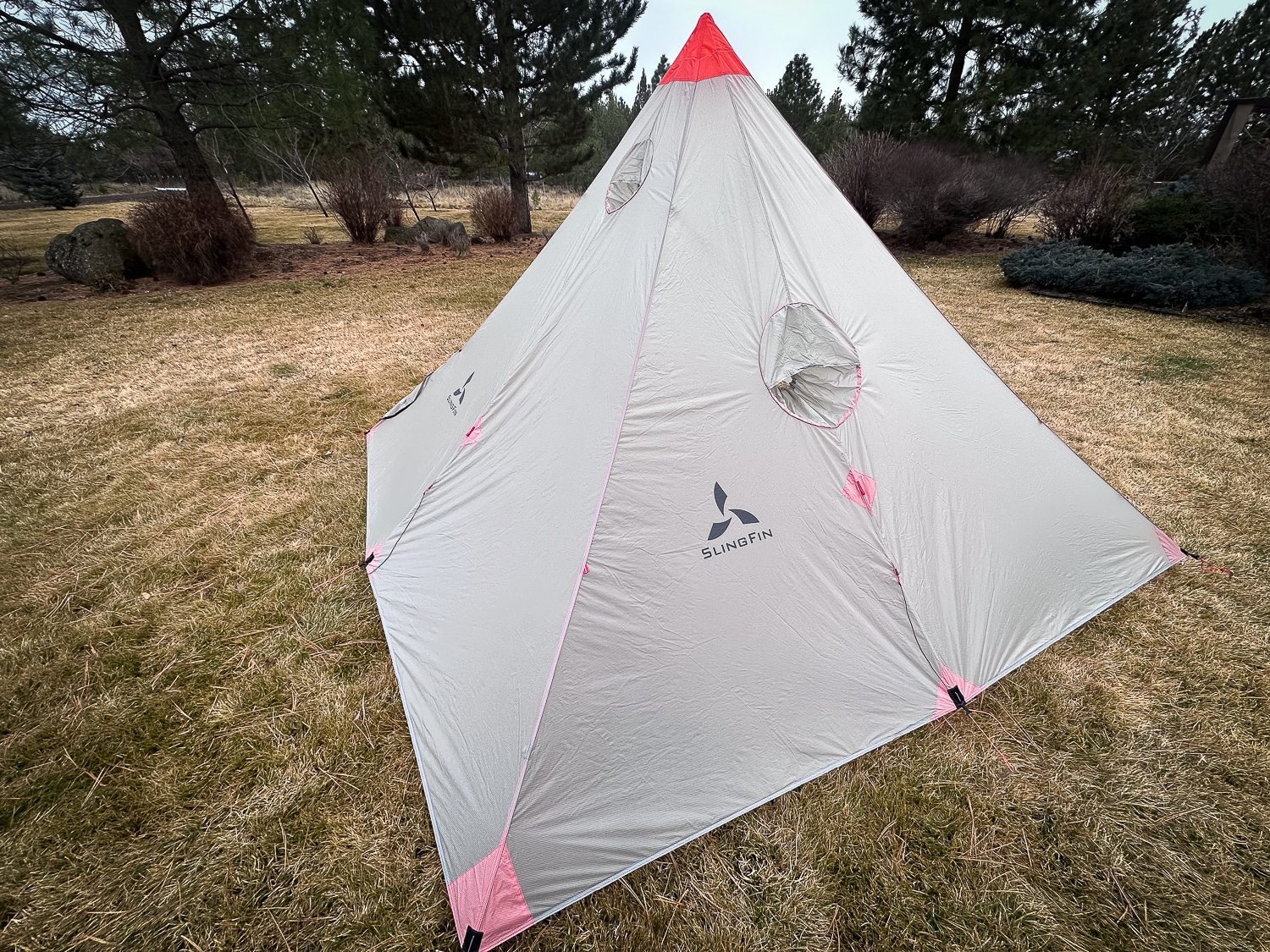
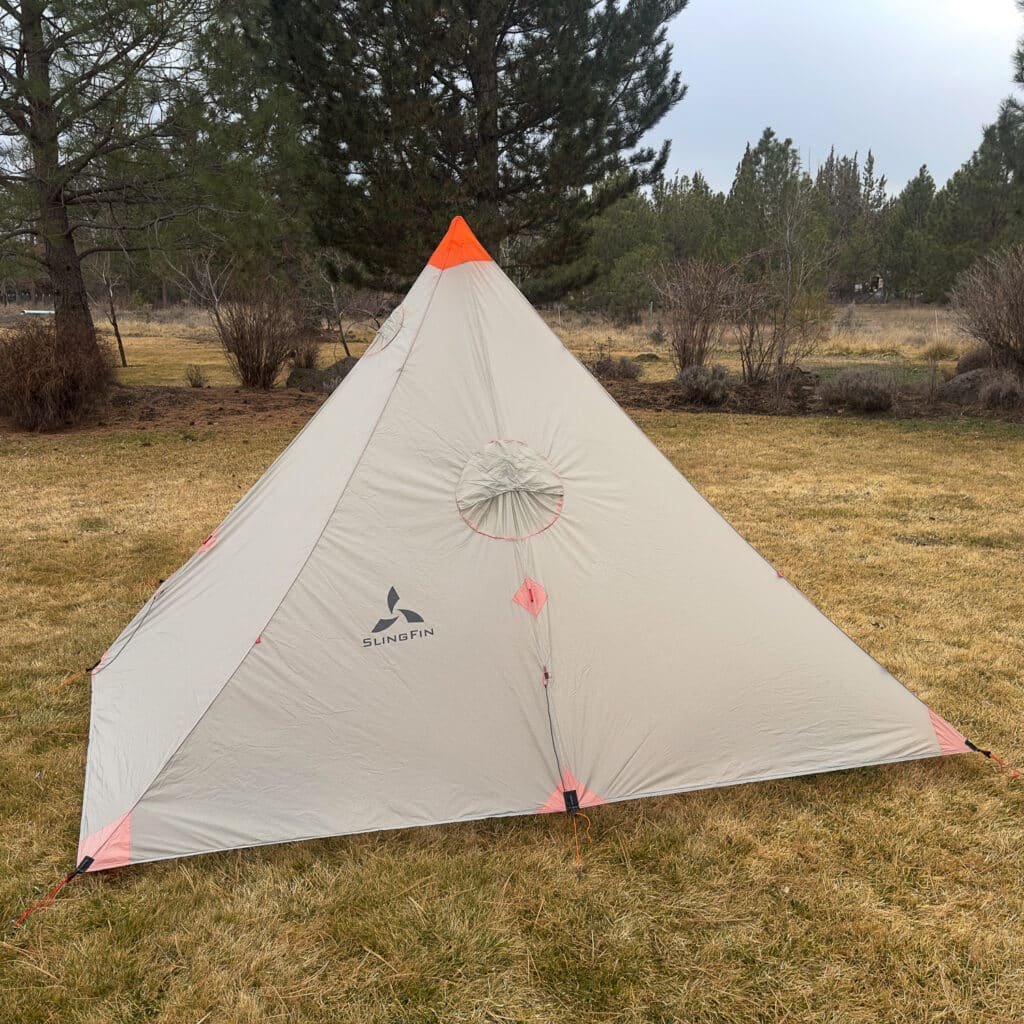
We opted for the SlingFin Cinder Cone, which weighs a claimed packed weight of 1.11kg (2lb 7.4oz (1.11kg). This spacious mid has an interior footprint of 108″ x 108″ (274cm x 274cm). That leaves room for changing, packs + gear, and my child’s 6’4”+ frame.
We had considered bringing a tent—something like the Hilleberg Nalo 3P, which is an excellent tent weighing 2.7kg (5lb 15oz…let’s call it 6lbs). Let’s just say that we split the tent into two packs and, well, the setup became a pain. On the next trip, we brought a mid. And, for the most part, we were psyched. But there were some cold nights.
Any mid requires some labor after a long day of traversing. There’s a flat(ish) platform to stamp out. There’s some modest weatherproofing/wall building if wind/snow are expected. There are strategic interior zones to dig out, and some raised ones, too, if you choose to get more elaborate. So, yes, we vacillated: tent or mid. And yes, too, we considered a single-wall tent, like a 3P Firstlight, despite the predicted battles with condensation and wet sleeping bags. But that mirage lasted for only a day or two. The ease of a minimalist tent and its quick setup at the end of a long day were alluring, though.
Back to SlingFin and the Mid
SlingFin has been on my radar since 2013, when I worked on stories about carbon fiber and the R&D efforts to make America’s Cup catamarans haul at ungodly speeds. While in San Francisco reporting those stories, I somehow spent time chatting with Slingfin’s founder, Martin Zemetis, who helped design timeworn expedition tents from The North Face, Sierra Designs, and ultimately, Mountain Hardware. Zemetis is the real deal when it comes to tents. Considering his design chops and gear, the legendary John Middendorf comes to mind.
So here we are, 13 years later, and boom, a Slingfin product made its way to Bend, Oregon. But there are plenty of solid mids out there. I’ve had great luck with my friend’s MSR Front Range 4 Person Ultralight Tarp Shelter. I also own a first-gen BD Mega Mid. Yup, it still works after about 25 years, but it’s heavy and stinks. Several minimalist-oriented companies sell excellent lightweight mids, and then there’s the HMG ULTAMID 4 – ULTRALIGHT PYRAMID TENT, made from Dyneema, weighing a claimed 635g (22.4oz.) and costing $880.00.
Slingfin’s Cinder Cone retails for $490, and the main panels are constructed from 10D NY66 RS sil/sil. Key here, at least on paper, and hopefully in practice, is the sil/sil. The Cinder Cone is made from lightweight Silnylon, and the sil/sil means there’s a silicon coating on both sides of the fabric. Silnylon is not breathable.
One added caveat is that the Cinder Cone features three strategically placed vents: two are higher up, near the pyramid’s apex, and the other is larger and situated lower down. Slingfin calls it a vent/window. No matter, all three vents can open/close with drawstrings, and we trust, will be weatherproof. We hope the vents, if it is not too cold, can be opened, perform as designed, and eliminate or decrease condensation.
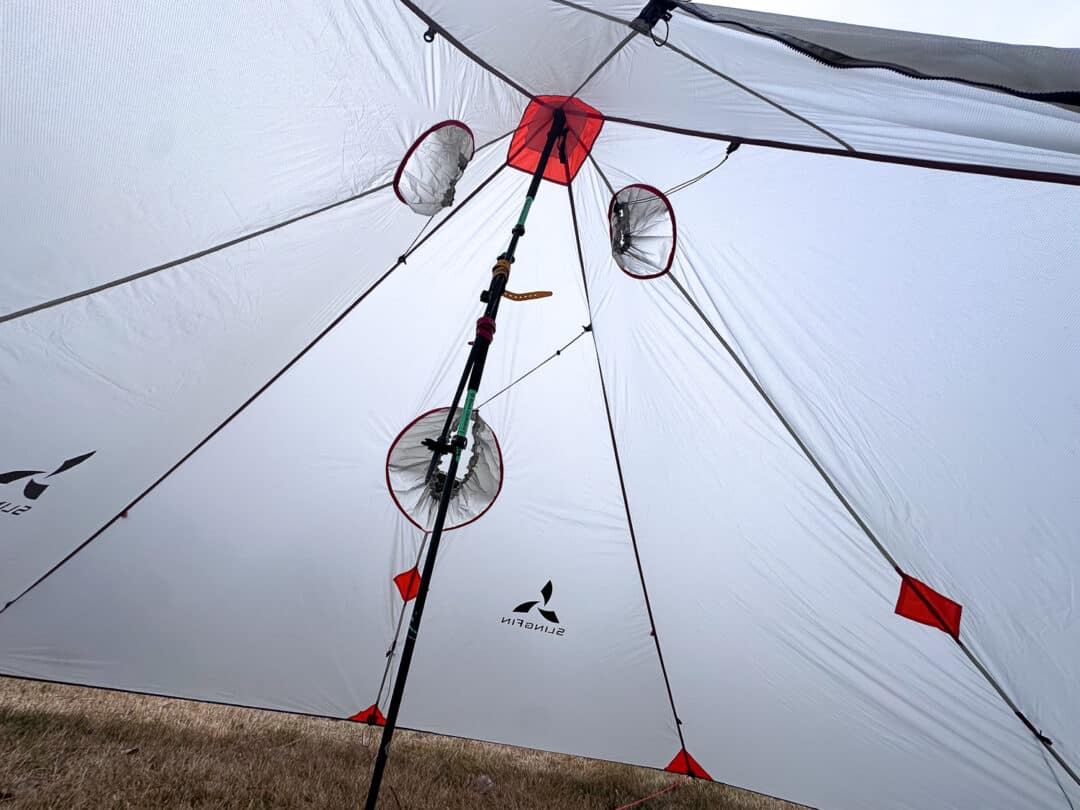
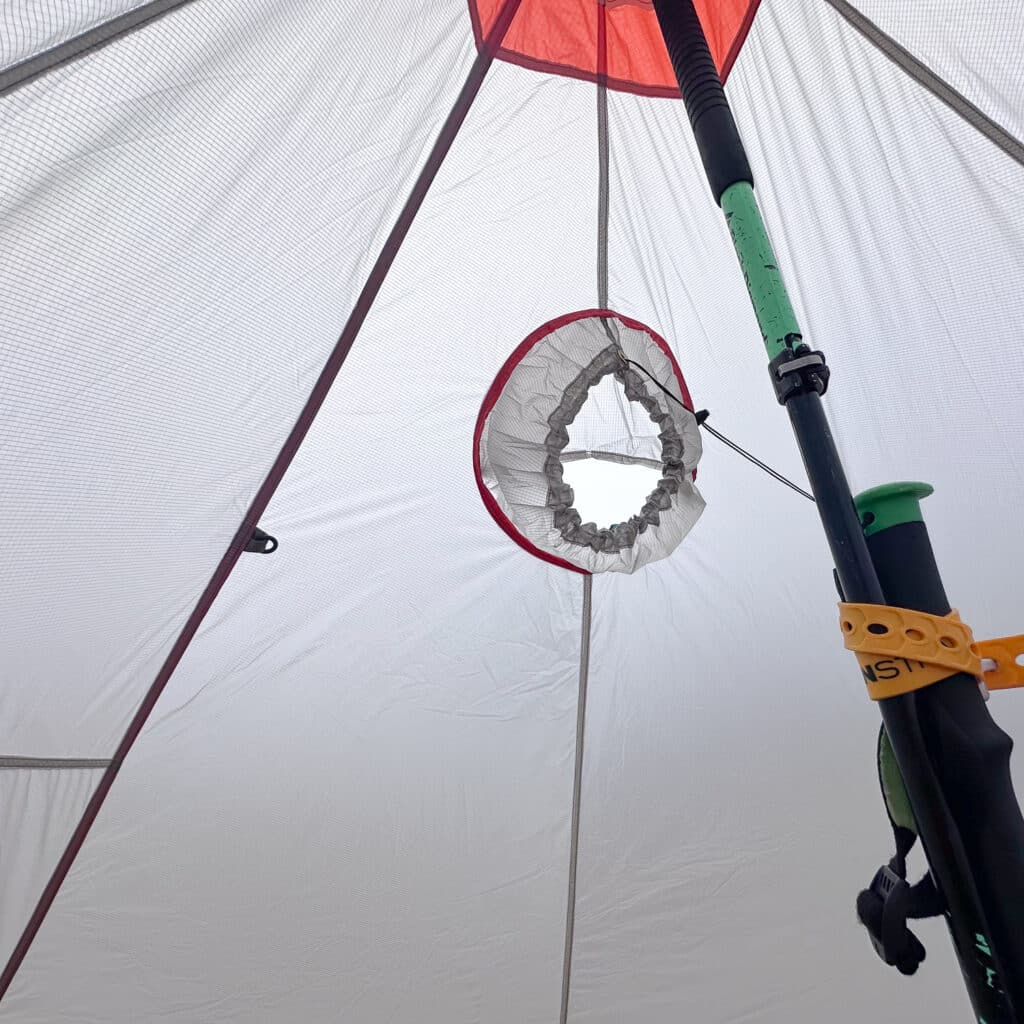
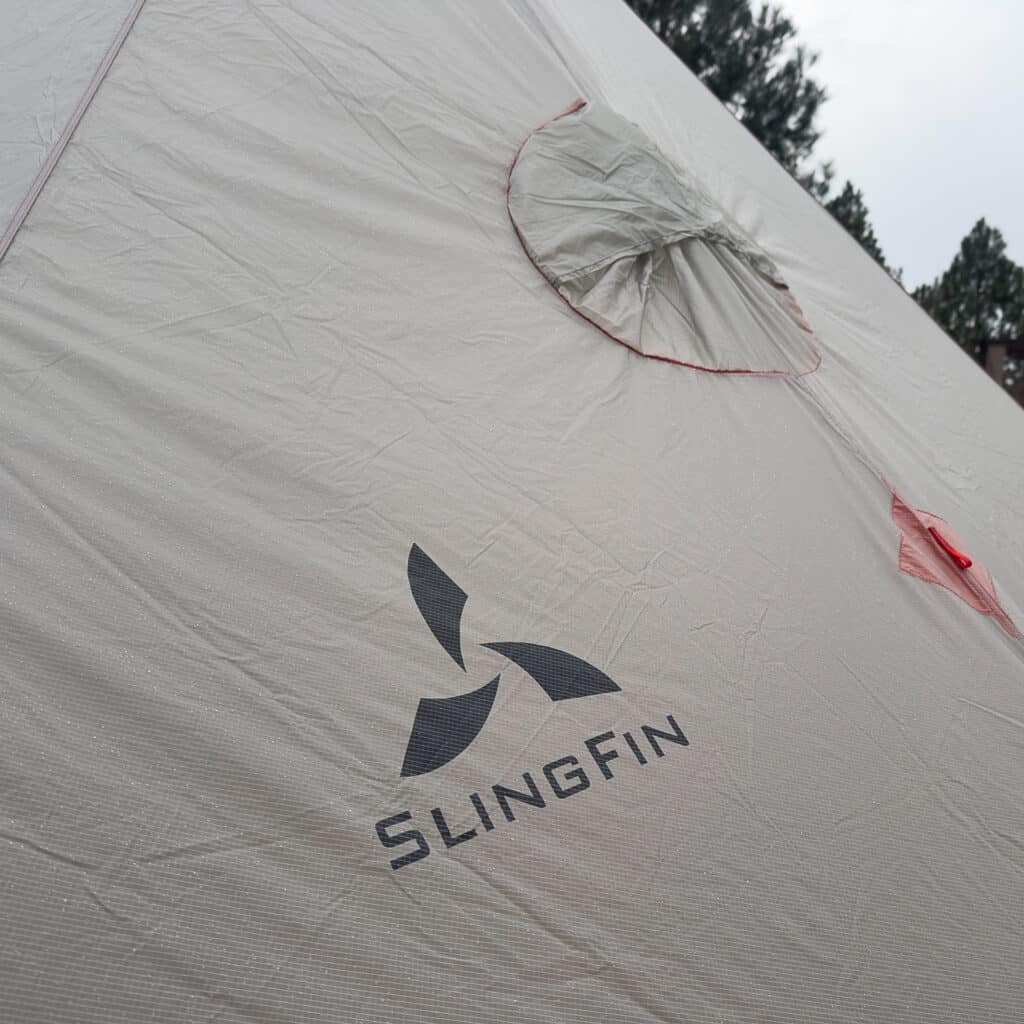
SlingFin also incorporates what it calls Perimeter Pull Vents along the four main panels. From the inside, the idea is that one can tension a cord that raises the panel’s bottom edge from the middle. When raised, working in conjunction with the three thru-vents, a chimney effect is created, helping reduce condensation.
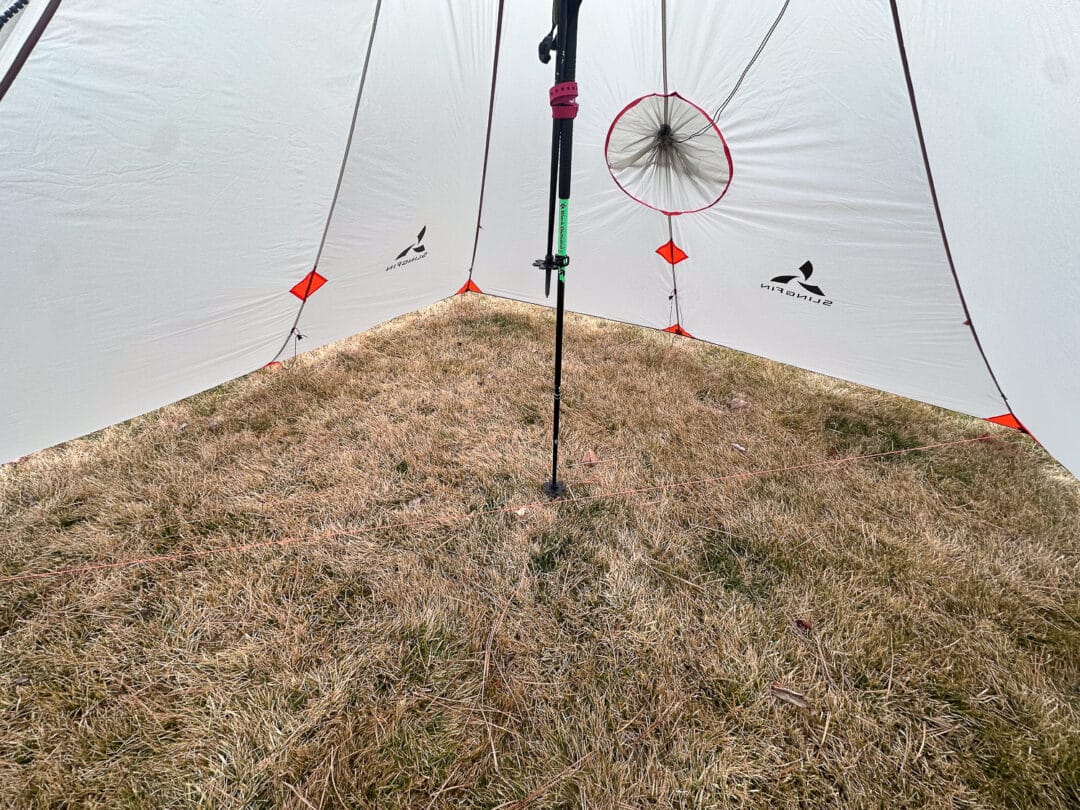
I was also drawn to the Cinder Cone for a simple yet elegant addition. Running from one corner to another, diagonally across the floor, is what SlingFin calls the Quick-Pitch Dyneema cord. Here’s the marketing copy, and it’s true: “The Quick-Pitch cord sets the correct distance between the corners, giving you a perfect pitch every time and avoiding the dreaded ‘Rhombus.’ If you’ve set up a mid before, you get it. The Quick-Pitch cord can be easily unclipped when the tent is in use.”
I have pitched a mid, and I know the rhombus and all sorts of other fubar efforts to square a mid. Upon my first solo effort to pitch the Cinder Cone, the Quick-Pitch cord, although simple and something I could probably incorporate into any mid, was genius. Staking the corners out proportionately to maintain a square base required very little fiddling.
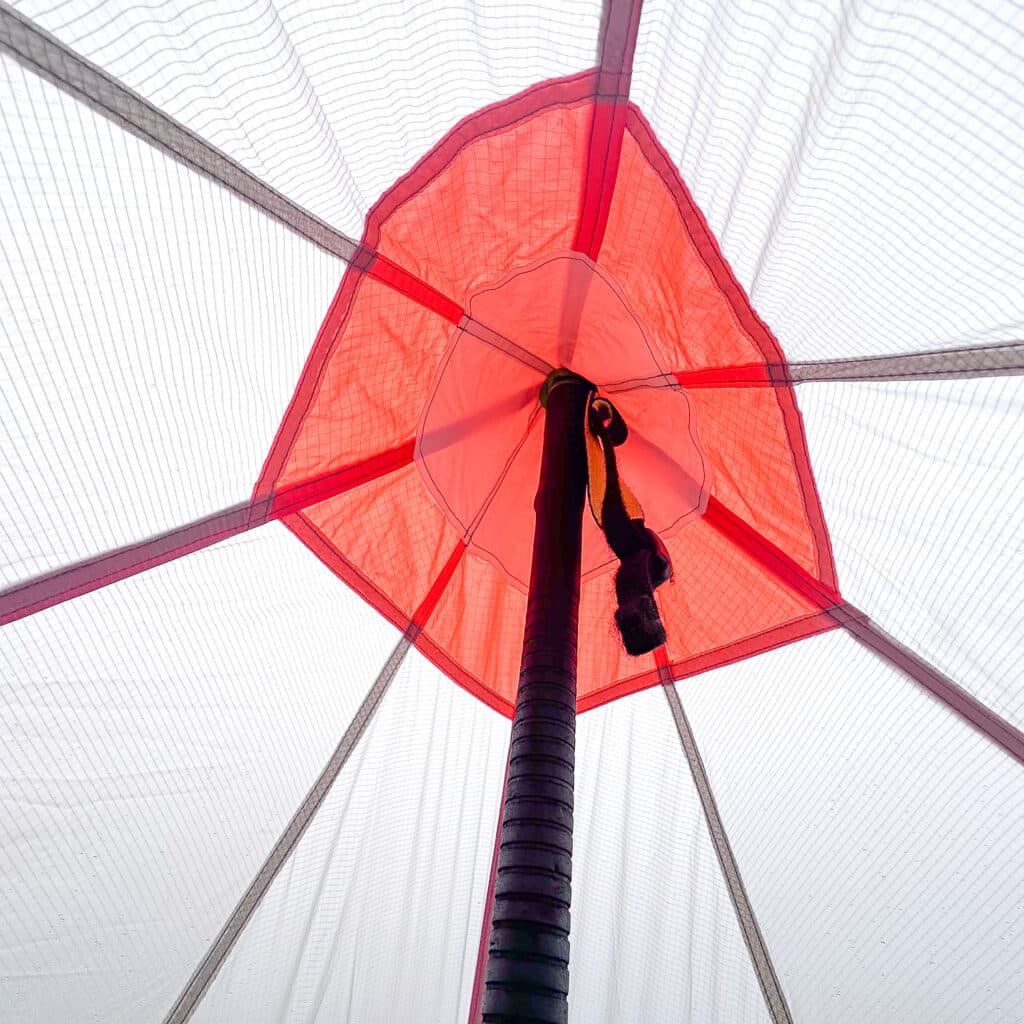
Lastly, the top cap, or tippy top of the pyramid, is reinforced with ALUULA Durlyte HH-155.
We’ll report back on how it all works in the field.
SlingFin does sell a segmented carbon pole for use as the center pole; however, we’re opting for the 2 x voile strap + 2 x ski pole center pole method.
Cinder Cone 4P Pyramid Tent Features:
- 10D NY66 RS SIL/SIL has exceptional UV resistance and tear strength for the weight
- ALUULA™ top cap reinforcement has the best durability of any lightweight composite fabric ever made
- Sets up with I-pole (not included), ski/trekking poles, kayak paddle, skis, etc.
- YKK VISLON™ Aquaguard zipper outlasts coil zippers and keeps rain out without a zipper flap
- Zipper has 2 preinstalled spare sliders to prolong zipper life
- 2 upper drawstring thru vents
- 1 large low drawstring vent/window
- Super packable: silnylon packs down to a fraction of the size of DCF
- Radial Seam Tape reinforcements on corner seams to increase strength and maintain stability in wet conditions
- Perimeter Pull Vents allow airflow under the bottom perimeter
- 4 perimeter pull out loop tensioners
- 4 corner guy loops
- 3 mid-panel webbing guy loops
- Straight cut sides can be sealed against the ground
- Bottom perimeter nylon herringbone reinforcement for added abrasion resistance
- Includes 7 120″ 1.5mm Dyneema core reflective guylines with pre-attached tensioners
- Internal o-rings for hanging gear
- Includes 8 size L DAC J-stakes and 7 size MS DAC J-stakes
- 20D PE-coated reinforcements
- Quick-Pitch cord makes setup easy
- Integrates with Cinder Cone Mesh Body and Tub Floor (coming late 2024)


Leave a Reply
You must be logged in to post a comment.