
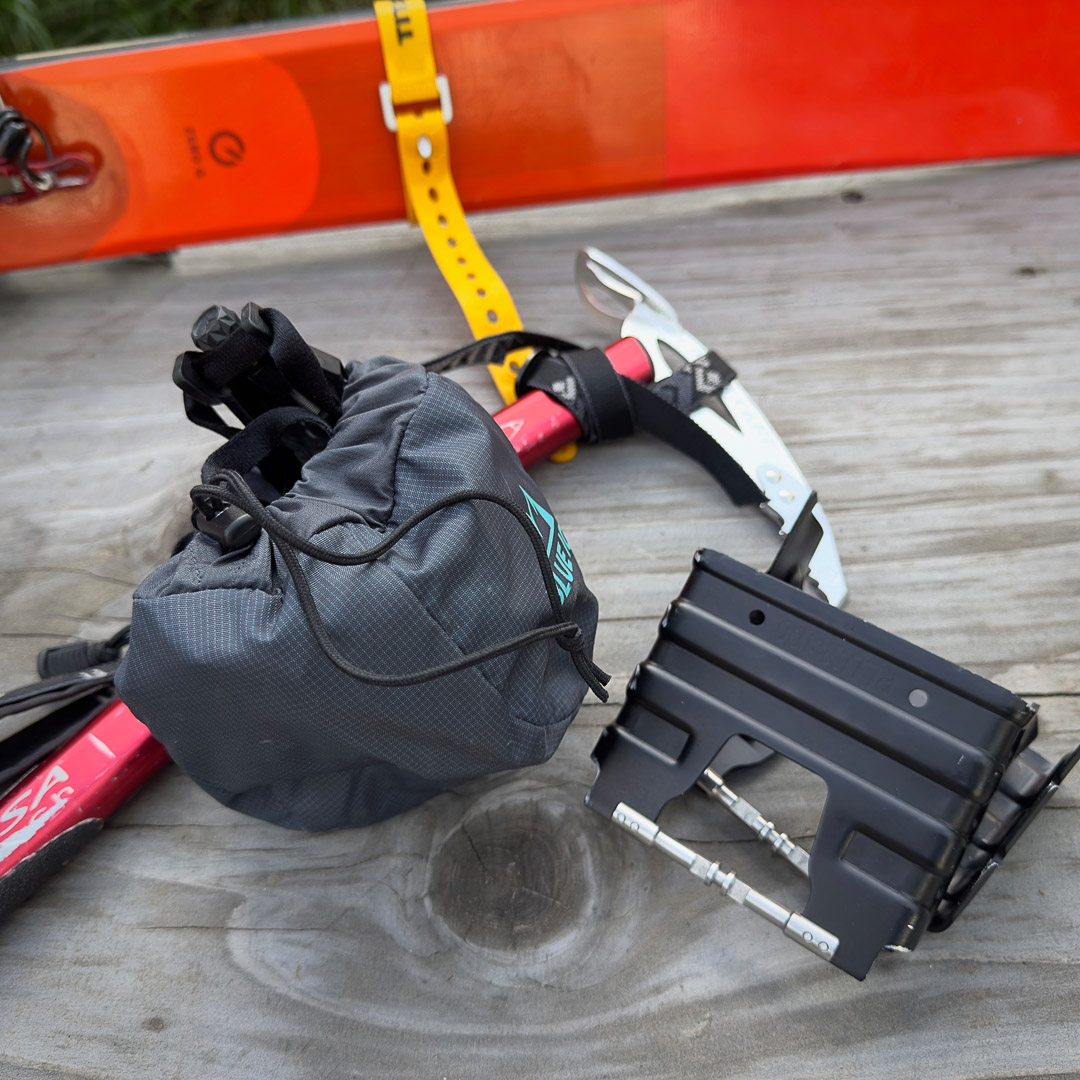
I like to think that, when it comes to gear, there are a few basic, agreed-upon pieces. Bring the avalanche safety gear and know how to use it. Have a splitboard or skis with functional bindings and skins, and occasionally wax the ski base, especially in spring. Boots, they are key, too. Hey, because we are open-minded, let’s include a POW surfer as a viable snow sliding tool, too.
Without these items, you’re unlikely to be touring. Could you tour sans clothing? Sure. But brisk temps will take their toll. Surely, the list of items could and should expand.
Ok, here’s a task: look around pretty much any touring group, and you’ll note a diverse array of gear and colorways. Five members in your group, and it’s usually five different packs, jackets, pants, and on and on. I’ve chuckled these past few years with the onset of designs and designers claiming they’ve nailed it, say with a pack design—that they’ve bent the space-time continuum to their will, and behold, the core market shall kneel at thy feet while wearing said pack.
It doesn’t work that way. Some pieces of gear work exceptionally well for some tourists, but not all tourists. I’ve been thinking of this notion for a few months after listening to some minimalist dogma from some fellow ski tourists. Which got me thinking about the essentials, like the absolute essentials we need for big-smile touring.
Which also got me thinking about items that may or may not be essentials. And again, it depends on the group (individual) and how they roll. So I am here to sing the praises of ski crampons. Essential? Maybe. We’ll cut to the chase, you can do as I’ve been told by the ski crampon naysayers, when it gets too steep and too firm for skins, remove the skis, A-frame them or sling’em in a skimo-carry, and boot it on up—with or without crampons (affixed to your boots). Sure, you can do that. But for the hefty weight tax of roughly 70 grams for a 90mm-wide ski crampon (~140g for the pair), you can remain skinning across somewhat steeper and firmer terrain (or even less steep but firm terrain where sidehilling can over-tension your core and legs, as well as your mind). Using ski crampons seems like a win, and in most zones, it doesn’t categorically make you a weenie.
But, as I’ve heard, they are not for everyone. As a backcountry 101 advocacy piece, you should decide for yourself.
But, they are for some of us. I’ve watched a friend, as dawn broke over a chilled eastern sky, skin away from me on near-bulletproof 15 to 20-degree terrain. He had ski crampons. I did not. Up to that moment, I had poo-pooed them. Why? I had no decent answer. Up to that moment, I had been gripped, dancing an unchoreographed dance traversing across and up too-firm snow. I’ve been in this zone many times since then, all now with at least the option for ski crampons, as I carry them in my pack during periods of mid-winter high pressure, and almost always once spring hits. The melt-freeze-melt cycle, yup, a spring phenomenon, is a good time to have ski crampons on hand. I could also come up with real-world scenarios where donning ski crampons simply makes me more efficient and confident. And come to think of it, if you are heading to the high or low alpine and the winds have ripped, I’ve found ski crampons useful as well.
I’ve been working on this site for three seasons. I just searched for an article on ski crampons. Zero ski-crampon-specific articles populated my query. Now, at least, I feel like I am doing my part to spread the ski-crampon gospel.
This is not a deep dive on the merits of ATK/Dynafit slide-in ski crampon attachments, or the Plum style drop-in attachment, I think both have their up and downsides, just know that spending the less than $100 to kit yourself with ski crampons is an investment in you and your new and improved skinning in conditions and terrain where otherwise your working harder, not smarter.

Leave a Reply
You must be logged in to post a comment.