
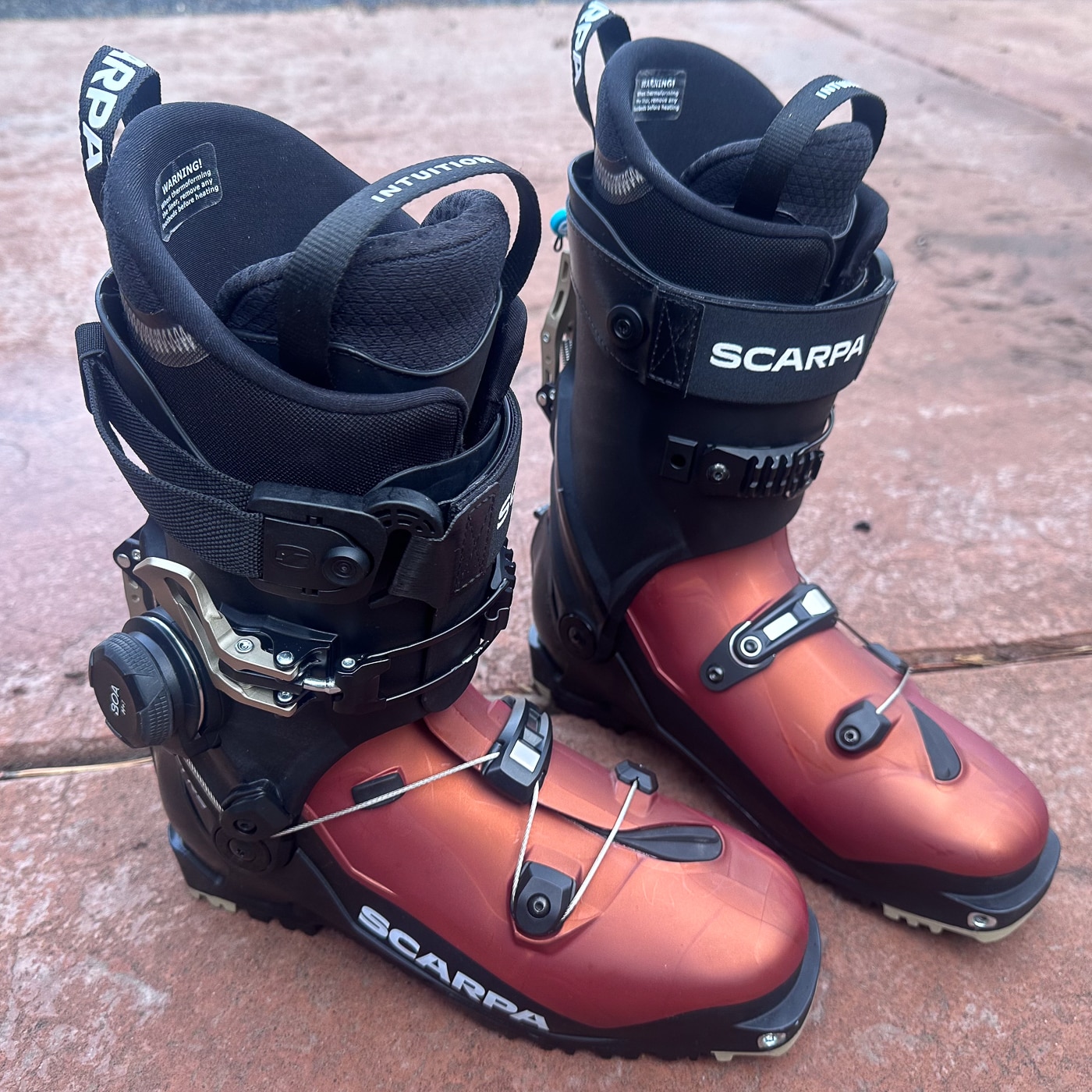
Feet scorned by ill-fitting touring boots should be a thing of the past. And poor turns or earned-vert scorned due to poor-performing touring boots: too mushy, too stiff, not enough ROM, or too much friction. Human feet come in all sorts of shapes and sizes. As do preferences regarding fit and flex characteristics.
Lucky us, we live in the time of the touring-boot bounty. After a long duration of boot stasis years ago, when mods and shell molds were mandatory, or just a downright pain because a mod or mold didn’t help, we’ve had a big burst of boot evolution. For most of us, there’s a boot out there that will work. Enter Scarpa, the Italian sports brand focused on mountain boots and shoes. In their touring boot lineup alone, I see 18 touring models—including men’s and women’s and the Quattro line, which some folks see as a hybrid boot—to find a boot that suits your needs. Add in Dynafit, La Sportiva, Tecnica, Atomic, Dalbello, and onward, and you see where we’re going.
But as the title suggests, we’re here for a first look at Scarpa’s F1 RS. As part of our process to learn more about the boot and its development, Gavin and I recently spoke with Scarpa North America CEO Kim Miller, and we’ll have that story edited and posted soon.
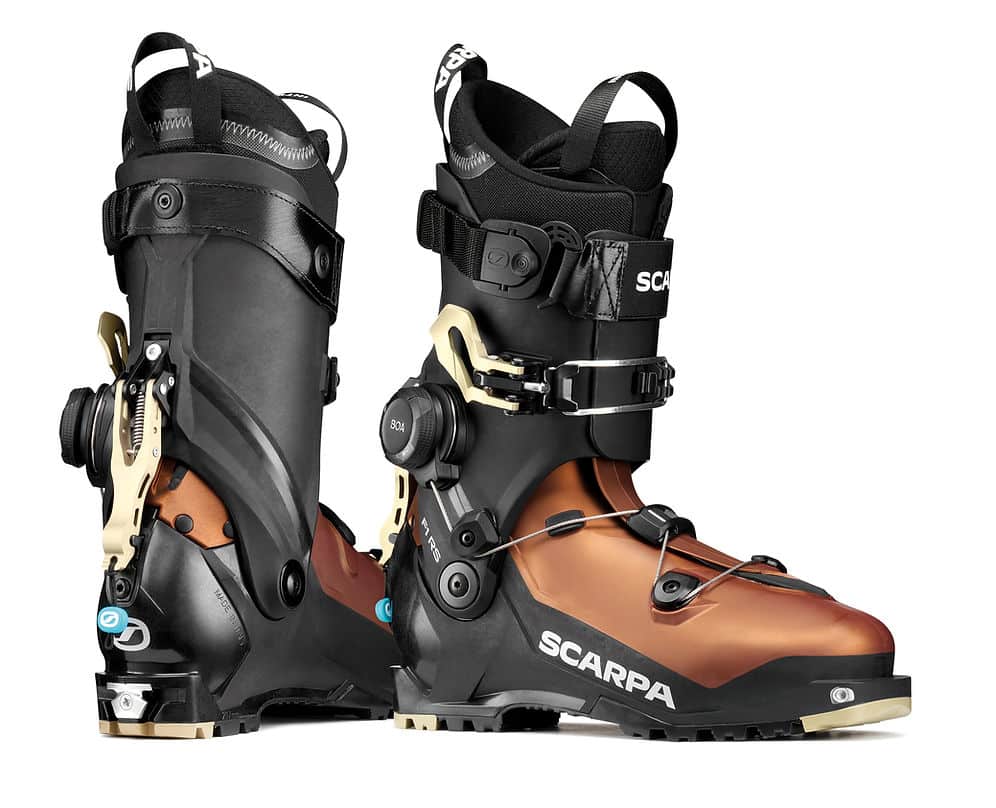
The new F1 RS replaces the venerable F1. Over the years, the F1 line expanded to include the F1 LT (BOA), F1 XT, and F1 GT. These boots generally sat in the 1 kg realm in the smaller sizes, and focused on a solid combo of ascent and descent characteristics. For those looking for a more sporty descent performance or to drive burlier skis, ski tourists often bump up to the F1, the Maestrale, or the Gea, respectively.
But what catches our eye here is likely what caught your eye—the implementation of the BOA H+1 System. I know, some of you might be checking out already. Many of us, yup, we are out here, are BOA fans. And we know the potential pitfalls of BOA’s past (or Dynafit’s Twistfit system)—they might fail, they just don’t tighten properly, and they don’t secure the foot the way a buckle does. I’ve spent several years in either the Fischer Travers Carbon and the Dynafit Blacklight, and I’ve never had a failure or thought that properly securing my foot in the scaffo was an issue. I like buckles fine, and they serve their purpose in the Blacklight 2s and Sportiva Kilos—both use a Z-buckle—but, considering the whole boot package and all things being equal on a boot, I prefer a BOA.
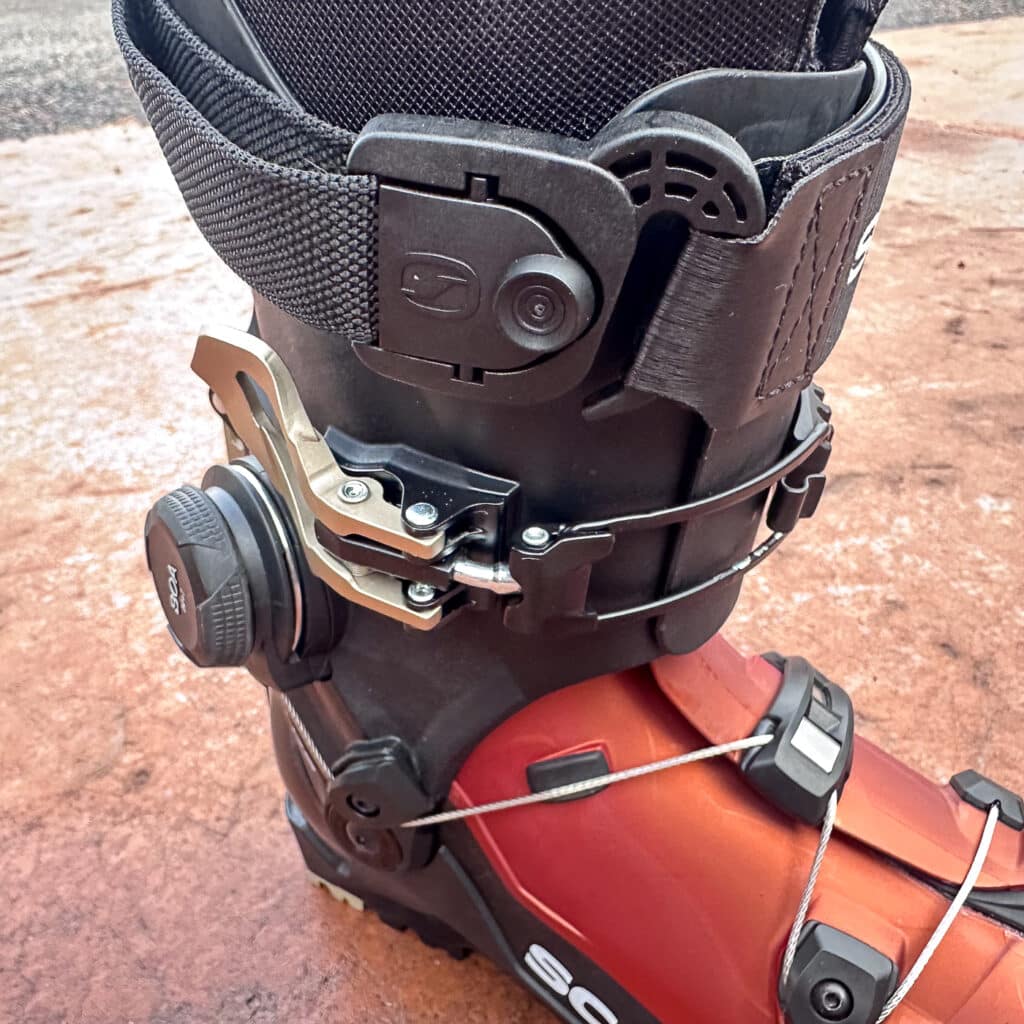
The F1 RS is one of the first touring boots to integrate the BOA H+1, which is a beefed-up version of the original BOA system found on boots like the Travers, Scarpa F1, and F1 LT. The F1 RS is the first touring boot to secure the BOA dial on the boot cuff, while the cable, when tightened, secures the foot in the lower. This is why Scarpa, in their marketing copy, calls it the “BOA REMOTE DIAL H+1 REMOTE CONFIGURATION.”
This remote system is similar to the H+i1 BOA now found on many alpine boots, but in those configurations, for example, a BOA dial on the cuff secures the upper, while a dial on the scaffo secures the lower. The advantages of the remote system are the positioning of the dial away from a spot on the boot where shearing the BOA dial off while booting may occur, a complaint some have made regarding BOA dial positions in the past. With the F1 RS remote design, although it is a larger, more robust dial, it is positioned on the upper outer side and presumably out of the way of obvious wear-and-tear scenarios. The H+i1 system also uses higher-gauge cable and offers multi-directional micro adjustments. Be warned, this system can offer a lot of closure force.
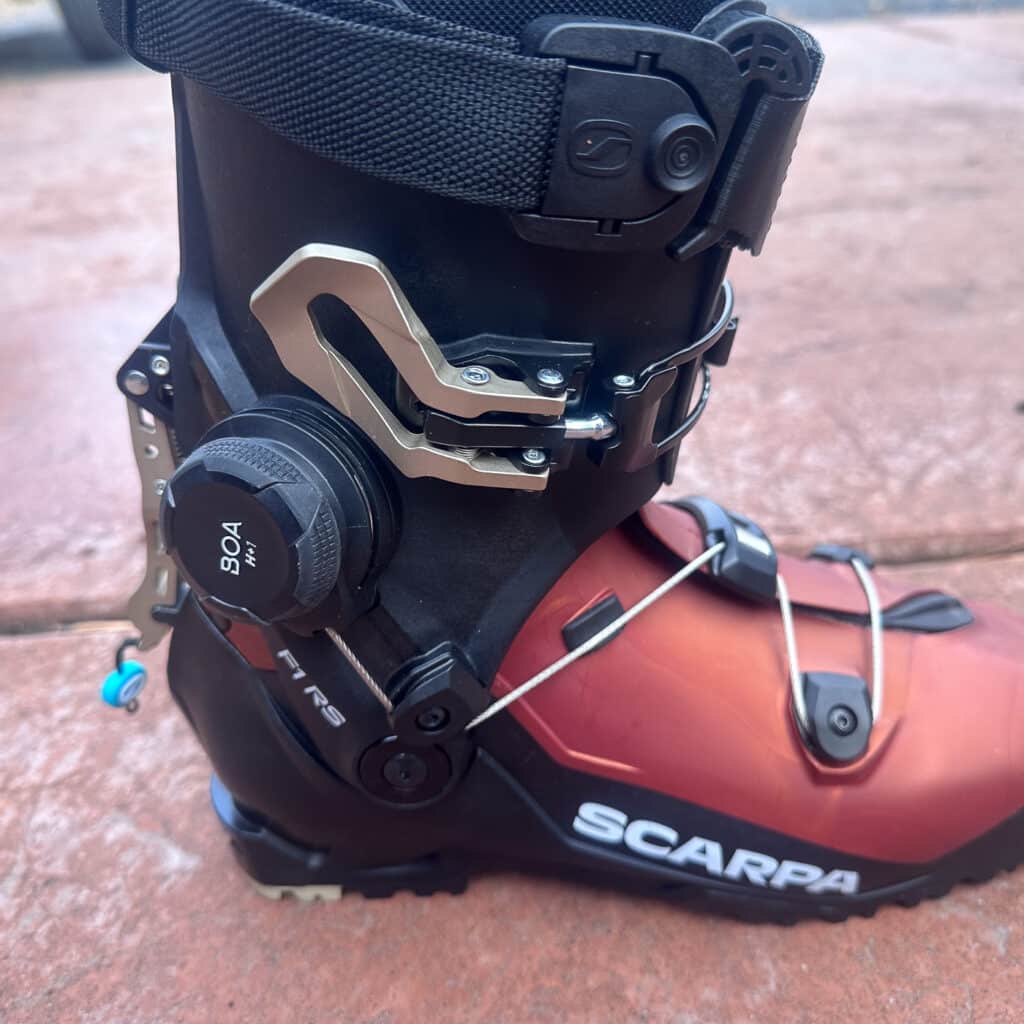
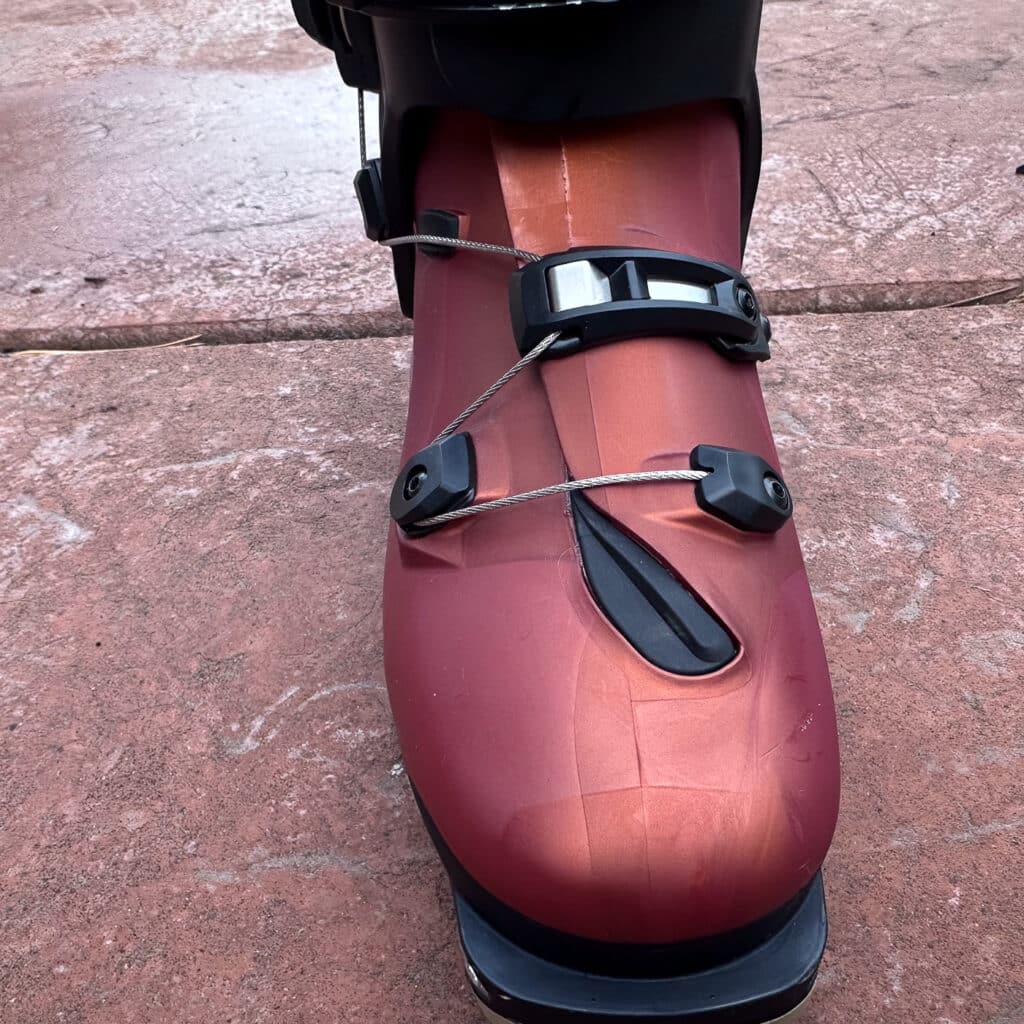
The F1 RS lower uses what Scarpa calls Overlap Flow Construction. According to Scarpa, “new technology features softer instep panels to facilitate easier entry and more natural walking, and a stiffer lower shell to deliver powerful force transmission and high-performance downhill control.” See photos below. I will state that when tightening the BOA, the cable snakes through the guides, the forefoot plastic subtly closes, and begins to secure the foot in a snug and precise fashion. We might as well mention the liner, which is the usual high-quality Intuition liner found across the Scarpa line. Scarpa calls it the Intuition FS Tour, and it includes a plastic overlay on the shin and forefoot. The shin overlay adds some stiffness, while the forefoot overlay helps disperse the BOA cable’s closure force across the forefoot.
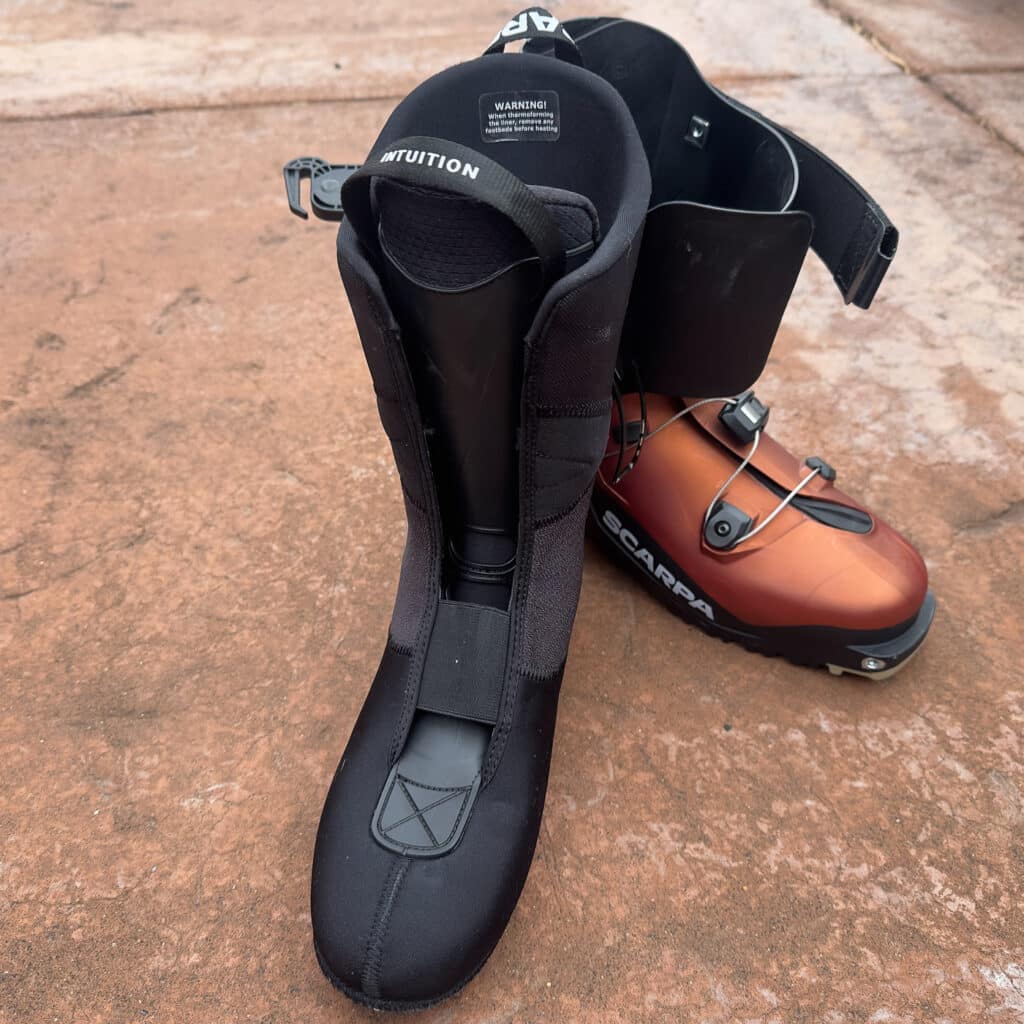
The boot upper is a Grilamid FG LFT and Pbax Rnew (a bio-based thermoplastic elastomer). In other words, the Grilamid is reinforced with long-strand fiberglass. Scraper claims the material has an “extremely high strength to weight ratio and stiffness values 20% to 30% higher when compared to a short-fiber construction found on most lightweight applications.” The cuff is an overlap design and tightens with the single buckle and cam-lock booster strap. The camlock is a thermoplastic with a button that serves as an effective quick release. Since the cam is not metal, we’ll keep an eye out for long-term durability. So far, even while wearing thick gloves, the button is easy to hit to release tension. The ski/walk throw is spring-loaded.
Well, it’s a first look and a first tease. That’s the qualifier. But I’ve had several days in the boot. After the first outing, I thought I needed to thermomold the liners. The next day, holy smokes, the liners fit great—so I am holding off on any molding for the time being. For some fit highlights, I usually wear a 2mm EZ heel sock to assist with heel hold. (I’ve used them in every boot the last four years outside of the Zero G Tour Pro with an Espresso Liner, the Scarpa Alien 1.0, and now, this boot.) I wouldn’t say I have a skinny heel, but maybe I do. Out of the box, with a thin Patagonia ski sock, and with either the stock footbed or my blue Superfeet insoles, the heel hold is exceptional. I might say it’s the best heel hold and heel fit I’ve ever experienced.
I also have skinny calves (it’s genetic…). With the buckle, powerstrap, and liner fit, I have no problems locking the boot upper onto my leg. Like the heel fit, the snugness of the boot upper is both comfortable and precise without overcranking the closure system.
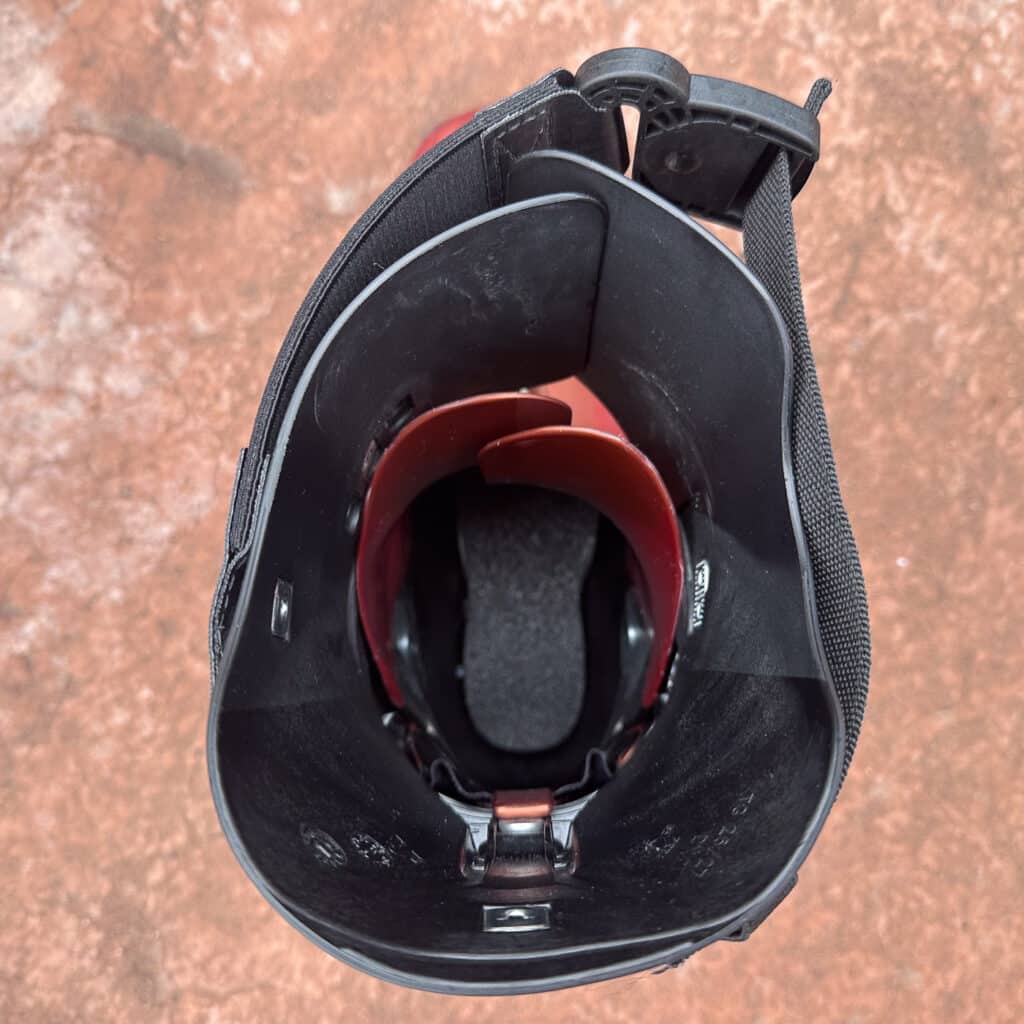
Scarpa boots are a hit-or-miss fit for me. The Scarpa 4-Quattro SL, with its 100mm last, was a bit too tight over the forefoot, and in a 27, the toe box felt a bit short and a smidge narrow. On the other hand, in the Alien 1.0, a Scarpa skimo boot, in a 27 and stock liner, the 27 length is great—I can tour in these boots all day, even with its 99mm last. Go figure. I’m also in a 27 F1 RS, and the length is about perfect for a performance fit. The last is 101mm in a 27, and so far, the instep height, width, and length feel ideal. If I end up cooking the liners or making any mods, I’ll note it in the review.
The claimed range of motion is 60 degrees. I’d say that is accurate, give or take a few degrees. To access the full ROM, ensure the powerstrap and buckle are properly loosened on the cuff when touring. I’ve tried varying degrees of looseness, and looser, to some extent, seems better. And, you’ll likely loosen the BOA on the lower for a bit more comfort, too, on the ascent. The ROM is better moving forward rather than rearward—at least that is what I am experiencing. The friction is about on par with solid touring boots in this class: it might be a bit better than the Zero G Tour Pro (that’s a four-buckle + powerstrap affair) and higher than the Ridge Pro and Blacklight (both Hoji Lock boots), where the Ridge Pro has a plastic tongue, and the Blacklight is tongueless.
F1 RS Transitions are pretty easy with the BOA, powerstrap, and buckle—at least compared to the ZG Tour Pro. As far as stiffness, Scarpa calls it a 115 flex. The weight with the stock liner is claimed to be 1340g (size 27). My scale says 1350g; call it a scale error.
The skiing, so far, feels great. Granted, I’ve only used it for a few days and in pretty light powder snow.
In closing, good on Scarpa for taking a leap and offering a touring boot with the BOA H+i1 system; it feels like a great option.
Stats
Sizes: 24.5-31 (half sizes)
Weight: 1340g; 2lbs 15.3oz (½ pair size 27)
Shell/Cuff/Tongue: Grilamid® Fiber Glass LFT · Pebax Rnew®
Liner: Intuition® FS Tour WMN
Last: 101mm
Flex: 115
Ski/Walk Mode: FS Lever
Closure: 1 Buckle + BOA® Fit System + Booster® Power Strap
Forward Lean: 15° ± 2°
Range of Motion: 60°
Outsole: Vibram® FS
Binding System: TLT, AT
Leave a Reply
You must be logged in to post a comment.