
There’s a simple concept in art called “mark making.” At its most basic, it means producing a mark on a specific medium (think paper, canvas, or an open space with a moving sculpture) that takes on broader meaning or significance. Certainly, if you can conjure the application to our outdoor pursuits, there’s mark-making involved with touring. Imagine those wiggles on a powder day, or your pillow-line hops, or the sinuous skin line bumping from one pass to another on a multiday traverse.
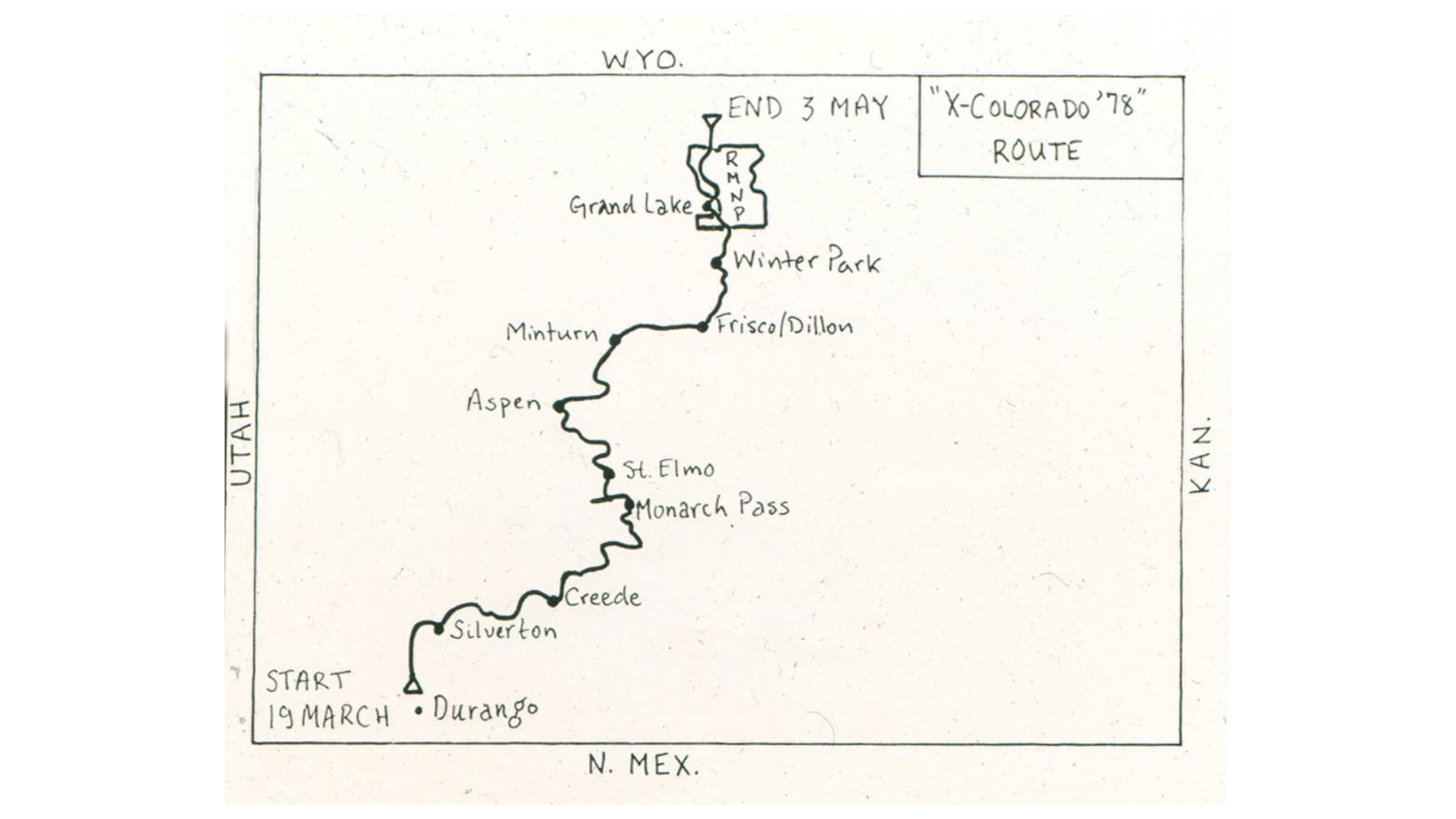
A documentary film released this fall, Moving Line, tells the story of the first ski crossing of Colorado by Alex Drummond, John King, and Peter Vanderwall in 1978. The film is the type that dials back the adrenaline and focuses on the slow, Herculean effort of a ski traverse. In their telling, we learn about the three adventurers and their efforts to be present, keep warm, feed themselves, and ultimately connect the dots from Durango north to the mountains northeast of Fort Collins.
The film will fill your wool clothing and down-to-basics quotient for the season, as Drummond, King, and Vanderwall kept it simple with minimal clothing, light packs (claimed to be no more than 20 pounds on any given day), and a belief in the promise of good things if they just kept moving forward. And they did.
For those planning their own big traverses, the trio kept pack weights to a minimum by caching 19 food buckets along their route in advance. As you’ll learn in the film, a note was affixed to the buckets stating, “Don’t mess with this, our lives depend on it.” Two buckets went missing.
There are many things about the film to like. There’s the dream, the documentation of the inexorable force driving these three young men forward. There’s the capturing of life’s arc: we all get older and will eventually have time to reflect. And, of course, as is the case for most multi-day ski/ride endeavors, there’s the slog. All 490 miles of it over six weeks.
The film’s three main characters, Drummond, King, and Vanderwall, are older now. Which is 100% a beautiful thing. In particular, hearing King (an artist focusing on large moving sculptures) and Drummond (certainly some sort of poet) reflect drives home the notion that what we do out there in the mountains can change lives. Or, at a minimum, keep us moving forward in our day-to-day slog as we dream up the next big adventure.
As Drummond says at one point in the film, “A line that fades to nothing in the spring, yet stays forever as a shining light in the memories of those who made it.” Moving Lines is full of good stuff.
Leave a Reply
You must be logged in to post a comment.