
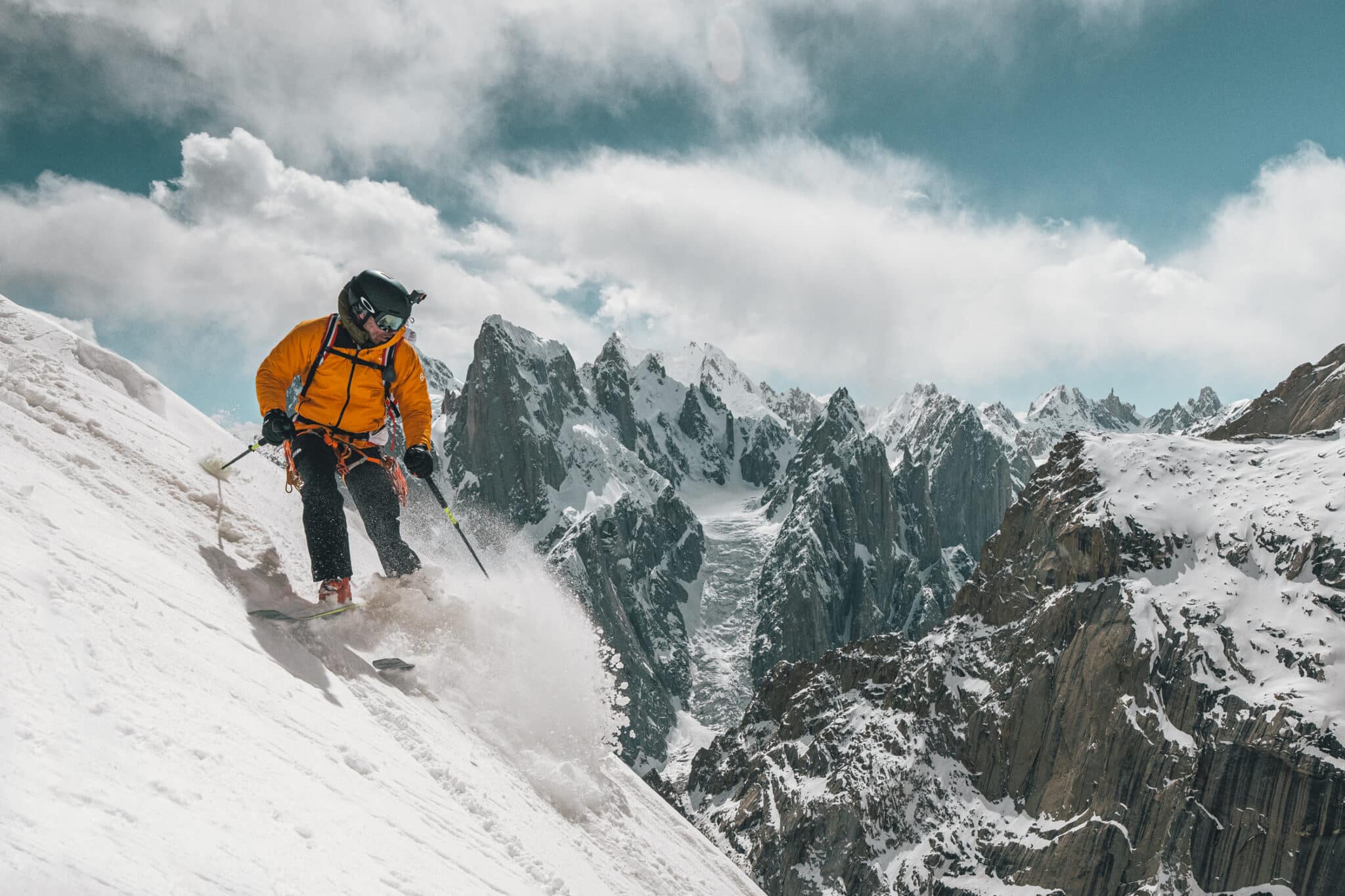
In May of 2024, Chantel Astorga, Christina Lustenberger (Lusti), and Jim Morrison made the first ski descent of Great Trango Tower. They linked a series of panels, ramps, and a final gully after climbing the 6286-meter peak in the Pakistani Karakorum. This successful expedition came on the heels of a 2023 trip during which Nick McNutt, Lusti, and Morrison climbed high on the mountain but turned back short of the summit.
Oftentimes, we imagine Great Trango, and it’s negibor, Nameless Tower, as granite monoliths jutting upward from the Baltoro Glacier. For decades, these faces have captured alpinists’ imaginations. The American Alpine Journal, over the years, has done an excellent job of cataloging some of those ascents. But skiing in this zone, known for plumbline verticality, has remained at the margins. A climbing line on Great Trango’s Northwest Face, first climbed in 1984 by Andy Selters and Scott Woolums, offered a plausible ski mountaineering path down the mountain.
For those keen on getting a more up-close and nuanced look at the descent, Trango, a documentary about the two expeditions to the mountain, is available to screen on Documentary+.
Documentary+ is a video-on-demand site featuring, you guessed it, documentaries. You have a free option and a paid, no-ads option. If you choose the free option, hang in there, have some patience, as skipping through the ads, as far as we can tell, is not an option. However, you’ll be treated to some excellent shots of the mountain, its scale, and the high-alpine terrain on the mountain’s upper flanks.
As part of the film’s release, we had the opportunity to interview Lusti and Morrison for more details about the 2024 ski descent. The interview is lightly edited and condensed.
***
The High Route: Since the spring of 2024, when, along with Chantel Astorga skied Great Trango, a lot has transpired, reading your expeditionary skiing. Lusti, you skied the South Face of Robson, among a list of impressive first descents, and Jim, you skied Everest’s Horbein Couloir this fall. So, can you provide some context for us? What were your respective headspaces a few years ago, when Great Trango loomed a bit larger for you?
Lusti: I was on the tail end of the trip I did in Baffin in 2022 with Hillary Nelson and Brett Harrington, which was like a stepping stone. It was such an amazing experience with Hillary. The questions became, where should we go next, and what should we do? And I talked with Jim about exploring Pakistan as well. And there was this excitement of always wanting to go to Pakistan, always wanting to ski with Hillary, and just having an amazing team and continuing to explore wild places.
So there was this initial excitement, and then [Hilary’s] tragic accident, and a loss of a teammate. But when you learn about Jim’s story, it becomes one foot in front of the other, continuing to follow our dreams. Trango was continuing to explore the impossible.
Jim Morrison: As climbers and skiers, we are drawn to one of the most dramatic mountain ranges in the world, if not the most dramatic range in the world. There’s just a long history of wild climbs and wild descents all over the range, and particularly there in the Trango Towers. For me, growing up and reading stories about Alex Lowe climbing, seeing posters of Greg Child and Lynn Hill, and other iconic alpinists and climbers, I was always inspired. I had always wanted to go to this range, to climb an 8000-meter peak, and to see the Baltoro Glacier.
Christina had pitched a trip to The North Face for a Pakistan ski expedition, and had asked Hilary and me to come. I was in extreme grief and in a really tough place in life, but I knew that that was probably the right thing for me to do, to head to Great Trango. I knew it was going to be hard, and getting back there and sleeping in my tent by myself without my partner was really difficult, day in, day out. From the first week of the trip to the last day, pretty consistently, I didn’t know if I could get out of the tent and go have breakfast. It was extraordinarily hard. And at the same time, being situated there under the Trango Towers, and having this dream landscape in front of us, and being able to try to climb up there with an awesome team, inspired me.
THR: Can either one of you discuss the impetus for the trip? More specifically, how did you land on skiing this specific line on this mountain? (For some background, the ascent/descent line, the mountain Northwest Face, was first climbed by Andy Selters and Scott Woolums in 1984.)
Morrison: We were originally going to go to a different place in the Karakorum that a number of skiers have been to. I had always had this fascination with Trango Tower. And I talked to a couple of our other athletes, Andres Marin and Anna Pfaff, who had been to the Trango Towers—they climbed Great Trango to acclimatize for the Nameless Tower. And as I was talking to them about this when we were climbing in Indian Creek. I was listening to them describe the route, which I’d never fully understood. I was asking if they thought I could climb it, and Andres turned to me and said, “Jim, you could ski it.”
And then Christina started to coax me into the idea of going back into the mountains and going on this expedition. I kind of said, “Yeah, I’ll go. But can we, can we walk to the Trango Tower and check this route out?”
She, too, started looking at it. And then we started looking at Edu Marin’s photos of climbing Eternal Flame on Nameless Tower that he was posting at the time. We were looking at those photos of them in their camp on the Sunny Terrace, and for the first time seeing the ski line in the background. And Christina got really excited about it. And I think in one of our calls with Nick McNutt, who was on the first Great Trango attempt with us, we sort of announced, “Hey, by the way, we’re going to Great Trango.” We decided to put all our marbles in this one basket and try to pull this off.
THR: As people will learn from the documentary, this was a two-expedition effort. Meaning, the first attempt was a solid effort, but conditions did not align, and you descended before reaching the top. But for something of this scale, multiple expeditions are not uncommon.
Patience, as they say, becomes a virtue. Lusti, you strike me as a charger. As someone who is eternally energized and motivated. I am curious, how do each one of you balance or instill patience in the short term, like you’re at camp and you may not be able to move on a particular day, and how does it manifest (or maybe it doesn’t) in the long-term, like waiting another year for another chance at the line? How do you both embrace, or convince yourself, to be patient?
Lusti: There’s a certain amount of determination and obsession that goes into these things: I use the term “locking in.” When you have that imagination and inspiration sparked to climb and ski something that hasn’t been done before, I completely lock in. And I remember being very dedicated the winter leading up to this, planning logistics with our team, the film team, and the brand, just obsessing over details and really wanting to do a lot of front-end work that would eventually pay off once we had our feet on the ground in Pakistan. And then you’re there in the moment, and you’re confronted with avalanche conditions, rockfall, sickness, crevasses, and all these things that you know are part of the process, part of figuring it out, to do something for the first time, and eventually, you are coming home, defeated, unsuccessful, but successful in other ways.
I think taking what we learned on the first expedition and knowing completely that our team could go back and be successful, it was just making subtle adjustments from year one to year two, but knowing that our team was locked into this goal. I remember coming back and, within the first week, someone telling me, “Yeah, you probably won’t get sent back there.”
I knew that Jim and I were going to go back on our own dime, on our own time, if needed, that we were devoted to finishing this project, and then it just became this subtle, well, maybe not so subtle, convincing of our team and and finding more money, and really sharing our energetic obsession with the people that could green light the trip for a second year.
Morrison: I want to just add two things in there. One is that you highlighted Christina being a charger and being really driven. That’s true. Most of our community and our friends look at us both as really driven, really focused, kind of neurotic freaks.
I even remember going on the second trip with one of the photographers, who’s a very close friend of mine, and she was just like, “Man, you’re not a patient person. I don’t know how you’re going to do this.”
We spent 68 days in basecamp over two trips to ski one run. And I think Christina is really patient when it comes to achieving something we’re really focused on and driven for. And when you have a climbing and skiing objective that you really care about, sometimes, day to day, you’re not patient. You want to go out there, train, and get it done. You want to move on to the next thing to try to reach that goal. I think the film does a good job of showing that, that’s really what’s inside of us, that’s really what we’re driven to do.
And, you know, Christina has done it over and over and over again since, and I think that’s pretty special and cool. The other thing I want to highlight is this brand that supported us, The North Face. It seems like we’re these sponsored athletes, and we get all this money from this brand that’s doing it because they have all these goals that align with ours. That’s not really what happened. Basically, Christina pitched this idea to them and secured funding to develop the concept. And then we advocated to increase that funding to bring a film team, not because they wanted to do it, but basically because the two of us, you know, for lack of a better term, forced them and begged, borrowed, and stole to get that funding to bring a film crew. We thought this was such a cool and unique endeavor, and we wanted to document it well. And then we failed on that first attempt and didn’t make it to the top.
And just like Christina said, we came back, and we were like, “We’re doing this, whether we’re doing it with The North Face or not.” Ultimately, that’s something really special to know that we got down and we texted our team manager and the other producers of this film to tell them we had pulled it off—we did not want to not to say, “Hey, you can go share this dramatic film that we’re going to make”, but to convey that we’re alive, and we pulled it off. And everyone was so psyched.
THR: What was clearly evident in the film was the objective hazards. Jim, you referred to the stream of avalanches and the powder cloud as “the smoke in the air” on several occasions. Can you talk a little bit about the hazards, the different sections of the route, and how, according to the expedition profile, they were managed?
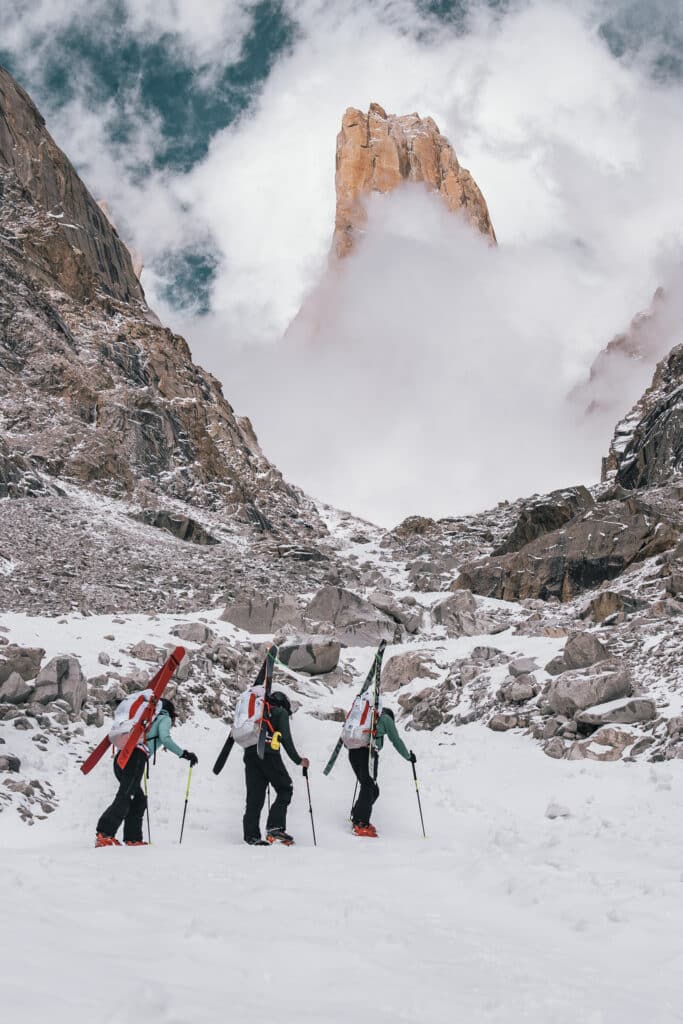
Lusti: In the film, you really see the terrain. And when you leave basecamp and move all the way to high camp, you’re moving through a gully, which is an hourglass feature with a huge amount of vertical relief with a mountain sitting above it. There were very specific, active areas threatened by serac fall or avalanches. And for sure, you can’t remove that risk, but we could move through one at a time, or just move as fast as we could. That really was the name of the game when we were going up to high camp. Just move fast, get up there.
At high camp, we were protected under this big rock at 5000 meters. Above that, I think we eliminated some of the overhead hazards, but we became more exposed to the intricate ramp system as we moved onto the upper glacier. There were crevasses and more avalanche hazard underfoot, at that point, than coming from above. We were always assessing where we were in the moment, what you’re connected to, what you’re exposed to, and just trying to subtly mitigate it the best way we could. But, for sure, we knew we were in an uncontrollable environment, trying to control it the best way we could.
On the first expedition, when we went up high for the last time, we saw more snow accumulated than during the previous snowstorms, and we saw these granite slab features release with only 10 centimeters of snow, creating sloughs in the terrain we’re in, which just becomes very uncomfortable. It became very reactive, very quickly. And I think at that point too, at the end of the expedition, you just hit this threshold of exposing yourself to danger and all the cumulative risk and fear and fatigue at the end, and it became this internal feeling of just wanting to be done with the trip
Morrison: The smoke in the air reference that you mentioned comes from the movie Maverick in basecamp. We had just watched that, and it seemed very fitting. In that film, the fighter pilots are flying through missiles coming at them, and they say, “Let me know if there’s smoke in the air,” so they have time to react, to send out their countermeasures, to try and avert that impending doom. And it was similar during our climb in that initial gully. In the summer, when people are going to climb on Nameless Tower, usually there’s a lot of rockfall there. For us, the avalanches that we’re seeing are so far away. It’s such tremendous terrain that you can watch this avalanche coming down, and there’s actually quite a lot of time before it’s going to get to you. So we did rely a little bit on the idea that we would have time to run, take cover, and hide, or to get through the section where it funnels through. As a team, we’re all kind of trying to look, and everyone’s on the radio, too. So I know that that’s an interesting part of how we got through it, as the scale of the mountains is really dramatic. We also took several days to process all the risks and took a long time to figure it out and to discuss what our threshold for risk was—when we were going to say “go,” and when we were going to say “no go.” And I think we made a lot of good decisions.
Leave a Reply
You must be logged in to post a comment.