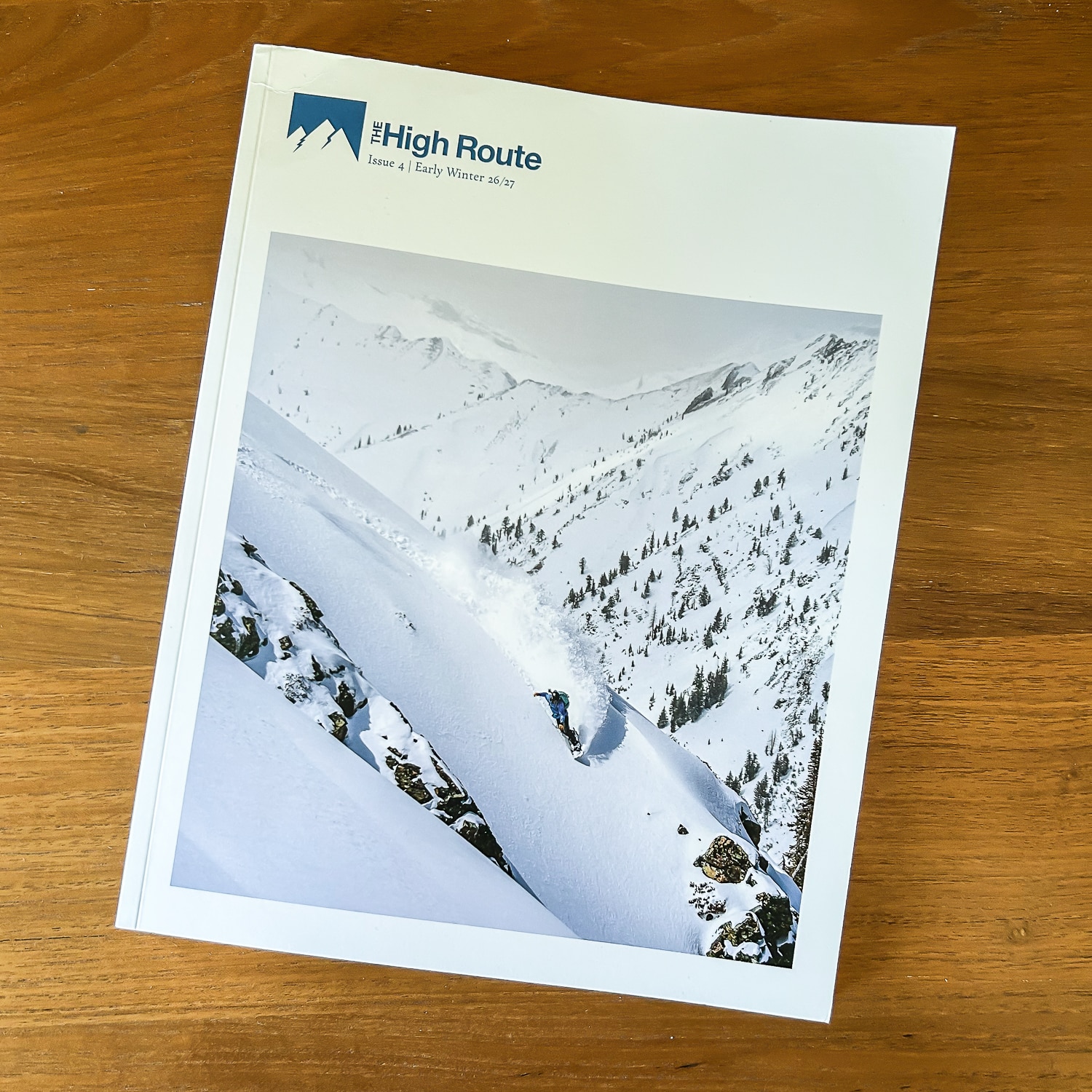
In the next issue of The High Route journal, we worked with writer Michael Wejchert on a story about the 2026 Perry’s Peak avalanche that killed nine people—three guides and six clients. When we sent the story to the printer (well, actually, that’s in about six days), it seemed likely that the guiding company, Blackbird Mountain Guides, would eventually be served papers in a civil case.
I began looking into these legal nuances because right after the avalanche, the Nevada County Sheriff’s Office opened a criminal negligence investigation. That investigation ceased in August, and the DA’s office received the findings. No charges have been filed.
Here, in this survey, we’ll explore how cases may be prosecuted when a guided client dies or is injured in an avalanche in various countries (the U.S. and Canada, Austria, France, Italy, and Switzerland).
The US
Civil cases involving guides and clients can pivot on several things; first and foremost, how the court interprets the guide’s actions. There’s negligence, recklessness, and gross negligence. I’ll set up this qualifier: local, regional, and state statutes specify how negligence, recklessness, and gross negligence are defined.
Negligence is the least severe; the guide in question, for example, used poor judgment; their actions did not align with what a reasonable person would have done. In short, there was no intent. Damages in these cases are compensatory—usually a fine/award that covers losses like medical bills and/or pain and suffering.
Sometimes a jurisdiction does not differentiate between recklessness and gross negligence. Here’s the difference between the two in a legal sense. Recklessness implies the actions/decisons in question were made with an awareness of the risk, not simply carelessness. For example, the guide knew of the risk, but did not take proper steps to mitigate it. It seems like splitting hairs when defining gross negligence—and again, depending on where the incident occurs or where the charges are filed, recklessness and gross negligence are very similar, if not the same. When gross negligence defines the actions in a case, it often hinges on the “degree” of neglect. For our purposes, let’s call it extreme carelessness: actions taken with complete disregard for cause and effect.
When actions are deemed reckless or grossly negligent, the damages are punitive in nature, meaning they go beyond simple losses. They are meant to punish.
(I feel like I need a waiver to post this story. That said, as I understand it, a standard waiver often covers a guide against claims of negligence.)
Canada
Similar to the U.S., a guided client’s death in an avalanche does not trigger criminal proceedings. If a case is brought, it would likely play out in civil court. Canada uses a “balance of probabilities” as the standard for guilt, which is equivalent to “a preponderance of the evidence,” the U.S. standard.
Europe
The European legal system, generally, is a bit different from the U.S./Canadian system. Europe’s legal system (here, think Swiss, Austrian, French, and Italian) has a “civil” legal tradition, meaning decisions are based on written statute rather than precedent. The North American system has a common law tradition; precedent often dictates future court decisions. However, both systems have civil and criminal branches.
What’s important here is that in Europe, any death triggers an official investigation by the authorities.
Example in Switzerland: A few weeks ago, I briefly explored the criminal findings/sentence relating to a 2023 incident in the Swiss Alps involving the death of two high school students who were in a guided group. Unlike in North America, an avalanche fatality often triggers an investigation, and the criminal system handles charges and filings. For example, if the family member does not pursue a civil case, local, state, and federal officials can pursue one. As a result, guides/guiding businesses are vulnerable to criminal proceedings.
From what we can gather, despite slight differences, the law and its enforcement are similar in Austria (see “Legal consequences of fatal avalanches in the European Alps”).
In France
While this is a serious topic, it is also a wormhole. And we started down a French one. To clarify how the courts treat intentional and unintentional harm, the French introduced something called Faute caractérisée into their statutes. (You can find more info here and here.)
Here, the law gets nuanced. It differentiates between deliberate behavior and behavior that may have put a client at risk, and the guide clearly would have been aware of the decision/action in question. In other words, a guide’s actions contributed to an avalanche fatality, yet they did not directly cause the avalanche. For example, a guide did not ensure clients were properly trained to use a transceiver. The code uses a word similar to “accumulated” or “accumulation” to describe circumstances where one action/decision leads to another. So, although there may be no clear act that caused injury/death to a client, it could be that the accumulation of poor decisions exposed the group to greater risks and ultimately, a fatal incident. The language is explicit: “une accumulation de négligences graves,” or “an accumulation of serious negligent acts.”
In Italy
Let’s look at Article 449 of the Italian code. The translated text outlines what the code calls a “negligent disaster.” It covers behaviors that unintentionally put a group at risk. Importantly, it seems a guide could be prosecuted simply by putting clients at risk, even if an avalanche does not occur and no client/bystander is injured or killed. There does not need to be a victim. Prosecution can occur simply by endangering people, which, of course, would need to be proven.
It seems that guides are a somewhat protected class because of their expertise and the technical nature of their job. So, for example, misreading a snow pit may not be cause for a guilty finding. However, the case law shows that in a crevasse fall, when clients are not roped up on a crevassed glacier and an accident occurs, this goes beyond negligence—it was a choice the guide made. (This is just one example.) In this case, the guide defended her choice, saying she didn’t want the clients to rope up because of increased avalanche danger.


Leave a Reply
You must be logged in to post a comment.