
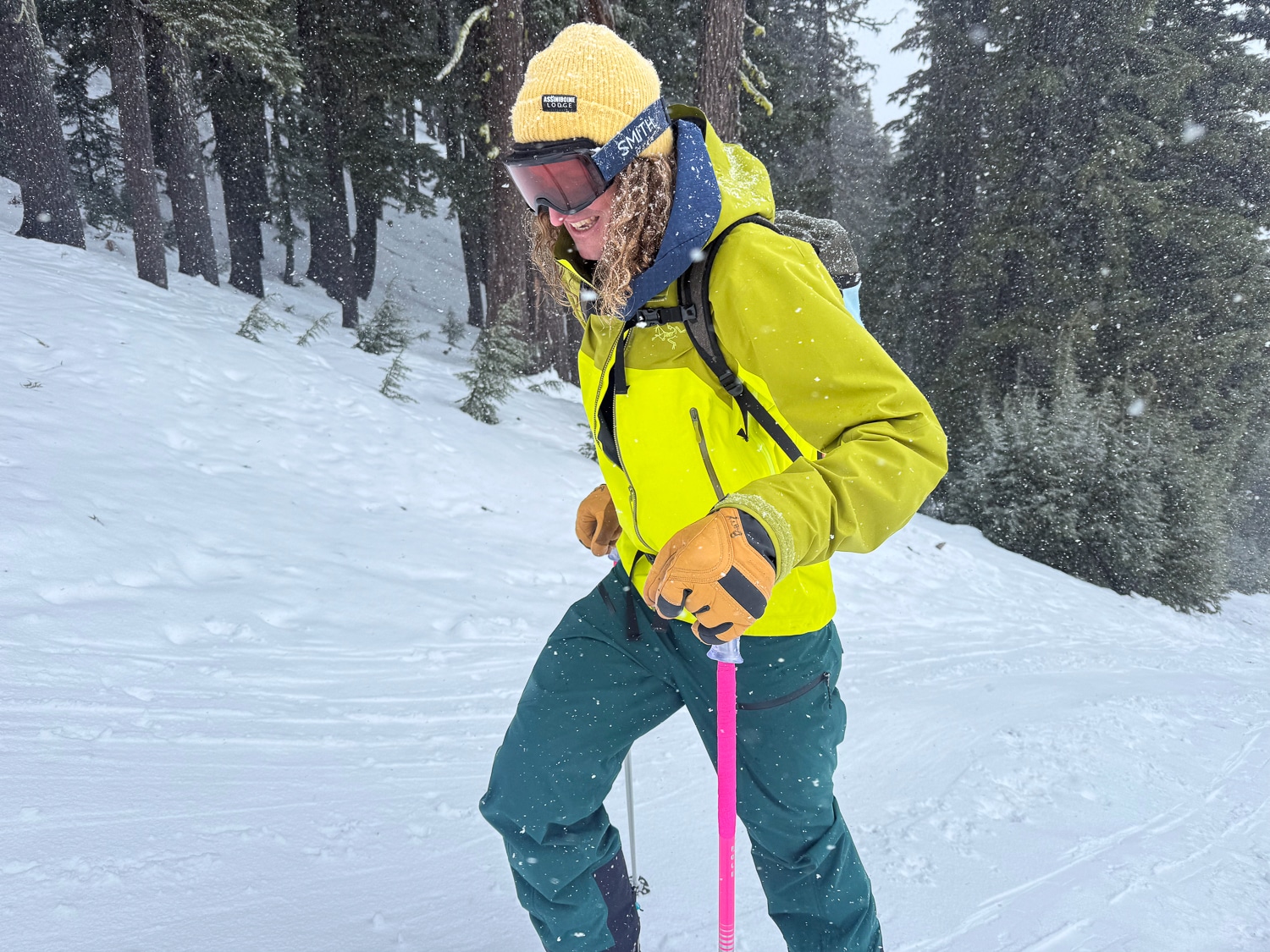
Bright yellow and a bit stiff and crinkly straight out of the box, the Arc’teryx Beta AR cuts a clean figure as we pass it around Jason’s house and try it on. It feels fancy, almost too fancy, so much so that I hesitate to actually take it into the mountains. Jason insists. So here we are.
This past September, my partner and I hitched a ride from Chamonix to Aosta, Italy, in a van full of climbers and their Portuguese mountain guide, then boarded a bus bound for Courmayeur. The Mont Blanc Tunnel was closed for maintenance, and our final destination, five days later on foot, lay somewhere along the Tour des Géants route in the northern Italian Alps.
We powered out of Courmayeur on a sunny afternoon, my pack jammed full of flip-flops, a puffy, many, many snacks, and the Beta AR. Our route traced a saw-blade profile: town to pass, pass to town, over and over again, eventually ending at a Michelin-star restaurant in Cogne, Italy.
Day one brought real threats of thunder, but we scurried over the pass and dropped into La Thuile with only a single, distant rumble chasing us off the ridge.
Day two felt more serious. Two successive passes, clear skies, and aggressively cold wind over the second col. I pulled on the Beta AR and was instantly wrapped in a Gore-Tex microclimate. The wind battered the ergonomic hood, while inside, I stayed calm, warm, and quietly jubilant.
Traversing ancient footpaths through big Alpine terrain felt like a fitting proving ground for the Beta AR. Each morning, as I stuffed snacks around my flip-flops, the jacket stayed near the top of my pack, ready for quick deployment as we climbed back into high, exposed country carved by ancient glaciers.
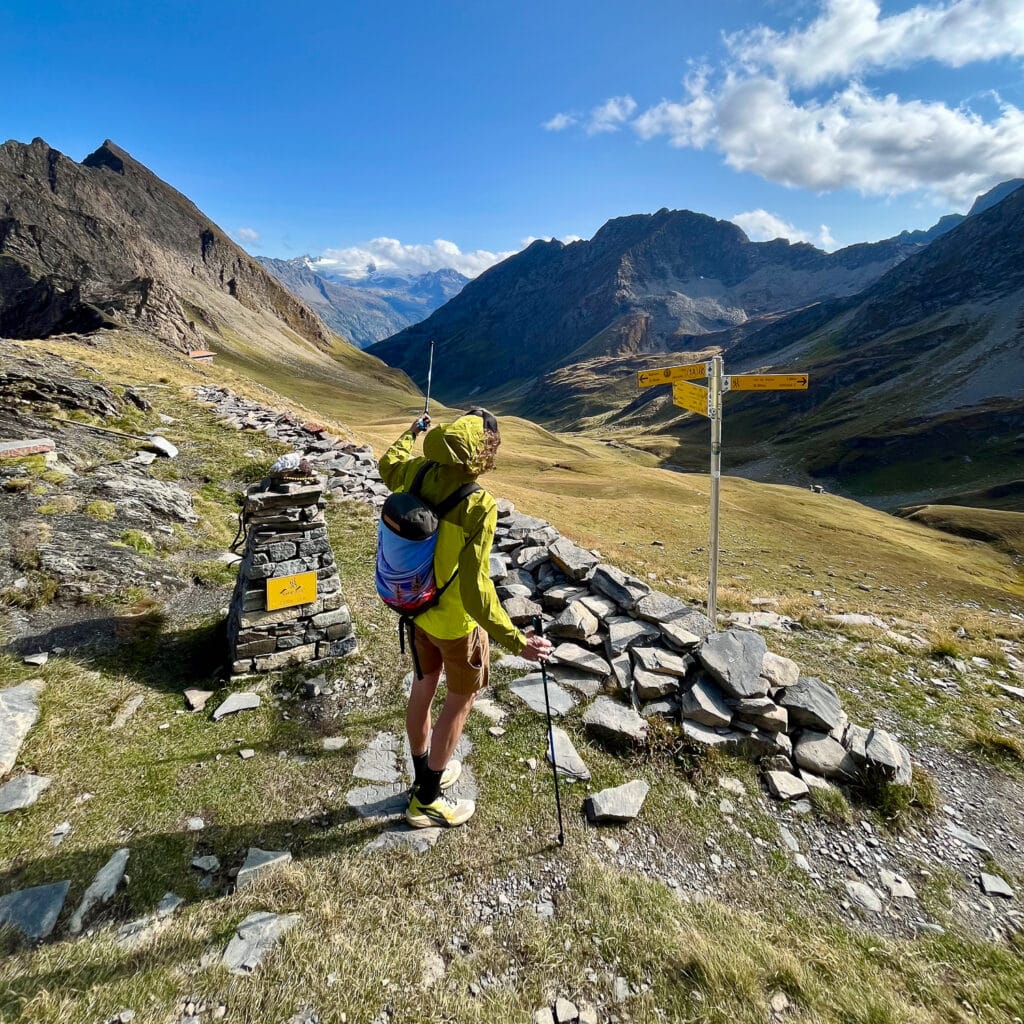
Around day four, the Tour des Géants ultra running race finally caught us. The TDG is a 330 km trail race that circumnavigates the entire Aosta Valley in one continuous push. As I ambled along in cut-off Dickies and my Beta AR, I took note of the wafer-thin shells and minimal running kits worn by the gaunt racers flowing over the passes. I was clearly living in the lap of luxury with my fully featured setup.
I was warm, dry, and comfortable—and crucially, I wasn’t mistaken for a racer at each rifugio as we refueled with generous plates of spaghetti. The Dickies were the tell, the Beta AR, while prime for multi-day traverses or a day meadow skipping in a storm, also looks racey.
When emotional lows cropped up along the way, the bright yellow jacket may have helped buoy my mood. Communication in heavy rain, however, was noticeably hampered by the loud drumming of water on the hood, an inevitable downside of burly technical hardshell fabrics.
Floating in a saltwater pool at a two-story luxury spa at journey’s end, reflecting on my outerwear choices, I struggled to find fault with the Beta AR. It did exactly what it promised: kept me warm and dry through wind, rain, and cold. And should something have gone truly sideways, my fluorescent yellow silhouette would have been easy to spot from a helicopter.
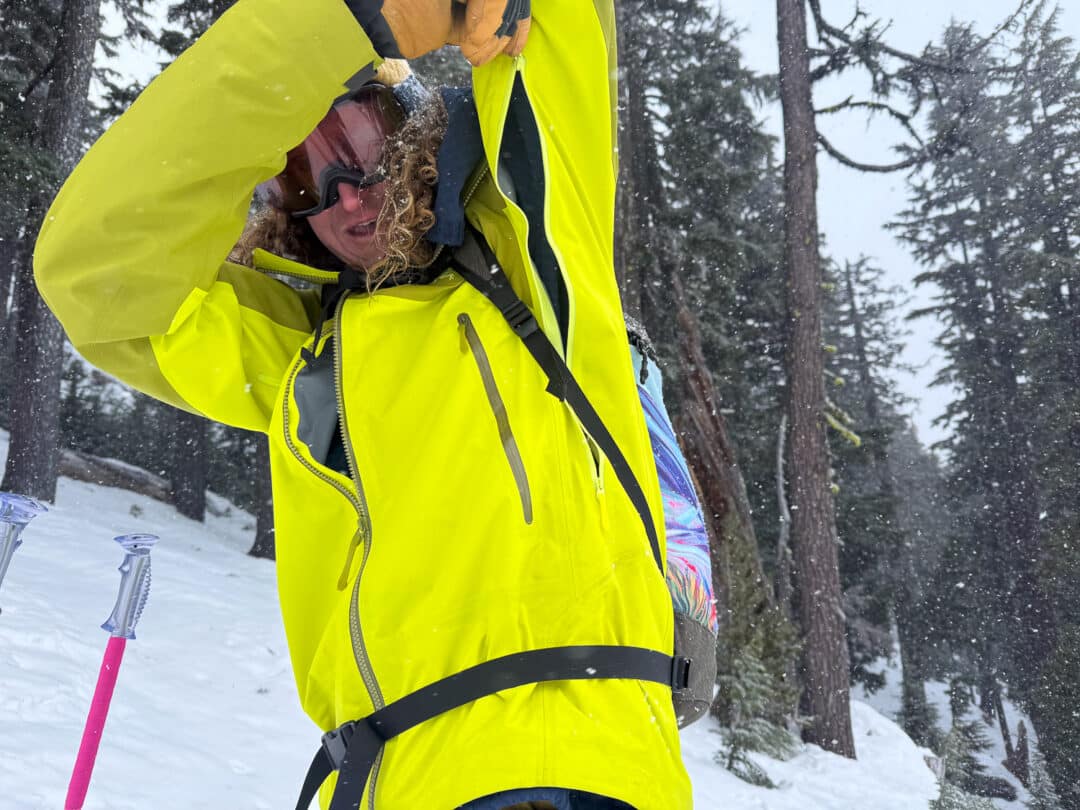
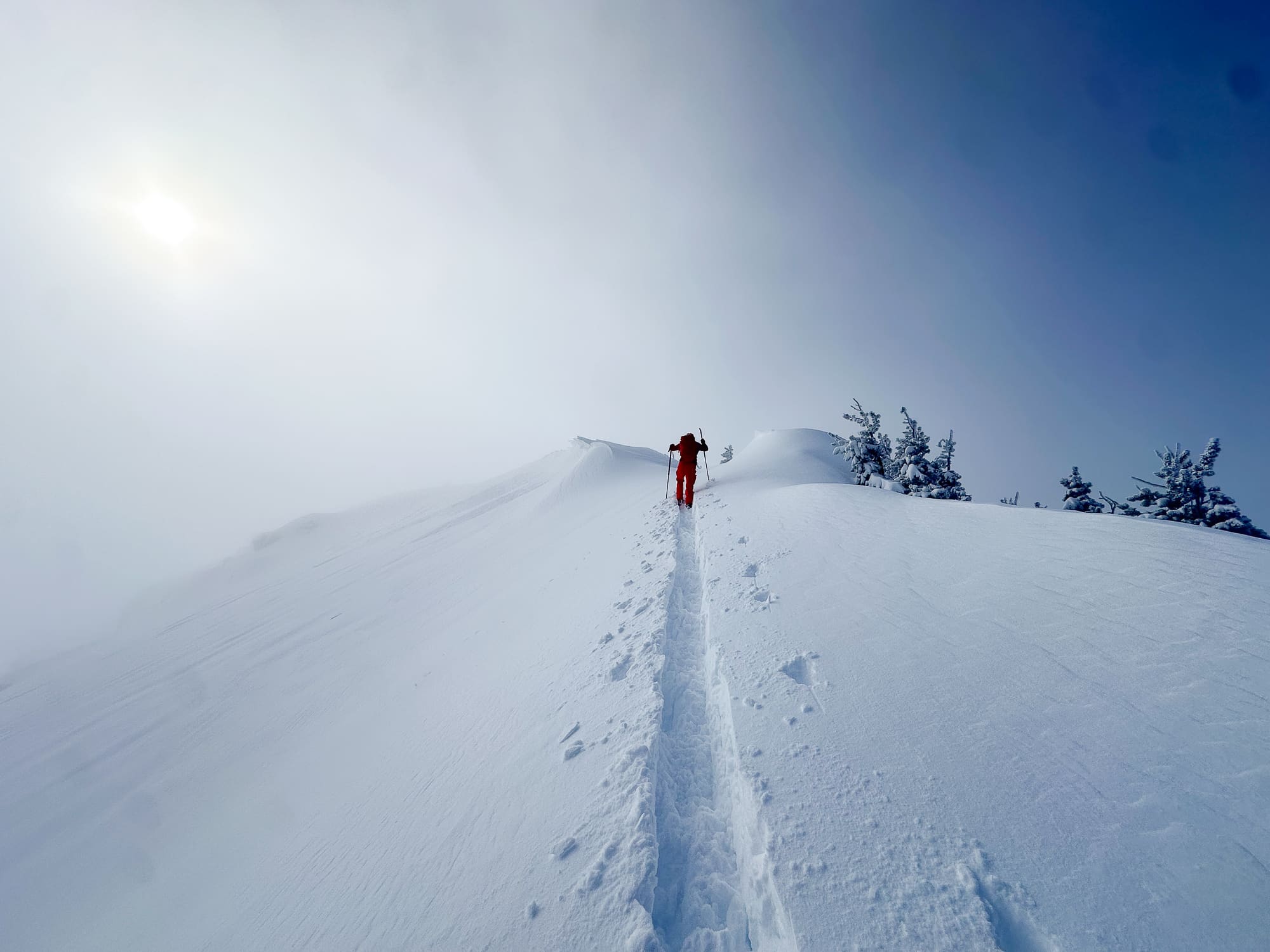
How about skiing, though, since this is a touring website? Well, yes indeed, the Beta AR works wonderfully as a touring hard shell, especially here in the rather wet Pacific Northwest. (It has been a wet, as in rain, late fall and early winter.) Voluminous pit zips allow for air exchange on days when precipitation is trending towards the liquid form; the high belly pockets do not interfere with backpack straps or the waist belt; and the tall collar and separated hood give ample visibility, coziness, and head mobility, even with a helmet on. The design is not ski-specific, as the chest pockets are not sized to accept skins, but jamming them inside the jacket above my backpack waist belt feels amply secure for all but the most spirited descents.
Fit, however, is worth discussing. We tested a size Medium, and at 6’5” and 180 lbs, I would never have guessed that would be my size. Aside from a waist hem that was perhaps an inch shorter than ideal, the shoulders and arms fit perfectly, with no tightness through the torso and ample arm length for my lanky frame. I shudder to think what a Large or XL might fit like, as swimming in acres of extra fabric isn’t my ideal. Yet, for more Arctic temps, where layering several layers under the hardshell is the call, sizing up to a large would be the call. Again, note, I’m tall.
The fabric itself (a Gore-Tex Pro ePE fabric) feels stiffer and more crinkly than the Gore-Tex Pro ePE used in Patagonia’s PowSlayer kit I’m also currently testing. That stiffness translated into a bulkier feel when stuffing the jacket into my pack. This may have something to fabric’s Denier. The Beta AR’s body is 80D, while the contrasting fabric on the arms, yoke, and hood is beefier at 100D. In contrast, the PowSlayer uses 80D across the board.
We dove into the features a bit in the first look. The basics are covered here: an adjustable hem closure, helmet-compatible DropHood that provides excellent chin coverage, velcro cuff closures, and ample enough pockets for the extras. Although the vibrant green colorway of the Bets AR we reviewed does scream “technical,” this is also a jacket that is practical; if you live in a rainy or otherwise wet climate, the Beta AR will be at home walking to your favorite cafe to poach WiFi and read the latest on THR, or downing an espresso in a place like Squamish, and then heading into the high hills for a big long tour. We appreciate that kind of duality.
The fit…if it fits your body and you want a robust, steady mountain companion, the Beta AR fits the bill. I’d strongly recommend trying it first. For minimalists, there may be better options. And since Arc’teryx is based on the moist Pacific Ocean, their line of technical hardshells is robust, and they still hold up. The Beta AR can take a beating, and you feel that burliness in your hand. Build quality is top-flight, and despite my flippant disregard for the jacket’s well-being, there were no leaks, seam failures, zipper issues, or fabric staining. And so far, a few months in, the DWR and weather-proofness are holding up.
In short: a serious shell for serious weather, one that makes you secretly hope the forecast turns bad.
Specs:
Hood: Helmet compatible DropHood™ with cord-lock adjustments.
Pockets: Internal chest pocket and two hand pockets with zippers.
Contrast fabric: 3L GORE-TEX PRO ePE Beam Dyed 100d plain weave recycled nylon, 126 gsm, C0 DWR – 100% Nylon with ePE and PU Membrane 100% Nylon Backing
Body fabric: 80d 3L GORE-TEX PRO ePE, recycled plain weave, 135 gsm, FC0 DWR – 100% Nylon with ePE and PU Membrane 100% Nylon Backing
Fit: Arc’teryx calls this is “regular” fit. On our people, the men’s medium felt at home on a 5’10” person and a 6’5″ (ish) person. Who wore it better? It depends on who you ask.
Price: $650.00
Leave a Reply
You must be logged in to post a comment.